
Deployment strategy of a LoRaWAN network for shipboard IoT

Copyright © The Korean Society of Marine Engineering
This is an Open Access article distributed under the terms of the Creative Commons Attribution Non-Commercial License (http://creativecommons.org/licenses/by-nc/3.0), which permits unrestricted non-commercial use, distribution, and reproduction in any medium, provided the original work is properly cited.
Abstract
Maritime operations are increasingly being restructured around data-centric management models, in which persistent sensing and systematic analysis of onboard information play a critical role. Such evolution has driven the growing integration of Internet of Things (IoT) technologies into shipboard environments. Deploying IoT infrastructures on vessels necessitates wireless communication systems capable of operating under strict energy constraints while maintaining reliable connectivity in challenging maritime conditions. Absent these capabilities, sustained data collection and the integrity of acquired information cannot be ensured. Given these considerations, the Long-Range Wide Area Network (LoRaWAN) protocol presents a practical communication solution, owing to its support for low-power operation and extended transmission coverage suited to large-scale IoT deployments. The deployment of a LoRaWAN network in a shipboard environment requires a comprehensive evaluation of system-level constraints, including energy efficiency, communication reliability, throughput efficiency in terms of achievable data rates, and overall network capacity. Therefore, this paper proposes a LoRaWAN network deployment strategy that takes into account these various factors as well as the requirements of the relevant standard.
Keywords:
Long-range wide area network (LoRaWAN), Shipboard IoT, Network deployment1. Introduction
The rapid advancement of IoT technologies has accelerated their adoption across diverse industrial sectors, leading to expanding applications and increasing economic value. Maintaining reliable and long-term communication among distributed wireless nodes remains a key technical challenge, especially under strict energy constraints. Consequently, significant research has concentrated on extending node lifetime through energy-efficient system architectures and power optimization methods [1]. In real-world IoT deployments, devices equipped with sensing and communication functions must ensure wide-area connectivity while operating within limited battery capacity [2].
The maritime industry has progressively embraced data-driven management approaches to improve operational efficiency and navigational safety. These shifts require communication infrastructures that can function reliably within the unique environmental and operational conditions of shipboard settings. This trend is further reinforced by regulatory requirements mandating that passenger and cargo vessels with a gross tonnage of 3,000 or more, constructed after July 1, 2002, be equipped with Voyage Data Recorders (VDRs) to support post-accident investigations [3]. A VDR is an onboard data acquisition system that gathers diverse navigational and operational information from distributed sensors across the vessel. Its deployment complies with the International Maritime Organization (IMO)’s Safety of Life at Sea (SOLAS) Convention, particularly IMO Resolution A.861(20) [4].
IoT implementations in shipboard environments demand communication technologies that enable distributed devices to maintain dependable connectivity under stringent energy limitations, ensuring precise and continuous collection of operational data. Among the available IoT communication solutions, LoRaWAN [5] has gained significant attention as a promising solution, primarily because it supports low-power operation and data rates optimized for long-range communication scenarios.
When deploying a LoRaWAN network, it is necessary to consider not only the energy consumption of end devices but also the time-on-air constraints specified in the standard, as well as the probability of packet collisions [6]. Therefore, this paper aims to propose a practical deployment strategy for LoRaWAN networks in shipboard IoT that takes into account various design factors as well as the requirements of the corresponding standard.
The remainder of this paper is structured as follows: Section 2 describes the proposed deployment strategy for LoRaWAN networks. In Section 3, the performance of the proposed enhancement is evaluated. Finally, concluding remarks are presented in Section 4.
2. LoRaWAN Network Deployment Strategy
During the network deployment process, the requirements of the target application must be carefully examined, and various factors such as the channel conditions of the installation environment should be taken into account. The spreading factor (SF) required to satisfy an application’s data rate must be determined (although the SF can be adaptively adjusted according to channel conditions through the adaptive data rate (ADR) method), and the target signal-to-noise ratio (SNR) necessary to ensure reliable communication with the selected SF must be guaranteed. Therefore, these considerations can be validated through a criterion such as that given in Equation (1).
| (1) |
where, SNRmeas denotes the measured SNR, SNRtarget(SF) represents the target SNR required to ensure reliable communication with the corresponding SF, and Δ indicates the margin necessary for stable operation.
Figure 1 presents the proposed deployment strategy of a LoRaWAN network for shipboard IoT. First, the SNRtarget for each SF is determined through an installation test. This step establishes the minimum required SNRs to ensure reliable communication under the given deployment environment. Next, the system verifies compliance with the predefined criterion in Equation (1). This decision step evaluates whether the current configuration satisfies the reliability requirement. If the criterion is satisfied, the process may extend the distance between the Network server and the end device to configure the network with the minimum number of nodes. This step incrementally extends separation to identify the maximum feasible communication range while maintaining performance constraints since the current configuration, including the SF, guarantees adequate link quality [7]. If the criterion is not satisfied, the process moves to reduce the distance between the Network server and the end device in order to restore sufficient link quality to meet the required SNR condition. Consequently, through iterative distance adjustment and criterion verification, the procedure determines the allowable deployment range that guarantees reliable communication for the selected SF.
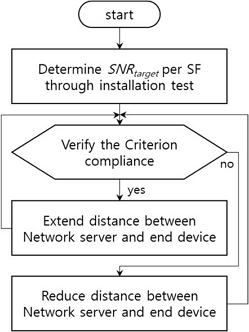
Proposed deployment strategy for LoRaWAN
3. Performance Evaluation
This section presents the performance validation results obtained using the LoRa Modem Calculator [8]. The evaluation assumes an SX1262 configuration with a 4/5 coding rate, an 8-symbol preamble, and a 50-byte payload.
Figure 2 illustrates the variation of link budget as a function of the SF, ranging from 7 to 12, for three different bandwidth (BW) configurations: 250 kHz, 125 kHz, and 62.5 kHz. For all bandwidth cases, the performance metric increases almost linearly as the SF increases. This indicates that a lower SF results in a diminished link budget, achieving the required coverage necessitates a relatively higher node density.
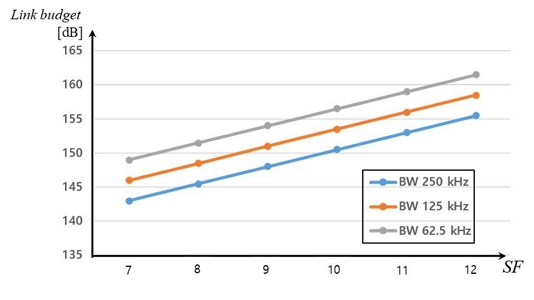
The relationship between the SF and the link budget
Figure 3 presents the variation of effective data rates with respect to the SF for three bandwidth configurations: 250 kHz, 125 kHz, and 62.5 kHz. A joint examination of Figures 2 and Figure 3 reveals that lower SF values provide higher data rates but suffer from link budget degradation, thereby decreasing deployment efficiency. Accordingly, the proposed strategy facilitates the determination of an optimal parameter combination that satisfies the required data rate while minimizing the number of deployed nodes.
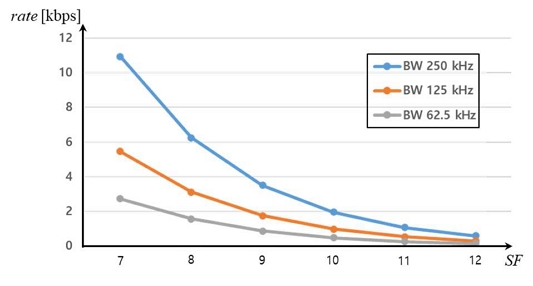
The relationship between the SF and the effective data rate
4. Conclusion
This study proposes a LoRaWAN network deployment strategy that takes into account various factors such as link quality, required data rates. The proposed approach jointly accounts for the channel conditions necessary to ensure reliable communication and the application requirements supported by the LoRaWAN network, facilitating effective and efficient node placement at the deployment stage. Moreover, as the proposed approach fully adheres to the LoRaWAN specification, it can be readily incorporated into existing commercial LoRaWAN deployments.
Author Contributions
Conceptualization, Y. -I. Joo; Methodology, Y. -I. Joo; Writing-Original Draft Preparation, Y. -I. Joo; Validation, Y. -I. Joo; Writing-Review & Editing, Y. -I. Joo.
References
- J. de Carvalho Silva, J. J. P. C. Rodrigues, A. M. Alberti, P. Solic, and A. L. L. Aquino, “LoRaWAN — A low power WAN protocol for Internet of Things: A review and opportunities,” in Proceeding of 2017 2nd International Multidisciplinary Conference on Computer and Energy Science (SpliTech), pp. 1-6, 2017.
-
Y. -I. Joo, “Networking strategy for data-driven management in a ship: Requirements and applications,” Journal of Advanced Marine Engineering and Technology, vol. 46, no. 4, pp. 193-195, 2022.
[https://doi.org/10.5916/jamet.2022.46.4.193]

- Voyage Data Recorders, https://www.imo.org/en/OurWork/Safety/Pages/VDR.aspx, , Accessed March 19, 2026.
- Voyage Data Recorders, https://en.wikipedia.org/wiki/Voyage_data_recorder, , Accessed March 19, 2026.
- LoRa Alliance, LoRaWAN 1.1 Specification, October, 2017.
-
F. Adelantado, X. Vilajosana, P. Tuset-Peiro, B. Martinez, J. Melia-Segui, and T. Watteyne, “Understanding the limits of LoRaWAN,” IEEE Communications Magazine, vol. 55, no. 9, pp. 34-40, 2017.
[https://doi.org/10.1109/MCOM.2017.1600613]
-
T. Elshabrawy and J. Robert, “Closed-form approximation of LoRa modulation BER performance,” IEEE Communication Letters, vol. 22, no. 9, 2018.
[https://doi.org/10.1109/LCOMM.2018.2849718]
- LoRa Calculator, https://www.semtech.com/design-support/lora-calculator, , Accessed March 19, 2026.