
Region-based stress assessment for evaluating the applicability of tetrahedral solid elements in lifting lug contact analysis

Copyright © The Korean Society of Marine Engineering
This is an Open Access article distributed under the terms of the Creative Commons Attribution Non-Commercial License (http://creativecommons.org/licenses/by-nc/3.0), which permits unrestricted non-commercial use, distribution, and reproduction in any medium, provided the original work is properly cited.
Abstract
Tetrahedral solid elements are widely adopted in practical finite element modeling due to their geometric flexibility and robustness in automatic mesh generation. However, their applicability for stress evaluation in contact-dominated three-dimensional structural details remains a practical concern, particularly in lifting lug structures where steep stress gradients develop around the pin–hole interface. This study investigates the applicability of tetrahedral solid elements for stress evaluation in lifting lug contact analysis. Three-dimensional finite element models using quadratic hexahedral and tetrahedral elements are constructed under identical geometric, material, and frictionless contact conditions. The mesh sensitivity of peak von Mises stress is first examined for both element types. In addition, a region-based volume-averaged stress, defined over a radial influence zone measured from the hole surface, is evaluated to assess mesh-robust behavior. The results indicate that peak stress obtained using tetrahedral elements exhibits stronger mesh dependency compared to hexahedral discretization. However, when the region-based averaged stress is applied, both element types demonstrate similar convergence trends with respect to mesh refinement. This finding suggests that, although tetrahedral elements may lead to amplified local peak stress variation, physically defined region-based stress evaluation can provide consistent and practically interpretable results. The present study provides practical guidance for stress assessment in lifting lug contact analysis when tetrahedral meshes are employed and contributes to the establishment of mesh-robust stress evaluation strategies for contact-sensitive three-dimensional structural details.
Keywords:
Tetrahedral solid element, Finite element analysis, Lifting lug structure, Volume-averaged stress1. Introduction
Lifting lug structures are critical load-carrying components in shipbuilding and offshore engineering, where heavy modules and structural blocks are transferred through pin-connected lifting arrangements. The load transfer mechanism is governed by localized contact interaction between the pin and the hole surface, generating steep stress gradients and highly three-dimensional stress states in the vicinity of the hole [1]-[3]. Reliable stress evaluation in this region is essential for safe lifting design.
Three-dimensional finite element analysis (FEA) using solid elements is generally required to capture through-thickness stress distribution and contact-induced stress concentration [4]. In practice, hexahedral solid elements are often regarded as numerically superior due to their structured interpolation and favorable convergence characteristics [5]. However, in complex geometries such as lifting lugs, fully hexahedral meshing may not be feasible, and automatic mesh generation frequently leads to tetrahedral discretization.
Tetrahedral elements provide geometric flexibility and robustness in mesh generation, particularly for curved and irregular contact surfaces [6]. Consequently, they are widely used in industrial finite element modeling. Nevertheless, several studies have reported that tetrahedral elements may exhibit stronger mesh sensitivity in stress prediction compared to hexahedral elements, especially in problems involving high stress gradients [5][7]. In contact-dominated analyses, the computed peak stress can vary significantly depending on element formulation and mesh density.
The issue of mesh sensitivity in local stress evaluation has been discussed extensively in finite element literature. In linear elastic contact problems, stress concentration near boundaries may not converge monotonically with mesh refinement [8][9][10]. For practical design purposes, this raises the question of how to define a reliable stress metric that is not excessively dependent on discretization.
One possible approach is to evaluate stress over a physically defined region rather than relying solely on single-point peak values. By integrating the stress field within a specified geometric zone surrounding the contact interface, numerical fluctuation can be mitigated while preserving physical relevance. Similar concepts have been adopted in structural stress methods and nonlocal stress approaches, where stress averaging over a finite domain is used to reduce mesh dependency and improve physical relevance [11][12]. In this study, a radial influence region defined with respect to the hole radius is adopted, and the volume-averaged von Mises stress within this region is evaluated.
While region-based stress evaluation can reduce numerical instability, its effectiveness may depend on the underlying element formulation. In particular, it remains unclear whether tetrahedral discretization can provide stress measures comparable to those obtained using hexahedral elements when such averaging strategies are applied.
The objective of this study is therefore to assess the applicability of tetrahedral solid elements for stress evaluation in lifting lug contact analysis. Hexahedral and tetrahedral finite element models are constructed under identical geometric, material, and loading conditions. The mesh sensitivity of peak stress is first examined for both element types. Subsequently, the region-based volume-averaged stress is evaluated and compared between hexahedral and tetrahedral discretizations.
The central hypothesis of this work is that, although tetrahedral elements may exhibit stronger mesh sensitivity in peak stress prediction, the region-averaged stress can demonstrate convergence trends similar to those observed in hexahedral models. By clarifying this relationship, the present study aims to provide practical guidance for stress evaluation in contact-dominated three-dimensional structural details when tetrahedral elements are employed.
In shipbuilding and offshore engineering practice, automatic tetrahedral meshing is frequently employed for complex structural details such as lifting lugs, padeyes, brackets, and connection structures. Therefore, establishing a stress evaluation methodology that remains robust against mesh formulation is of practical importance for reliable structural assessment. Unlike previous studies that mainly focused on the accuracy difference between element formulations, the present study focuses on the definition of a mesh-robust stress metric itself. The novelty of this work lies in demonstrating that a physically defined region-based stress measure can significantly reduce the discrepancy between tetrahedral and hexahedral discretizations in contact-dominated structural details.
2. Theoretical Background
2.1 Characteristics of Hexahedral and Tetrahedral Solid Element in Contact-Dominated Problems
In three-dimensional finite element analysis, solid elements are commonly classified into hexahedral and tetrahedral types. Hexahedral elements are typically preferred in structural analysis due to their structured interpolation, favorable numerical performance, and generally superior convergence characteristics [1][2]. Quadratic hexahedral elements, in particular, are capable of representing bending-dominated stress fields with high accuracy.
Tetrahedral elements, on the other hand, provide significant advantages in terms of automatic mesh generation and geometric adaptability. Complex geometries with curved boundaries and irregular features can be discretized efficiently using tetrahedral meshes [3]. For this reason, tetrahedral elements are widely used in industrial applications where fully structured meshing is difficult to achieve.
However, it is well documented that stress prediction using tetrahedral elements may exhibit greater sensitivity to mesh refinement compared to hexahedral elements, especially in problems involving high stress gradients [2][4]. The difference arises from element formulation, interpolation functions, and numerical integration schemes.
In contact-dominated structural problems, these differences may influence the accuracy and stability of computed local stresses.
Contact analysis introduces additional nonlinear constraints into the finite element formulation. Even under linear elastic material behavior, the enforcement of contact conditions can lead to highly localized stress concentrations near the contact boundary [5].
In such regions, steep stress gradients develop over short distances. The discretization must be sufficiently refined to capture these gradients accurately. If the mesh is too coarse, stress peaks may be underestimated. Conversely, as the mesh is refined, the computed peak stress may continue to increase due to improved resolution of localized stress fields [6].
2.2 Mesh Sensitivity of Local Peak Stress
The maximum von Mises stress is commonly used as a design indicator in solid finite element analysis. It is defined as
| (1) |
where Ω represents the analysis domain, and σvm denotes the von Mises equivalent stress.
In problems involving geometric discontinuities or contact boundaries, local peak stress may not converge monotonically with mesh refinement [4][6]. Instead, the value may increase as the discretization becomes finer. This behavior is particularly pronounced in contact problems due to the combination of boundary constraint effects and stress gradient amplification.
From an engineering standpoint, reliance on peak stress alone may lead to inconsistent evaluation results when different mesh densities or element types are used.
2.3 Region-Based Volume-Averaged Stress Concept
To reduce excessive dependence on local discretization, stress may be evaluated over a finite geometric region rather than at a single point. Let R denote the hole radius of the lifting lug. A radial influence region can be defined as a three-dimensional domain extending outward from the hole surface by a prescribed distance δ, expressed as
| (2) |
where k is a dimensionless influence coefficient.
The volume-averaged von Mises stress within the influence region Ωk is defined as
| (3) |
In discrete finite element form, this becomes
| (4) |
where is the element-averaged von-Mises stress of element e, and Ve is the volume of element e.
This region-based evaluation reduces the influence of localized numerical amplification and provides a stress metric that reflects the integrated response within a physically defined domain.
The effectiveness of this approach may depend on the underlying element formulation. Therefore, it is necessary to examine whether tetrahedral discretization yields region-averaged stress values comparable to those obtained using hexahedral elements.
Similar averaging concepts have been widely adopted in nonlocal stress theories and structural stress methodologies to reduce numerical sensitivity while preserving physical significance. Therefore, the present approach should be interpreted as a complementary engineering metric rather than a replacement for local peak stress evaluation.
3. Numerical Model and Analysis Setup
3.1 Geometry and Material Properties
A 12-ton class lifting lug was selected as the target structure in this study. The geometry consists of a single-plate lug with a central circular hole through which load is transmitted via pin–hole contact. The configuration represents a typical lifting detail widely used in shipbuilding applications.
The detailed geometric dimensions of the target structure are illustrated in Figure 1. The hole radius is denoted as R, which serves as the reference geometric parameter for mesh refinement and influence-zone definition.
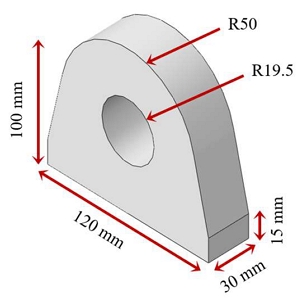
Detailed geometric dimensions of target structure
The material was assumed to be isotropic linear elastic structural steel with the following properties:
- • Young’s modulus: E = 210 GPa
- • Poisson’s ratio: V = 0.3
Material nonlinearity was not considered in order to isolate the effect of element type and mesh discretization on stress evaluation.
3.2 Boundary and loading conditions
The boundary and loading conditions applied in this study are shown in Figure 2.
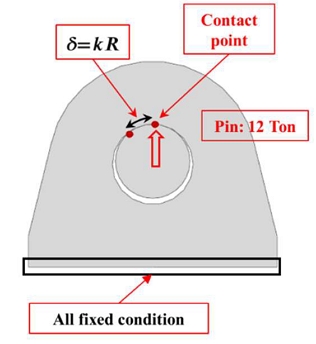
Boundary and loading conditions
Surface-to-surface frictionless contact was defined between the pin and the hole surface. In this study, frictionless contact was assumed to isolate the influence of element formulation and mesh discretization on stress evaluation. Although friction may affect the stress distribution in practical lifting operations, introducing friction would add additional nonlinearities that may obscure the primary objective of this study. Therefore, a frictionless condition was adopted as a baseline configuration. The influence of frictional contact will be considered in future work. The bottom surface of the lifting lug was fully constrained to represent rigid attachment to a supporting structure. All translational degrees of freedom were fixed at this boundary.
A static load corresponding to 12 tons was applied along the pin axis. Identical boundary and contact conditions were applied to both hexahedral and tetrahedral models to ensure a consistent basis for comparison.
3.3 Element Formulation and Mesh Strategy
To investigate the applicability of tetrahedral elements, two element formulations in the commercial software ABAQUS 2024 were considered:
- 1. Quadratic hexahedral solid elements (C3D20)
- 2. Quadratic tetrahedral solid elements (C3D10)
Second-order elements (C3D20 and C3D10) were selected to ensure accurate representation of stress gradients near the contact region. First-order elements are known to exhibit reduced accuracy in stress prediction due to their limited interpolation capability. By using second-order elements, the influence of element formulation can be more clearly isolated without additional numerical errors introduced by low-order interpolation.
The mesh resolution around the hole region was controlled by the number of elements distributed along the hole circumference, denoted as Nθ. The circumferential element size is defined as
| (5) |
Four mesh refinement levels were adopted:
- • Coarse mesh: Nθ = 32, 36
- • Medium mesh: Nθ = 40
- • Fine mesh: Nθ = 44
For the hexahedral models, structured meshes were generated to maintain regular element shapes around the hole region. For the tetrahedral models, unstructured quadratic tetrahedral meshes were generated using automatic meshing algorithms.
The mesh configurations of both element types are compared in Figure 3. For the tetrahedral models, the global mesh size near the hole region was adjusted such that the characteristic edge length was approximately equivalent to hθ used in the hexahedral models.
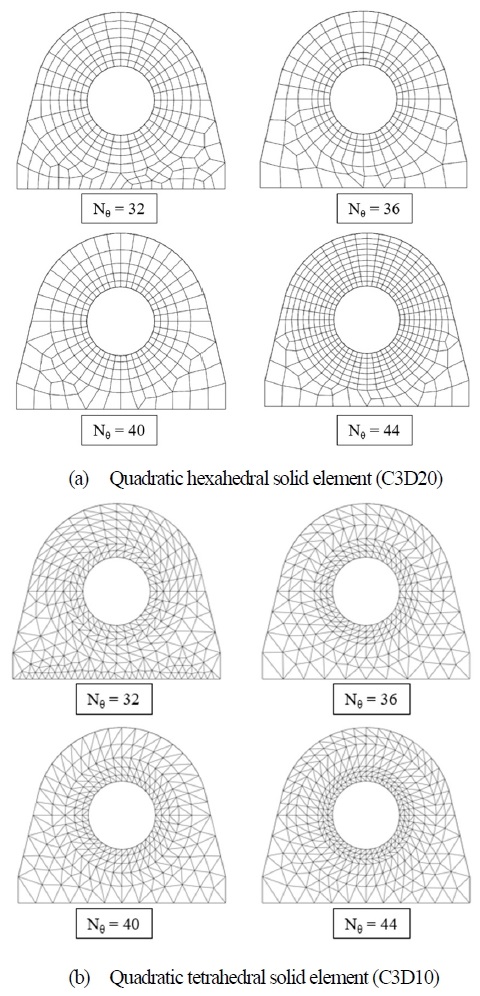
Mesh configurations of two element types
Radial and thickness-wise mesh refinement were proportionally adjusted in both models to minimize element distortion effects and maintain comparable discretization density. This meshing strategy enables a direct comparison between structured hexahedral and unstructured tetrahedral discretizations under similar geometric resolution.
The hexahedral meshes were generated in a structured manner to provide a reference solution, whereas the tetrahedral meshes were generated automatically to represent practical industrial modeling procedures. The mesh density near the hole boundary was adjusted to ensure comparable circumferential resolution between the two discretizations.
4. Results and Discussion
4.1 Stress Distribution Comparison
The von Mises stress contours obtained from hexahedral and tetrahedral models are compared in Figure 4 for each mesh level.
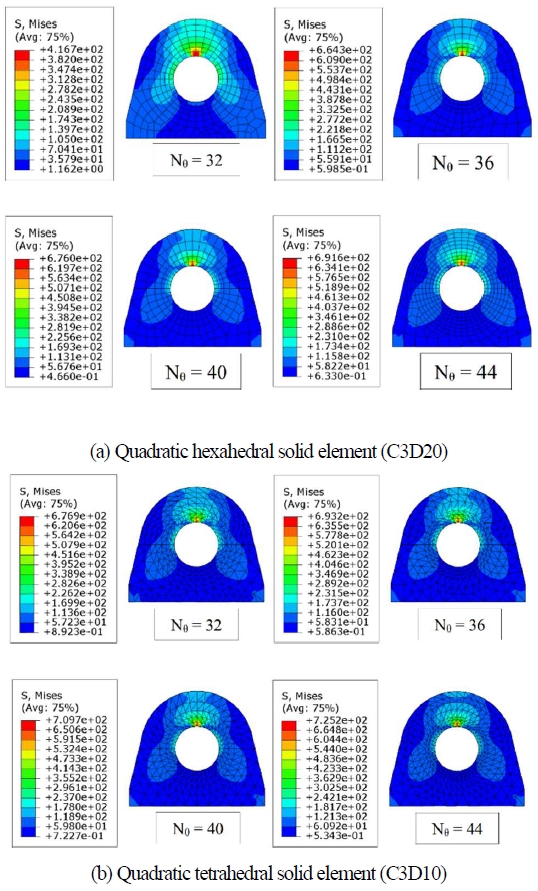
von Mises stress contours of two element types
In both discretizations, high stress concentration is observed near the pin–hole contact interface. The overall stress distribution pattern is qualitatively similar between the two element types. However, the tetrahedral model exhibits more localized and irregular stress concentration in the vicinity of the contact boundary.
As mesh refinement increases, the stress field becomes progressively sharper for both element types. The localized stress amplification near the contact interface is more pronounced in tetrahedral discretization.
4.2 Peak stress sensitivity
The variation of maximum von Mises stress with respect to circumferential mesh resolution Nθis presented in Figure 5.
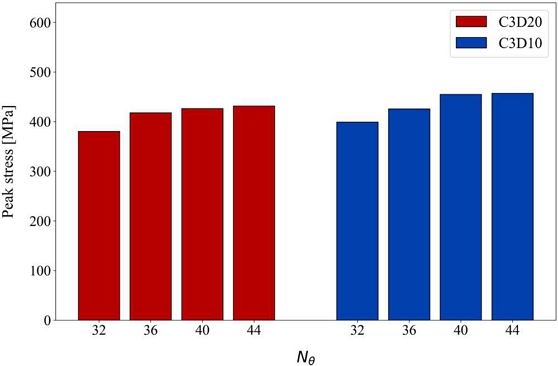
Variation of maximum von Mises stress with respect to the circumferential element resolution
For both element types, peak stress increases as the mesh is refined. However, the increase is more significant in the tetrahedral models.
In contrast, the hexahedral models show relatively smoother growth of peak stress under refinement. Although complete convergence is not achieved within the considered mesh range, the sensitivity trend is less pronounced than that observed in tetrahedral elements.
This result indicates that peak stress evaluation in contact-dominated lifting lug structures is strongly dependent on element formulation and mesh density. Tetrahedral elements tend to amplify local stress variation under refinement, which may lead to inconsistent design assessment when peak stress alone is used as the evaluation metric. In this context, it should be noted that peak stress in contact-dominated problems is highly dependent on mesh density and element formulation, and therefore does not represent a stable or physically reliable quantity.
4.3 Region-based Averaged Stress Comparison
Region-based volume-averaged stress was evaluated using the radial influence distance defined in Section 2.
The variation of averaged von Mises stress with respect to the influence coefficient kis shown in Figure 6 for both hexahedral and tetrahedral models, and the corresponding values are presented in Table 1.
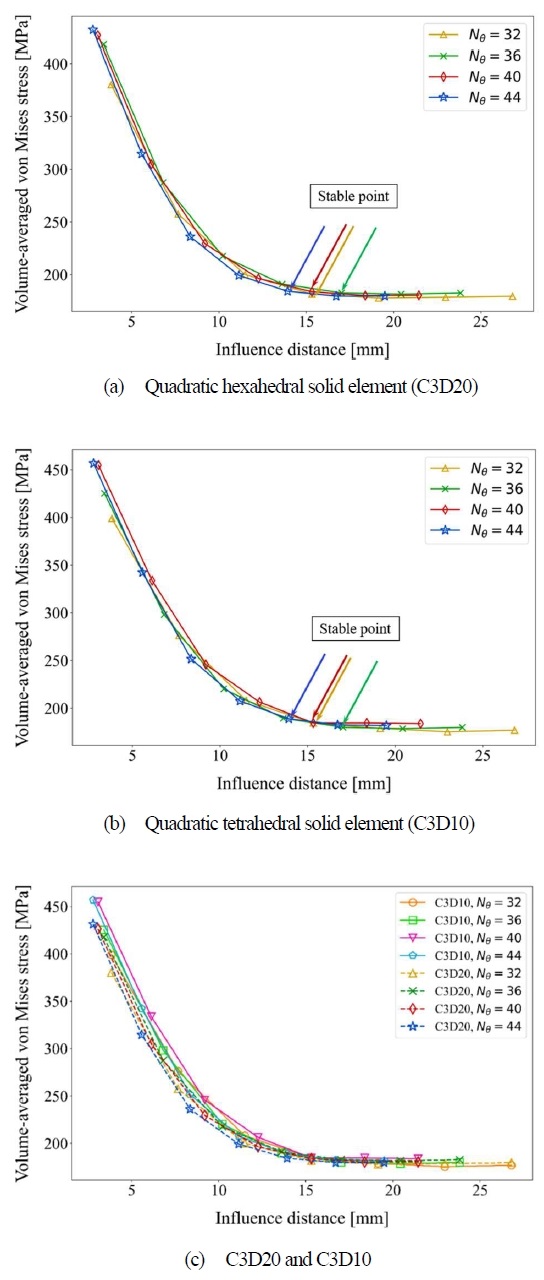
Variation of volume-averaged von Mises stress as a function of the influence distance for different mesh resolutions and formulations

Summary of analysis results at stable point
For a given mesh level, the averaged stress decreases gradually as the influence distance increases and approaches a stable plateau. Importantly, the convergence trends of averaged stress are similar for both element types.
Although tetrahedral elements exhibit higher peak stress values, the difference in averaged stress between hexahedral and tetrahedral discretizations becomes significantly smaller within the stabilized influence region.
For sufficiently large influence distance, the discrepancy between element types remains within a small range compared to the variation observed in peak stress.
4.4 Stabilization Behavior and Applicability of Tetrahedral Elements
A 3% relative variation criterion was adopted to define the stabilization point of the averaged stress, which is commonly used in engineering practice as an acceptable convergence tolerance.
The stabilized values of averaged stress for each mesh level are summarized in Figure 7.
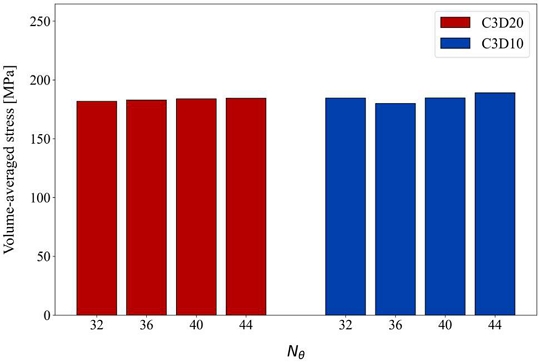
Stabilized values of averaged stress for each mesh level
The results show that:
- • Peak stress exhibits strong dependency on element type.
- • The difference in stabilized averaged stress between hexahedral and tetrahedral models is significantly smaller than the difference observed in peak stress.
These findings support the hypothesis that, although tetrahedral elements may produce amplified local peak stress under mesh refinement, region-based averaged stress evaluation yields comparable and practically consistent results.
From an engineering perspective, this suggests that tetrahedral solid elements can be considered applicable for lifting lug contact analysis when stress assessment is performed using physically defined region-based averaging rather than single-point peak values.
5. Conclusion
This study investigated the applicability of tetrahedral solid elements for stress evaluation in lifting lug contact analysis by comparing their numerical behavior with that of hexahedral elements under identical geometric, material, and frictionless contact conditions.
The main findings of the study can be summarized as follows:
- 1. The maximum von Mises stress obtained from tetrahedral discretization exhibits stronger mesh sensitivity compared to hexahedral elements. As mesh refinement increases, peak stress in tetrahedral models shows more pronounced amplification, indicating higher dependency on discretization density in contact-dominated regions.
- 2. In contrast, the region-based volume-averaged stress demonstrates stable convergence behavior for both element types. As the radial influence coefficient increases, the averaged stress approaches a plateau, reducing the influence of localized numerical amplification.
- 3. The discrepancy between hexahedral and tetrahedral models is significantly smaller for the stabilized averaged stress than for peak stress values. This indicates that region-based stress evaluation provides a more consistent basis for comparison across different element formulations.
- 4. From a practical engineering standpoint, tetrahedral solid elements can be considered applicable for lifting lug contact analysis when stress assessment is performed using a physically defined influence region rather than relying solely on single-point peak stress.
Although tetrahedral elements may produce amplified local peak stress under mesh refinement, this study shows that such sensitivity can be effectively mitigated through region-based averaging. It should also be noted that peak stress may still be relevant for assessing local failure mechanisms such as yielding or crack initiation. However, due to its strong mesh dependency, peak stress alone may not provide a reliable basis for engineering evaluation in contact-dominated problems. The proposed region-based averaged stress therefore serves as a complementary metric that enables stable and consistent assessment.
The limitations of the present study include the assumption of linear elastic material behavior and frictionless contact conditions. These simplifications were adopted to isolate the effect of element formulation and mesh discretization on stress evaluation.
The practical implication of this study is that reliable stress evaluation can be achieved in contact-dominated structural details where automatic tetrahedral meshing is unavoidable. This approach is particularly relevant to marine engineering applications involving lifting lugs, padeyes, brackets, and other complex structural components with localized stress concentrations.
Acknowledgments
This work was supported by the Dong-A University research fund.
Author Contributions
Conceptualization, J.-H.Kim; Methodology, M.Han; Formal Analysis, D.B.Jang; Investigation, D.B.Jang; Data Curation, D.B.Jang; Writing—Original Draft Preparation, D.B.Jang; Writing—Review & Editing, J.-H.Kim; Visualization, J.-H.Kim; Supervision, J.-H.Kim; Project Administration, J.-H.Kim; Funding Acquisition, J.-H.Kim
References
-
Z. C. Liu, B. Zhou, and S. K. Tan, “Finite element analysis and structural optimum design of lifting padeye,” Advanced Materials Research, vol. 658, pp. 399-403, 2013.
[https://doi.org/10.4028/www.scientific.net/AMR.658.399]

-
H. S. Saleh, S. Kakay, and S. C. Siriwardane, “Ultimate capacity of pad eyes used for lifting operations: Experimental and numerical simulations,” International Journal of Computational Methods and Experimental Measurements, vol. 6, no. 3, pp. 605-613, 2018.
[https://doi.org/10.2495/CMEM-V6-N3-605-613]
-
Y. Li, R. Huang, S. Zhao, and J. Wang, “Contact pressure analysis of pin-loaded lug with clearance,” Advances in Mechanical Engineering, vol. 14, no. 6, pp. 1–15, 2022.
[https://doi.org/10.1177/16878132221107475]
- K. J. Bathe, Finite Element Procedures. Upper Saddle River, NJ, USA: Prentice Hall, 1996.
- O. C. Zienkiewicz and R. L. Taylor, The Finite Element Method for Solid and Structural Mechanics, 6th ed. Oxford, U.K.: Elsevier Butterworth-Heinemann, 2005.
-
G. B. Sinclair, R. P. Grieve, and C. H. Dowling, “On the Detection of Stress Singularities in Finite Element Analysis,” Journal of Applied Mechanics, vol. 86, no. 2, pp. 021005-1–021005-11, 2019.
[https://doi.org/10.1115/1.4041766]
- R. D. Cook, D. S. Malkus, M. E. Plesha, and R. J. Witt, Concepts and Applications of Finite Element Analysis, 4th ed. New York, NY, USA: John Wiley & Sons, 2002.
-
P. Wriggers, Nonlinear Finite Element Methods, Springer, 2008.
[https://doi.org/10.1007/978-3-540-71001-1]
- B. Szabó and I. Babuška, Finite Element Analysis. New York, NY, USA: John Wiley & Sons, 1991.
- T. Belytschko, W. K. Liu, and B. Moran, Nonlinear Finite Elements for Continua and Structures. Chichester, U.K.: John Wiley & Sons, 2000.
-
M. Tüfekci, J. P. Dear, and L. Salles, “A finite element based approach for nonlocal stress analysis for multi-phase materials and composites,” Engineering with Computers, vol. 41, pp. 1103-1121, 2025.
[https://doi.org/10.1007/s00366-024-02076-x]
-
H. Dong, “Computationally efficient higher-order three-scale method for nonlocal gradient elasticity problems of heterogeneous structures with multiple spatial scales,” Applied Mathematical Modeling, vol. 109, pp. 426-454, 2022.
[https://doi.org/10.1016/j.apm.2022.05.010]