
Development of integrated energy management system for electric propulsion car ferry ship with movable battery

Copyright © The Korean Society of Marine Engineering
This is an Open Access article distributed under the terms of the Creative Commons Attribution Non-Commercial License (http://creativecommons.org/licenses/by-nc/3.0), which permits unrestricted non-commercial use, distribution, and reproduction in any medium, provided the original work is properly cited.
Abstract
This paper presents the development and implementation of an Integrated Energy Management System (IEMS) that applies a movable battery in an electric propulsion car ferry ship. The proposed system integrally controls fixed and movable battery, charging panels, inverters, and propulsion motors, and realizes stable and efficient power supply through the Power Management System (PMS) and the Energy Management System (EMS). It is also designed to quickly handle faults and alarms that may occur during operation through control logic and HMI-based monitoring. As a result of the experiment, the proposed system showed improved performance in operational efficiency and maintenance compared to fixed battery-based operation.
Keywords:
Electric propulsion car ferry ship, Fixed and movable battery, Power management system(PMS), Energy management system(EMS), Energy storage system(ESS)1. Introduction
With the recent reinforcement of environmental regulations by the International Maritime Organization (IMO), the decarbonization of ships and the introduction of eco-friendly energy are accelerating. Offshore transport ships such as Car Ferry ship are suitable fields for applying battery-powered electric propulsion systems. However, when only fixed battery is used, the charging time is long, maintenance is not easy, and operation efficiency such as sailing distance constraints is low. To overcome this limitation, it is necessary to consider how to operate a movable battery that can be charged more easily than a fixed battery and has a large capacity together [1][2][3].
The purpose of this study is to design an integrated energy management system for electric propulsion car ferry ship with movable battery and to implement a structure that enables stable operation and rapid energy replacement [4][5].
2. Related Research and Technical Background
Previous studies have focused on the development of Power Manage System(PMS) and Energy Management System(EMS) using ship energy storage systems (ESS) and battery. However, due to the nature of the ship, these systems are inefficient for car ferry ship that require fast charging after a short operation [6]-[10].
Table 1 shows the main differences between the existing fixed battery-based system and the movable battery-based system proposed in this paper.

Comparison of Fixed and Movable Battery Based Systems
Based on this differentiation, this study design a power integrated control system that adds a movable battery in the existing fixed battery operation and controls it in conjunction with PMS/EMS.
3. System Architecture
3.1 Electric Propulsion System Overview
The electric propulsion system consists of the power generation system based on the onboard battery system, the distribution system that manages and controls the generated power, and the propulsion system for ship propulsion, as shown in Figure 1. The system supports economic ship operation by efficiently generating and managing power through monitoring and control of each subsystem.
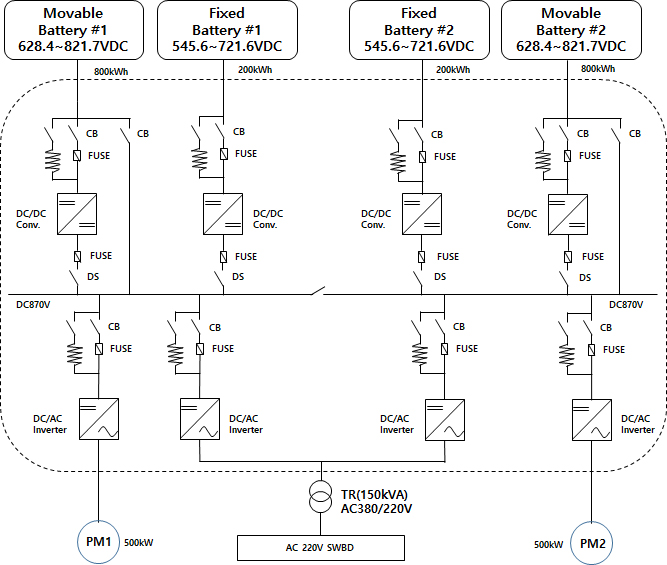
Single line diagram for electric propulsion car ferry ship
3.2 Power Management System (PMS)
The Power Management System is installed on the distribution board and controls and monitors the battery management system, DC-DC converter, hotel-load inverter, propulsion motor inverter, and circuit breaker for power supply in the ship. Each equipment is controlled and monitored through PMS and Hardwire connections and communication interworking. Modbus TCP is used as the protocol used during communication interworking, and the monitoring and control of PMS main data is performed using Hardwire, and other data is performed by communication [7][8].
- • Main Controller : PLC-based CPU with Redundancy Structure
- • Connection : fixed/movable battery, fixed/movable battery converter, propulsion motor inverter, Hotel Load inverter, Energy Management System
- • Interface : Hardwire, Ethernet(Modbus TCP), RS-485 Serial
- • Main Function
- On/off control and power status monitoring of fixed/movable battery
- DC-DC converters, Hotel-load inverters and PM motor drive : Pre-Charging, start, ttop, output power monitoring and control
- Monitoring and control main bus and circuit breaker status
PMS Main Specification
3.3 Energy Management System (EMS)
The Energy Management System (EMS) is a system that efficiently manages energy by monitoring and control the power generated by the battery and charging panels installed on board and the power consumed by the propulsion motor and onboard equipment. It also provides a function to control the propulsion motor inverter through the speed lever installed in the EMS Console for propulsion of the ship [9][10].
- • Application of PC-based HMI and PLC controller, redundant servers and marine monitor-based operations
- • Connection : Power Management System, Speed Lever
- • Interface : Hardwire, Ethernet(Modbus TCP)
- • Main Function
- Monitoring power generation and consumption of fixed/movable battery through PMS
- Display the status of DC-DC converters, hotel load inverters, propulsion motor inverters, and circuit breakers
- Control fixed battery charging using a movable battery
- Propulsion Motor Inverter Speed Command via Speed Control Lever
- Power Flow Monitoring, Alarm and Trend Data Management, Mimic Screen Display
4. Implementation
4.1 PMS Control Logic
The PMS controls battery charging/discharging and inverter operation in stages. It performs pre-charging, run, and stop control and includes an automatic shut-off function in case of a fault.
EMS Main Specification
Battery operation method
The cases and control methods of fixed and movable battery in the PMS are shown in the table below.
① Fixed battery independent operation
In this mode, the fixed battery system independently supplies onboard power. This operation is applied when the movable battery is not in use, such as during battery replacement while the vessel is anchored. The fixed battery ensures continuous power supply to onboard loads under these conditions.
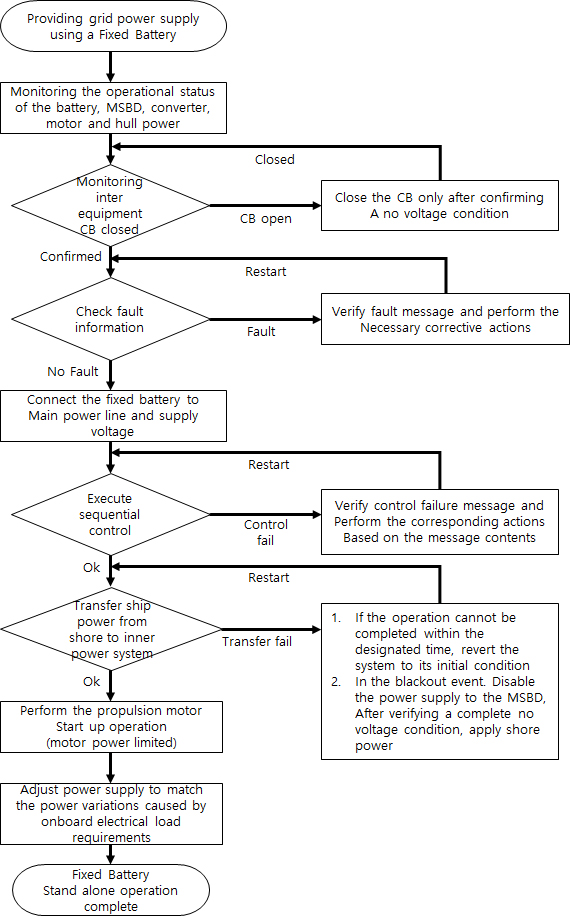
Fixed battery independent operation
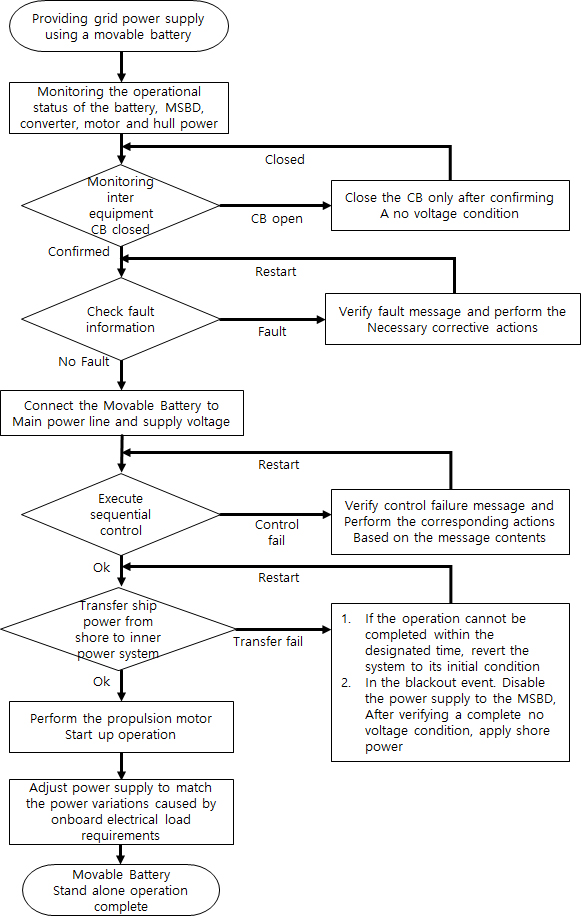
Movable battery independent operation
② Movable battery independent operation
During most propulsion operating conditions while sailing, the movable battery system operates independently. In this mode, the movable battery supplies power to both the onboard electrical loads and the propulsion motor, enabling normal vessel operation.
③ Battery Parallel Operation : Fixed (discharge) + Movable (discharge)
Parallel discharge operation is applied during departure and arrival, or when additional power is required during sailing, such as increased propulsion demand or higher onboard load. In these cases, the fixed battery system is connected in parallel with the movable battery system to support additional power demand and ensure stable system operation.
④ Battery Parallel Operation : Fixed (Charge) + Movable (discharge)
During sailing, if the state of charge (SOC) of the fixed battery system falls below a predefined threshold, parallel charging operation is initiated. In the proposed system, the IEMS evaluates the available power margin of the movable battery and performs charging of the fixed battery system when the SOC falls below 10%, which is set as the default threshold in the EMS.
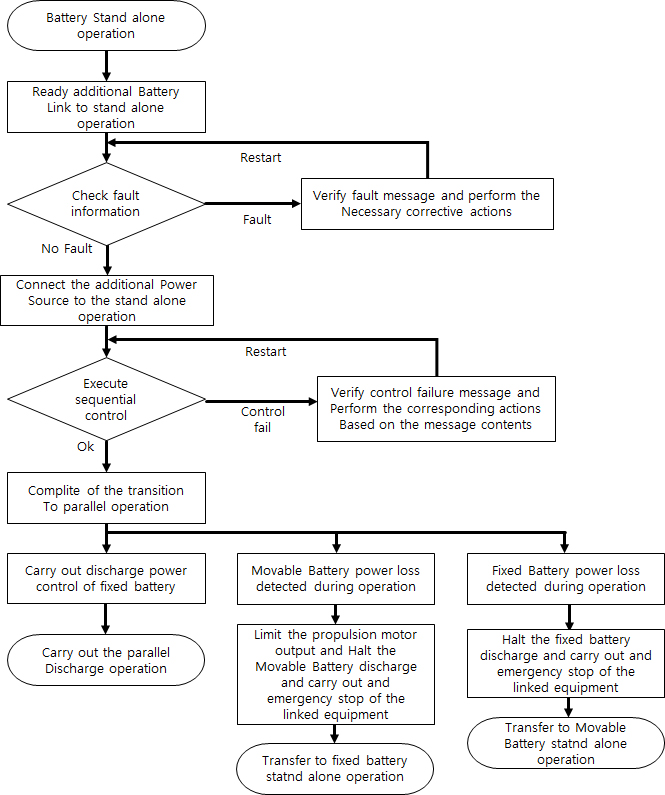
Battery Parallel Operation : Fixed (discharge) + Movable (discharge)
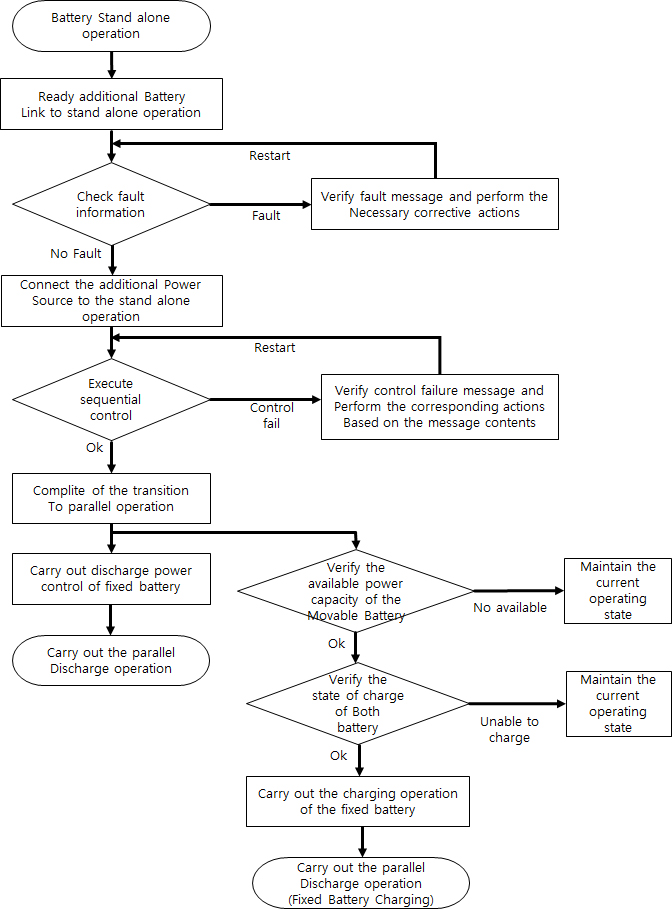
Battery Parallel Operation : Fixed (Charge) + Movable (discharge)
EMS Functions
4.2 EMS functions
The EMS visualizes the power flow of the power generation source (fixed and movable battery) and controls the propulsion motor through a speed lever. It also provides functions to limit the output of the propulsion motor through automatic/manual mode switching of the propulsion motor and power limit setting. To this end, the EMS provides several human machine interface (HMI) screens for the operator. EMS and related HMI screens were developed directly using a WinCC-based platform with custom screen layout and control.
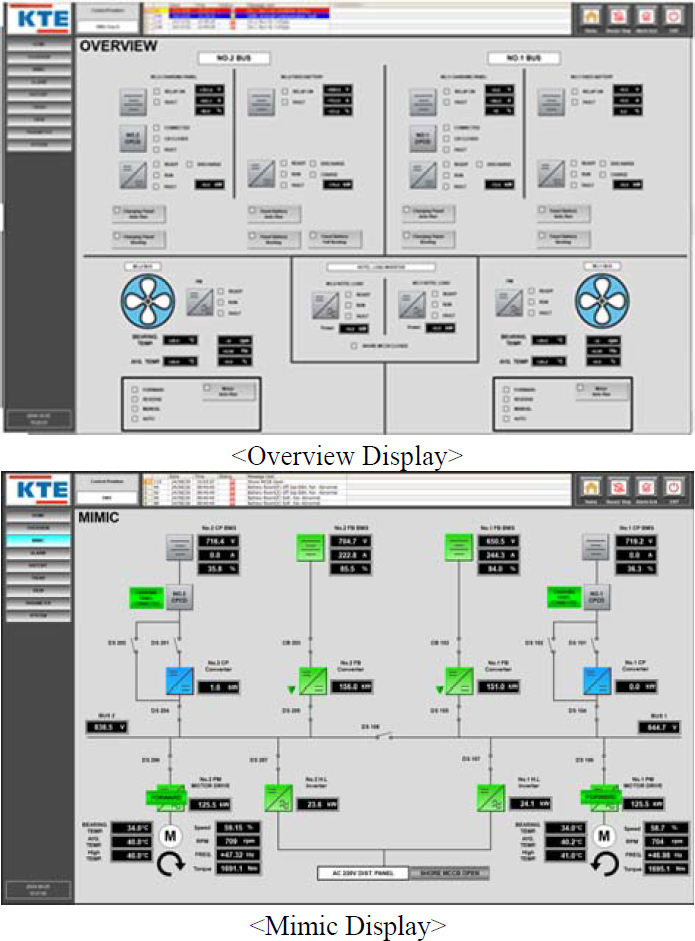
EMS HMI Configuration Screens
5. Experiment & Results
5.1 Experimental environment
The test environment was tested through a test operation using an electric propulsion car ferry ship, and the main electric propulsion equipment installed on the electric propulsion car ferry ship is as follows.
- • Ship battery: 200kWh class fixed battery system and 800kWh class movable battery system each 2 units
- • Two separate bus bars consisting of one each fixed and movable, and four converters for the battery
- • Two on-board power supply inverters and two propulsion motors using power supplied from each main bus
Two types of batteries used in this test were used, and their specifications are shown in Table 6.
Fixed Battery and Movable Battery Specification
The fixed battery is fixed to the hull and configured to be connected to the main distribution panel. The movable battery is installed in a 20-feet container and can be moved while mounted on the vehicle, and is configured to be connected to the main switchboard through a power connection device.
Two 500 kW propulsion motors were used in this test, and their specifications are shown in Table 7.
Propulsion Motor Specification
Operating conditions of the test cases
The test monitoring the battery state of charge (SOC) change and main bus power voltage change according to the load change in the ship using fixed and movable battery installed on the electric propulsion car ferry ship, and this test was conducted with the bus tie in an open state. The test items are as follows.
- 1) Battery SOC change and propulsion motor output results when using a fixed battery
- 2) Battery SOC change and propulsion motor output results when using a movable battery
- 3) Use movable battery to propel ships, supply onboard power, and charge fixed battery
- 4) Fixed and movable battery output voltage in parallel operation
5.2 Test Results
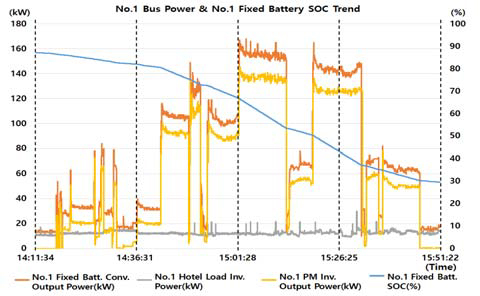
No.1 Bus power usage and remaining power trend graph when using a No.1 fixed battery
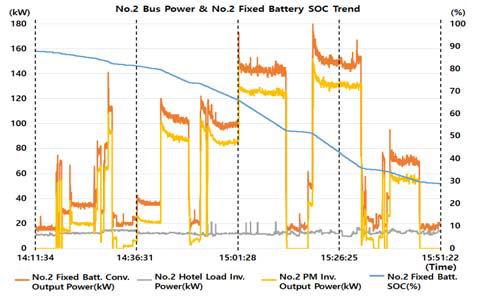
No.2 Bus power usage and remaining power trend graph when using a No.2 fixed battery
If the propulsion motor 700 rpm (160 kW) and the onboard power supply (10 kW) were supplied by each fixed battery, the discharge state could be maintained for about 1 hour.(When maintaining the corresponding propulsion state according to the sea trial verified condition, the battery SOC decreased from 92% to 28%, and the electric propulsion car ferry ship was operated for about 1 hour.)
The fixed battery was discharged in real time according to the change in power demand under the load change condition used during sea trial, and it was confirmed that the entire system could maintain stable power supply and demand.
If the power that propulsion motor 1050 rpm (390 kW) + onboard power supply (10 kW) is supplied by each movable battery, the discharge can be maintained for about 2 hours, but the actual electric propulsion ship was operated for 40 minutes, and at this time the battery SOC changed from 80% to 58%.
The movable battery was discharged in real time according to the change in power demand under the load used during the system test operation, and it was confirmed that the power supply and demand of the entire system could be stably maintained.
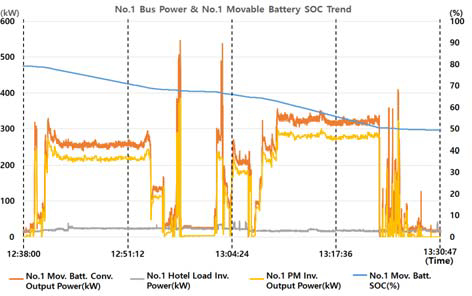
No.1 Bus power usage and remaining power trend graph when using a No.1 movable battery
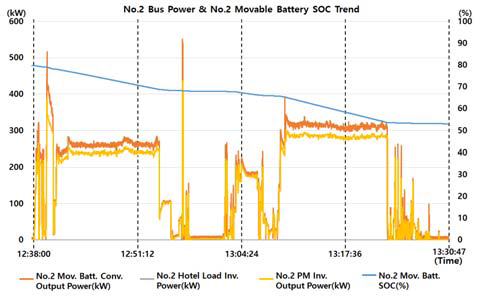
No.2 Bus power usage and remaining power trend graph when using a No.2 movable battery
While supplying power to the onboard power and propulsion motor with a movable battery, the fixed battery was charged as much as the extra power of the movable battery (more than 30kW of power) determined by the power management system.
During charging, the power management system supervises the charging current limit defined by the battery management system (BMS) and regulates the charging power accordingly. The charging current limit is not fixed; rather, it varies according to the state of charge (SOC) of the fixed battery based on the BMS charging profile. In this study, the charging power was determined by comprehensively considering the real-time available power of the movable battery, the maximum allowable charging current of the fixed battery, and the DC bus voltage variations caused by load conditions during the sea trial. The charging conditions were configured in accordance with the specifications and operating requirements provided by the battery manufacturer. If the extra power of the movable battery is less than 30 kW or the SOC of the movable battery exceeds 90% for 5 minutes or more during the charging operation of the fixed battery, the power management system ends the charging operation and switches to the movable battery only operation mode.
In the event that the excess power of the movable battery is less than 30 kW or the SOC of the fixed battery exceeds 90% for 5 minutes or more, the power management system ends the charging operation and switches to the movable battery alone mode.
The movable battery was discharged in real time in accordance with the change in power demand under the load used during the system test operation (propulsion motor + fixed battery charging by the excess power + power), and it was confirmed that the overall power supply and demand of the system can be stably maintained.
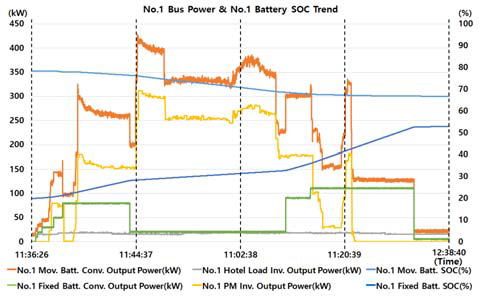
Graph of the use of No.1 Bus power and the remaining capacity of the No.1 fixed battery and the No.1 movable battery in parallel operation
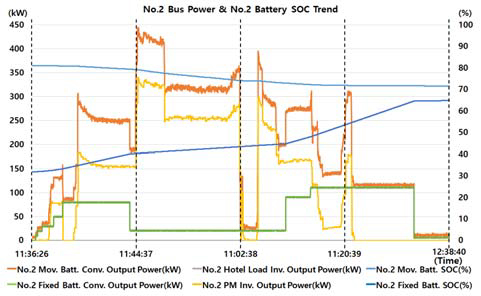
Graph of the use of No.2 Bus power and the remaining capacity of the No.2 fixed battery and the No.1 movable battery in parallel operation
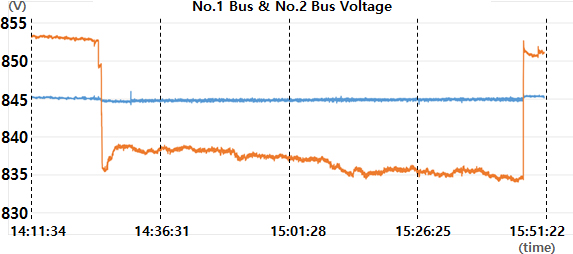
Graph of output voltages for No.1 Bus and No.2 Bus in parallel operation of fixed and movable battery
In the No. 1 Bus, the movable battery was operated alone, and in the No. 2 Bus, the fixed battery parallel operation (charging) while the movable battery was operated alone and then switched to the separate operation. In this case, it was confirmed that the output voltage was maintained within about ±2% even during the parallel operation of the fixed battery and the movable battery.
6. Conclusion
In this study, a DC distribution system was designed and implemented by integrating fixed and movable battery systems, a DC switchboard for DC power generation, and an Integrated Energy Management System (IEMS) capable of remotely monitoring and control equipment interconnected with the DC distribution network. The proposed system was applied to an actual vessel, and its feasibility and operational stability were verified under real ship operating conditions.
The integrated energy management system continuously monitors and evaluates the operational status of the battery power sources, enabling seamless transitions between parallel and stand-alone operation modes while maintaining continuity of power supply during mode switching. Furthermore, during parallel operation, an energy management strategy that utilizes surplus power to charge the fixed battery system was successfully implemented and validated, allowing the system to prepare for future increases in propulsion and onboard power demand.
Compared to conventional power systems based solely on fixed battery installations, the proposed system enhances operational efficiency by increasing flexibility in power source utilization, enabling adaptive power sharing according to operating conditions, and reducing operational downtime during battery replacement. In addition, maintenance and serviceability are improved by allowing the movable battery system to be replaced or serviced independently, thereby minimizing vessel downtime and simplifying battery management procedures.
Future research will extend the system architecture presented in this study to establish practical guidelines applicable to ships and shore-based equipment employing DC distribution systems. Further investigations will focus on scaling distribution capacity, expanding the number and configuration of power sources, and integrating the proposed system with existing ship automation systems. Moreover, the standardization of shipboard battery systems and the development of battery replacement and charging infrastructure will be addressed as key challenges for practical implementation.
Acknowledgments
This research is conducted with the support of the Korea Institute of Marine Science & Technology promotion(KIMST), funded by the Ministry of Oceans and Fisheries.[20200469, Development of an electric-powered car ferry and a roll-on/roll-off power supply system]
This research is conducted with the support of the Korea Planning & Evaluation Institute of Industrial Technology(KEIT), funded by the Ministry of Trade, Industry and Energy. [RS-2023-00252883, Development of Hybrid Propulsion Ship 10MW Class DC Distribution Technology]
This research is conducted with the support of the Korea Institute of Marine Science & Technology promotion(KIMST), funded by the Ministry of Oceans and Fisheries.[20210608(RS-2021-KS211503), Development of 1MW class Marine Test-bed for Adoptability Demonstration of Alternative Fuels]
Author Contributions
Conceptualization, J. Choi and S. Jeong; Methodology, J. Choi and S. Jeong; Software, J. Jung and T. Kim; Validation, J. Jung and T. Kim; Formal Analysis, J. Choi; Investigation, J. Choi; Resources, J. Choi; Data Curation, J. Choi; Writing-Original Draft Preparation, J. Choi and T. Kim; Writing-Review & Editing, J. Choi and J. Jung; Visualization, J. Choi and T. Kim; Supervision, S. Jeong; Project Administration, S. Jeong; Funding Acquisition, S. Jeong.
References
- International Maritime Organization, 2023 IMO Strategy on Reduction of GHG Emissions from Ships, MEPC 80 Resolution MEPC.377(80), 2023.
-
M. Anantharaman, A. Sardar and R. Islam, “Decarbonization of shipping and progressing towards reducing greenhouse gas emissions to net zero: a bibliometric analysis,” Sustainability, vol. 17, no. 7, 2936, 2025.
[https://doi.org/10.3390/su17072936]

- American Bureau of Shipping, Requirements for Direct Current (DC) Power Distribution Systems for Marine and Offshore Applications, American Bureau of Shipping, Houstion, TX, USA, 2022.
- J. H. Park, Y. S. Kim and H. J. Kang, "Development of pure electric propulsion car ferry ship and demonstration infrastructure of electric propulsion system," Proceedings of the Korean Institute of Electrical Engineers, vol. 74, no. 11, 2025 (in Korean).
-
J. -H. Lee, D. -W. Jang, S. -H. Jin, and S. -W. Shin, “Conceptual design for fully electrified car ferry powered by removable battery system,” Journal of the Korean Society of Marine Environment & Safety, vol. 27, no. 6, pp. 856-866, 2021.
[https://doi.org/10.7837/kosomes.2021.27.6.856]
-
J. H. Jang, and J. S. Oh, “The study on a ship energy management system applied rechargeable battery,” Journal of the Korean Society of Marine Engineering, vol. 38, no. 2, pp. 202-207, 2014.
[https://doi.org/10.5916/jkosme.2014.38.2.202]
-
P. Xie, J. M. Guerrero, S. Tan, N. Bazmohammadi, J. C. Vasquez, M. Mehrzadi, Y. Al-Turki, “Optimization-based power and energy management system in shipboard microgrid: a review,” IEEE Systems Journal, vol. 16, no. 1, pp. 578-590, 2022.
[https://doi.org/10.1109/JSYST.2020.3047673]
-
S. Ali, et al., “A review of DC microgrid energy management systems dedicated to residential applications,” Energies, vol. 14, no. 14, 4308, 2021.
[https://doi.org/10.3390/en14144308]
-
A. J. Albarakati, Y. Boujoudar, M. Azeroual, L. Eliysaouy, H. Kotb, A. Aljarbouh, H. Khalid Alkahtani, S. M. Mostafa, A. Tassaddiq, and A. Pupkov, “Microgrid energy management and monitoring systems: a comprehensive review,” Frontiers in Energy Research, vol. 10, 1097858, 2022.
[https://doi.org/10.3389/fenrg.2022.1097858]
-
M. F. Zia, E. Elbouchikhi, and M. Benbouzid, “Microgrids energy management systems: a critical review on methods, solutions, and prospects,” Applied Energy, vol. 222, pp. 1033-1055, 2018.
[https://doi.org/10.1016/j.apenergy.2018.04.103]