
Implementation of a practical tennis training algorithm based on random characteristics for enhancing immersion

Copyright © The Korean Society of Marine Engineering
This is an Open Access article distributed under the terms of the Creative Commons Attribution Non-Commercial License (http://creativecommons.org/licenses/by-nc/3.0), which permits unrestricted non-commercial use, distribution, and reproduction in any medium, provided the original work is properly cited.
Abstract
Based on a training machine that returns balls with randomness associated with the player’s own strokes, this paper presents research results that enhance immersion while simultaneously quantifying individual performance. The system consists of four modes. In Mode 1, the area sensor determines whether the ball has been hit into the designated target zone, and the score increases if the next ball is also hit in the target zone within a set time. Building on this foundation, Mode 2 introduces a stage where the player competes against the machine. After setting a self-determined skill level in advance, the player’s score increases when that level is met; otherwise, the machine’s score increases. This mode allows players to engage in immersive play with the machine even without a partner. Mode 3 features competition against another player, where players take turns hitting the ball; if a valid return fails, the opponent’s score increases. Finally, Mode 4 introduces a system in which the player’s score increases only when the preset skill level is met and the ball is hit in the target zone under the condition of the forehand or backhand position requested by the machine; otherwise, the machine’s score increases. The player listens to the command for the required position from the machine, quickly takes the required position, and strikes the ball into the target zone. Such training through competition is expected to be highly effective for practical on-court training.
Keywords:
Immersion, Practical, Tennis training, Random, Implementation1. Introduction
Tennis has been shown to extend healthy life expectancy by 9.7 years, a greater effect than badminton, soccer, running, swimming, and fitness training [1]. This fact demonstrates that exercising with others is more advantageous for life extension than engaging in individual sports, such as running, swimming, or fitness training.
For beginners in tennis, the challenge is that real practice requires playing games. However, more advanced players are often reluctant to play with novices. Even when beginners manage to find a partner, frequent mistakes may cause them to feel uncomfortable or self-conscious. Nevertheless, by continuing to play with stronger players, their skills gradually improve to the point at which they could rally at a game level. Once they reach this stage, they begin to enjoy tennis and gain more opportunities to play matches with others. At this point, they enter the stage of proper gameplay. However, because tennis techniques are highly demanding, continuous practice through real matches is required for further skill improvement. The development of tennis skills is continuous and often challenging. Some players note that because tennis techniques are challenging, a gradual sense of improvement makes the game even more enjoyable. Others say that tennis is fun because of the exhilarating sensation when a ball is struck cleanly.
For beginners to develop their skills at the level of playing real games, time, financial costs, access to appropriate facilities, and partners with at least a minimum level of skill are essential. In reality, acquiring these conditions requires significant time and effort, which leads many people to abandon learning tennis partway.
To develop tennis skills effectively, the speed and accuracy of forehand and backhand strokes have been examined [2]. The results showed that forehands were more accurate than backhands. These findings indicate the differences between stroke techniques and emphasize the need for training programs that consider ball accuracy and speed to improve match performance. Wearable technology has also attracted considerable attention in sports [3]. Real-time classification of shots was demonstrated using embedded devices attached to a racket. Tennis match videos have been analyzed to present a wide range of statistics related to player performance [4]. Such statistics can be used to improve player skills. Using an individual player’s match data enables virtual simulation of games in real time. Once such a system is established, players can accumulate match experience against opponents of varying levels and adjust the competition level by modifying the stored data. To effectively reflect the characteristics of rallies on the court, a system was proposed that returns balls with inherent randomness based on the player’s strokes [5]. This randomness enhances immersion, making rallies engaging, focused, and enjoyable, thus serving as an effective training device.
The aim of this study was to help tennis beginners reach the level of being able to play rallies with opponents by training indoors with a tennis machine that incorporates randomness. The training machine enables players to practice basic tennis skills indoors, learn through game-like interactions with the machine, and experience tension and enjoyment without a partner. Beginners first learn the fundamental grip and forehand and then seek to increase the number of consecutive successful hits into the target area. When a player uses a tennis practice machine that operates randomly, it is important to implement an algorithm that provides the feeling of playing an actual match on a real court. Furthermore, by quantifying and reflecting on the player’s skill level as it improves, the system enables the player to understand his or her current performance and visually confirm progress. This approach enhances motivation by increasing the sense of achievement and concentration.
The training system comprises four modes. Mode 1 displays the number of consecutive hits that landed in the target area. Mode 2 presents the competition between the player and the machine based on the player’s skill level. Mode 3 represents gameplay against an opponent, in which players alternate strokes. Mode 4 builds upon the competition in Mode 2, but requires players to satisfy the machine’s demands for forehand or backhand placement to compete.
2. Experimental Methods
Figure 1 shows the configuration of the experimental setup. At the top is a display unit, and near the center is a target area with a pair of area sensors on either side. In the lower part, optical sensors are placed on both sides and reflectors are positioned at regular intervals. Optical sensors detect the presence or absence of an object between the sensor and reflector.
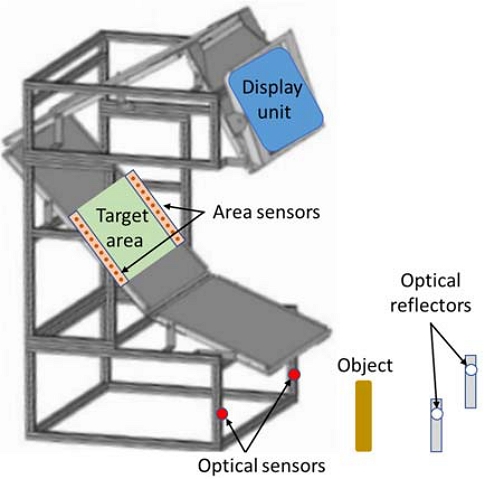
Schematic diagram of the experimental setup
The area sensor was made by Autonics, model BW20-16, with an optical axis pitch of 20 mm and 16 optical axes. It is capable of detecting objects with a diameter of 30 mm or larger. An area sensor registers a ball as “in” when it enters the target zone, and if the next ball also lands in the target zone within a limited time, the score increases. The area sensor operates in pairs: One side transmits an array of laser beams and the other side receives the transmitted signals. When the ball strikes within the array region, the sensor array detects the impact at that location.
The photo sensor, also made by Autonics (model BH4M-PDT) is the mirror-reflective type, with a detection distance of 4 m and a light source wavelength of 660 nm. The photosensor detects an object using light and is employed to determine whether a player’s stroke is a forehand or backhand. Two photosensors are installed on the lower left and right sides of the training machine, configured in a mirror-reflection arrangement where the reflector faces the optical sensor. When no object is present, the reflected light from the reflector is received by the photosensor. When an object appears, the light is blocked, and the sensor no longer receives it.
The initial screen displayed on the display unit is shown in Figure 2. Figure 3 shows a flowchart for Mode 1. The scoring principle in Mode 1, which represents the practice phase, is as follows: When the ball strikes the target area, the installed area sensor detects the signal. If another signal is generated within a time interval shorter than t1 after the first hit, the signal is disregarded. This situation occurs when the ball bounces against adjacent surfaces inside the training machine, creating additional false detections. As the ball bounces across multiple surfaces, such interactions generate randomness in the returned ball trajectory, thereby enabling realistic practice. This approach simulates how the randomness of an incoming ball in an actual tennis rally is influenced by the opponent’s stroke in response to a player’s shot. It also reflects the time delay for a ball returning after being struck on the court.
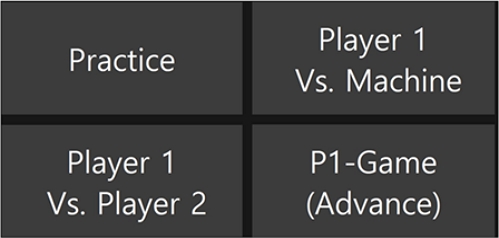
Initial screen of the display unit
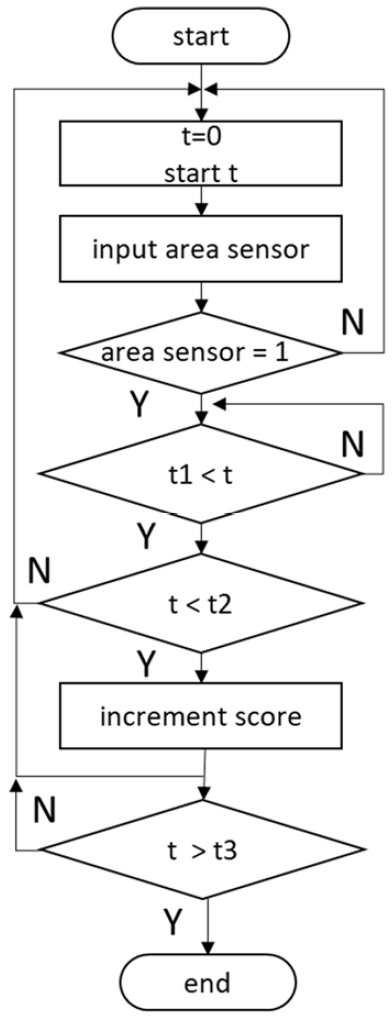
Flowchart for Mode 1
If the next valid hit in the target area occurs within a period of less than t2, the hit count increases by one. If it is equal to or greater than t2, the ball is regarded as “out,” and the attempt resets without increasing the score. This rule corresponds to real tennis, in which the ball struck by the opponent returns within a valid rally time if it arrives before t2. The total operating time of the system is limited by t3. In practice, a player’s shot travels to the opponent’s court and the opponent, influenced by the incoming ball, strikes it back. Depending on the conditions and intention of the opponent, the ball trajectory introduces randomness. By incorporating this property, the training machine enables a more realistic rally practice. This randomness heightens tension and enjoyment and maximizes training efficiency. Continuous rally training under such conditions develops instant incoming-ball response capabilities that can be directly applied to real matches.
Figure 4 shows a flowchart for Mode 2. Mode 2, which represents the phase Player 1 vs. machine practice, is a match mode against the machine. The player first sets a self-determined skill level (l1), and the score is increased using the same principle as in Mode 1. When the number of consecutive valid hits reaches l1, the player’s score increases by one step. If the number falls short of l1, then the machine score increases by one step. Thus, scoring follows the same logic as in an actual tennis match, allowing players to enjoy competition with the machine without a partner.
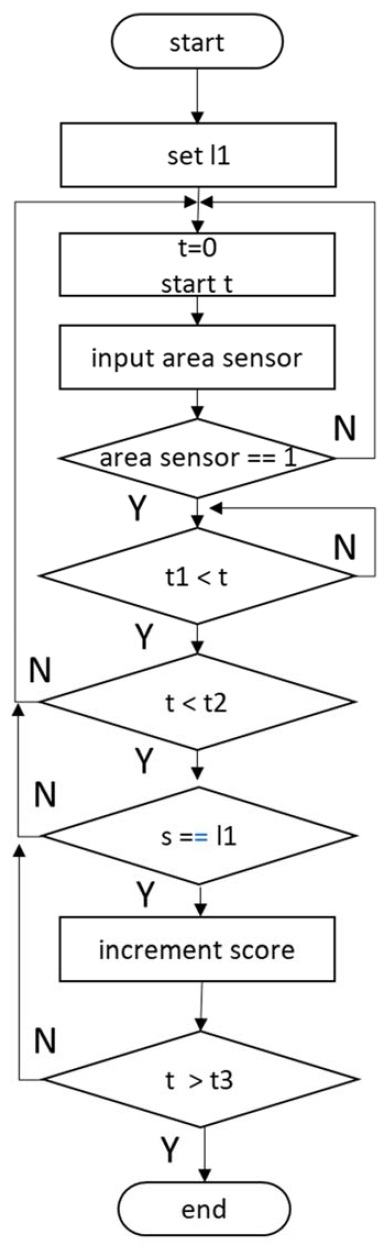
Flowchart for Mode 2
Figure 5 shows a flowchart for Mode 3. Mode 3, which represents the phase Player 1 vs. Player 2, is a head-to-head match mode between the player (m1) and a human opponent (m2), where the players alternate strokes. When it is Player 1’s turn, the player must land the ball in the target within a set time, as in Mode 1; otherwise, the opportunity shifts to Player 2. If Player 2 fails to strike the target within a limited amount of time, Player 1’s score increases. This mode simulates a one-on-one match.
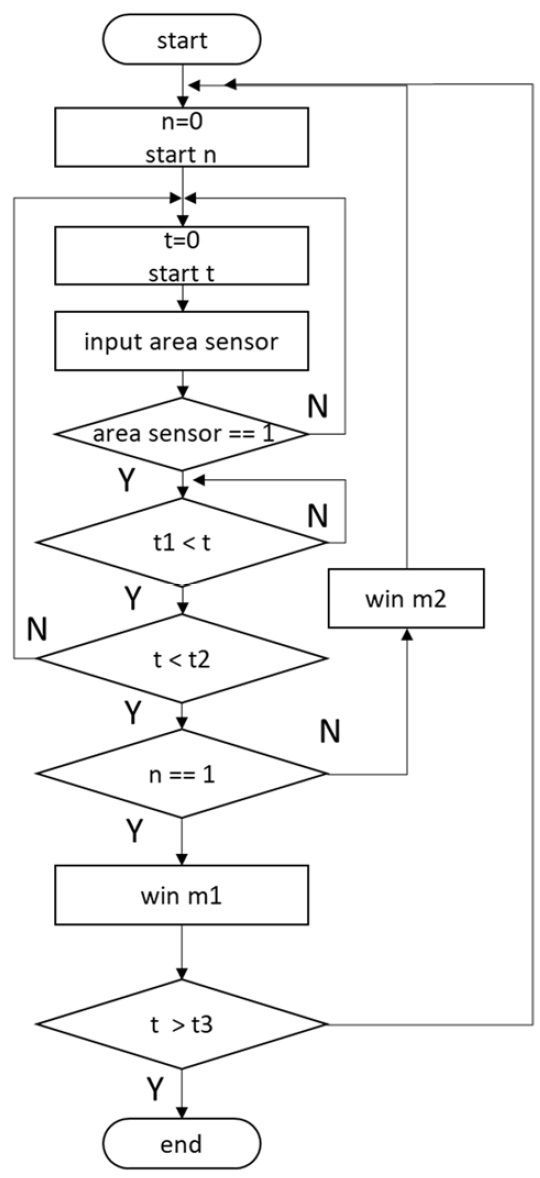
Flowchart for Mode 3
Figure 6 shows a flowchart for Mode 4. Mode 4, which represents the advanced game, is based on Mode 2 but requires additional conditions involving forehand and backhand strokes. The player must respond correctly to predetermined verbal or visual instructions (p1) specifying forehand or backhand, in addition to meeting the preset level l1. The score increases only when both conditions are satisfied.
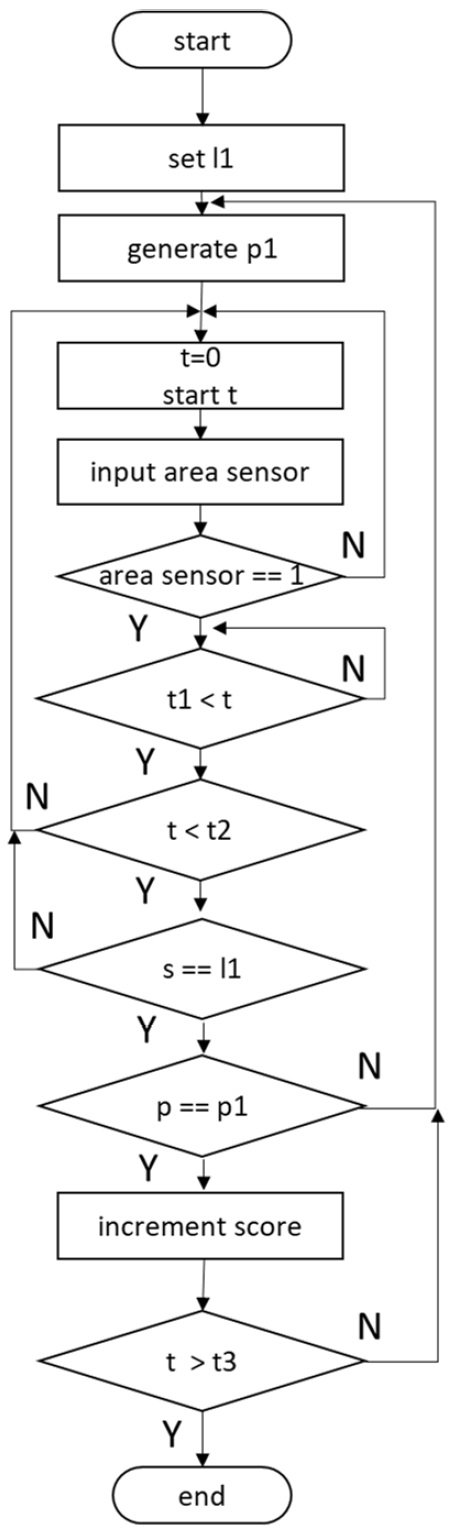
Flowchart for Mode 4
3. Results and Discussion
The system is operated in four modes. In Mode 1, as shown in Figure 7, when the player strikes the ball and it lands in the target area, the score increases. If the ball fails to land in the target area, the hit count resets to zero, and the consecutive rally count restarts. One set consists of 10 trials. After 10 trials, both the total score and best score are displayed before proceeding to the next set. Up to 10 sets can be played in total. The results can be saved and reloaded, if required. By observing the distribution and characteristics of their daily scores, players can assess their current condition. Because their present skill levels are displayed numerically, players can engage in rally training with greater concentration and objectively confirm their progress. This feature provides participants with objective confidence in their abilities. Once players gain confidence in their consecutive rally counts, they can proceed to the next mode.
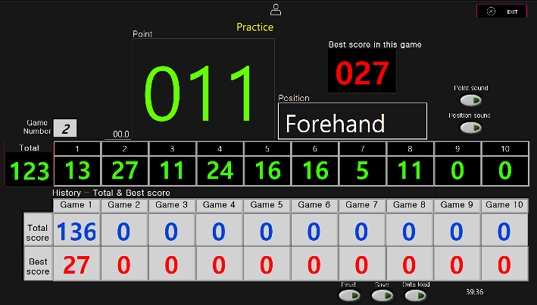
Experimental results conducted in Mode 1
In Mode 2, as shown in Figure 8, players can set their level according to their skill and play against the machine at that level. If the number of consecutive valid hits reaches the pre-set level, the player scores one point. If the number of hits falls short of the level, the machine scores one point. The scoring system follows the same format used in actual tennis. This approach allows players to play tennis games without the difficulty of finding suitable partners. As the matches continue, their skills improve, enabling them to increase their level setting and continue competing with the machine.
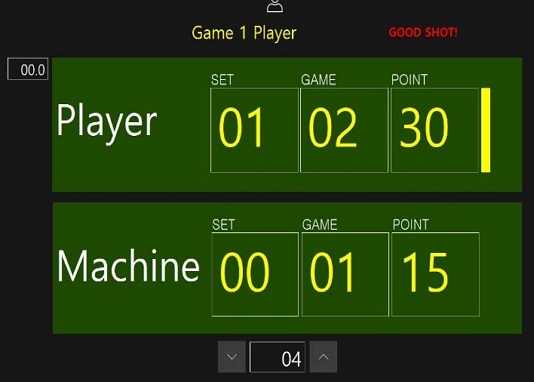
Experimental results conducted in Mode 2
Mode 3, shown in Figure 9, is the competition mode with another player. One player serves to start the rally, and both take turns striking the ball. If the player’s shot misses the target area, the opponent scores one point. Service rights are displayed and when the player’s service period ends, the serve passes to the opponent.
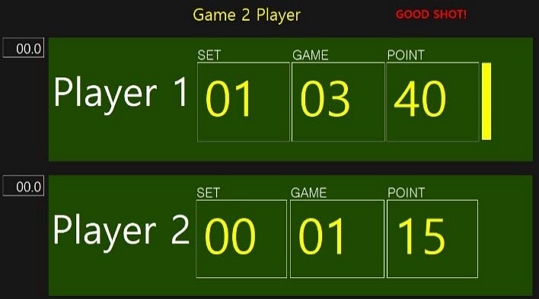
Experimental results conducted in Mode 3
Mode 4, shown in Figure 10, requires players to preset their level and specify either a forehand or backhand stance. Players must position themselves according to the specified stance and strike the ball into the target area for a successful attempt. Both the stance requirement and the target-area hit must be satisfied for the player to score according the preset level. Otherwise, the machine scores. Optical sensors are mounted on the lower left and right sides of the front of the training machine with reflectors placed 4 m ahead. When the left optical sensor fails to receive a signal, the system recognizes a forehand stance. The sensor on the right identifies a backhand stance in the same manner. If the detected stance matches the pre-specified stance, it is considered valid. The score increases when this condition is satisfied and the number of consecutive ball hits on the target area reaches a predefined level. Because both the stance and target-area hit must be satisfied, Mode 4 is more difficult than Mode 2 and requires quicker movements. This requirement makes training more realistic because players must adopt faster postures similar to those required in actual matches.
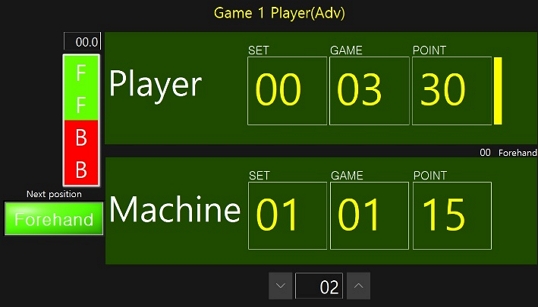
Experimental results conducted in Mode 4
4. Conclusion
To enhance interest in and immersion in a randomly operating tennis training machine, the number of consecutive successful hits that reach the target area is introduced in Mode 1. As this number increases, players recognize their own improvements and gain confidence. Based on this scoring principle, a competition mode against the machine is implemented in Mode 2. After setting their skill level, players earn points when their consecutive hit counts reach that level. In other words, players can improve their tennis skills by competing with machine according to their personal skills. This approach creates an engaging format in which players can challenge themselves without a partner, while reflecting on their current abilities. In addition, Mode 3 implements a match between two players in which each player alternately strikes the ball into the target area. This setup generates complementary excitement between players, allowing both to remain immersed even when there is a skill gap between them. Mode 4 builds upon the characteristics of Mode 2, but requires that, in addition to reaching the preset skill level, players must also meet the forehand or backhand placement requirements specified by the machine. Because players must simultaneously satisfy both their skill level and the machine’s instructions for the stroke type, this mode demands higher concentration and leads to more focused gameplay.
In summary, the proposed system implements competitive training features in which players compete with the machine based on their level, compete alternately with other players, or compete with the machine while meeting specified positional requirements. This system is expected to significantly aid players in adapting their skills to real matching situations on the tennis court.
Acknowledgments
This research was supported by the Korea Institute of Machinery and Materials under Ministry of Science and ICT [KN033E].
Author Contributions
Conceptualization, P. W. Heo.; Methodology, P. W. Heo.; Software, P. W. Heo.; Formal Analysis, P. W. Heo.; Investigation, P. W. Heo.; Resources, P. W. Heo.; Data Curation P. W. Heo.; Writing-Original Draft Preparation, P. W. Heo.; Writing-Review & Editing, P. W. Heo.; Visualization, P. W. Heo.; Supervision, P. W. Heo.; Project Administration, P. W. Heo.; Funding Acquisition, P. W. Heo.
References
-
P. Schnohr, J. H. O’Keefe, A. Holtermann, C. J. Lavie, P. Lange, G. B. Jensen, and J. L. Marott, “Various leisure-time physical activities associated with widely divergent life expectancies: the Copenhagen city heart study,” Mayo Clinic Proceedings, vol. 93, no. 12, pp. 1775-1785, 2018.
[https://doi.org/10.1016/j.mayocp.2018.06.025]

- T. Sangkaew, K. Phongsri, W. Khamros, N. I. Mohamad, and S. Sriramatr, “Analysis of ball speed and accuracy of groundstrokes on a clay court in young tennis players,” Journal of Physical Education and Sport, vol. 24, no. 7, pp. 1788-1794, 2024.
-
A. Dabbous, M. Fresta, F. Bellotti, and R. Berta, “Arduino nano-based system for tennis shot classification,” Lectures Notes in Electrical Engineering, pp. 357-362, 2024.
[https://doi.org/10.1007/978-3-031-48711-8_43]
-
P. Shiralagi, R. Bhandary, and B. Rajeshwari, “A novel approach to tennis game analysis and emulation using computer vision,” Proceedings of the 2020 IEEE International Conference on Communication and Signal Processing, pp. 286-292, 2020.
[https://doi.org/10.1109/ICCSP48568.2020.9182453]
-
P. W. Heo, “Multi-directional random ball generator based on impact characteristics without inter-frame interface,” Journal of Advanced Marine Engineering and Technology, vol. 48, no. 6, pp. 438-443, 2024.
[https://doi.org/10.5916/jamet.2024.48.6.438]