
1D AMESIM model development of ship mechanical injector with input flow rate

Copyright © The Korean Society of Marine Engineering
This is an Open Access article distributed under the terms of the Creative Commons Attribution Non-Commercial License (http://creativecommons.org/licenses/by-nc/3.0), which permits unrestricted non-commercial use, distribution, and reproduction in any medium, provided the original work is properly cited.
Abstract
The development of simulation models for ship subsystems currently plays a crucial role in reducing costs and time. One of the important subsystems in the maritime industry is the injector. The injectors used on ships are mechanical injectors. This study presents the development of a simulation model for a mechanical diesel injector, a critical subsystem in maritime engineering. The model was constructed using Siemens' AMESIM software, incorporating geometric and parameter data derived from technical drawings provided by the manufacturing company. Diesel fuel was used as the working fluid, and flow rate served as the input to simulate the pump action that triggers injection. The model's performance was evaluated based on three key parameters: injected flow rate, injected volume, and needle lift. Simulation results demonstrated that the model accurately replicates the expected behavior of the mechanical injector, indicating its potential as a valuable tool for optimizing injector design and performance in marine applications.
Keywords:
AMESIM, 1D model, Simulation, Mechanical Injector, Flow rate1. Introduction
In maritime engineering, the pursuit of efficient and cost-effective fuel injection systems is paramount for optimizing engine performance and reducing operational costs. Mechanical injectors, which operate based on fluid dynamics without relying on electronic controls, are particularly prevalent in marine applications due to their robustness and simplicity. These injectors are actuated by the pressure and flow of fuel, making their performance highly dependent on the hydraulic characteristics of the system.
To analyze and optimize the performance of mechanical injectors, simulation tools that can accurately model hydraulic and mechanical interactions are essential. Simcenter Amesim, developed by Siemens Digital Industries Software, is a multi-domain simulation platform widely used for modeling complex engineering systems, including fuel injection mechanisms.
Previous studies have demonstrated the effectiveness of using Simcenter Amesim for simulating fuel injection systems. One of them is [1] which introduces an adiabatic one-dimensional model to Simulate the dynamic changes of ballistic injector’s fuel temperature, challenging the traditional isothermal assumption. The findings suggest that while heat transfer between the fuel and injector walls occurs, the adiabatic assumption remains valid during steady-state injection, provided initial temperature differences at the injector inlet are considered. Then they continue the research to validate the simulation model by [2].
Some properties like fuel density and viscosity cannot individual varied under real operating conditions, a AMESim model was developed to study the effect of these properties on injection rate. This study determined that fuel viscosity give greater impact on injection rate than fuel density, primarily due to its broader variation range and its dual impact on both hydraulic and frictional forces. Higher viscosities cause the greater driving force of total driving force. The contribution of viscous friction accounted for as much as roughly 12% of the total driving force [3].
This study uses methodological and behavioral sensitivity study of a 1D mechanical injector model using controlled flow excitation, intended as a preliminary virtual prototyping framework. In this study, flow rate is applied as the direct excitation input to isolate the injector’s internal hydraulic–mechanical response from upstream pump dynamics. While real mechanical injectors are pressure-driven, the use of flow-rate input allows controlled investigation of injector behavior under predefined fuel delivery conditions. This modeling choice represents a simplification and is acknowledged as a limitation of the present work.
Unlike previous AMESIM-based injector studies that focus primarily on solenoid-controlled injectors or parameter sensitivity under fixed excitation, this work emphasizes the behavioral response of a mechanical injector model to systematically varied flow-rate shapes and durations. The study highlights how input profile design influences injection stability, needle dynamics, and multi-injection behavior. This provides practical insight for early-stage virtual prototyping of mechanical injectors in marine applications, where electronic control is limited.
2. Material and Methods
2.1 AMESIM Model
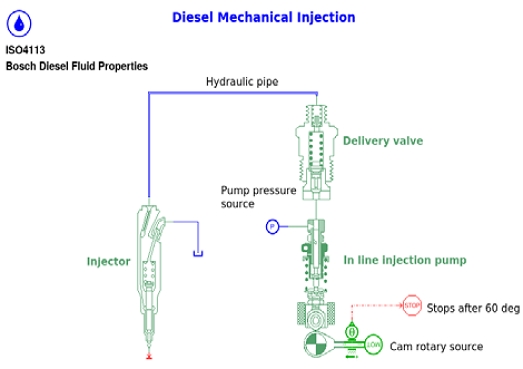
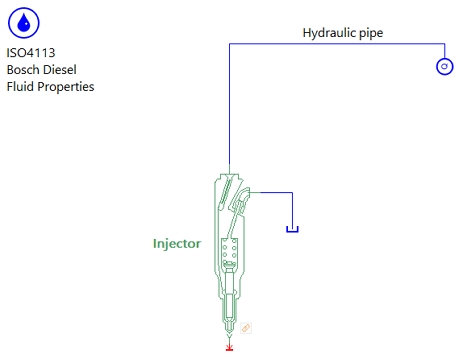
This study focuses on developing the model based on demo file of mechanical injector on AMESIM software. In its development, the demo file was modified by replacing the input section, which previously consisted of a pump and delivery valve, with a flow source component. Additionally, we updated the dimensions using measurements obtained from the company's technical drawings. Figure 1 illustrates the original mechanical injector demo file, while Figure 2 shows the modified mechanical injector.
Demo file Mechanical Injector Model
Modified Mechanical Injector Model
Figure 1 presents the original AMESIM demo model of a mechanical diesel injector, which serves as the baseline configuration for this study. The figure illustrates the default structure provided by the software, consisting of generic hydraulic, mechanical, and leakage components. This model includes a simplified representation of the needle, spring, piston, and nozzle, enabling users to explore basic injection behavior prior to incorporating real-world geometry or parameter modifications.
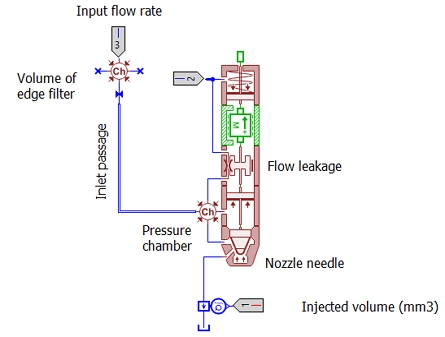
This mechanical injector model comprises five main components: the spring part, mass part, flow leakage part, piston part, and nozzle part. The spring part simulates the behavior of the injector's spring. The mass part restricts the movement of the spring. The flow leakage part represents potential leakages within the injector. The piston part models the piston's movement, and the nozzle part simulates the behavior of the injected fluid. Figure 3 provides detailed visuals of the developed model.
Detailed Mechanical Injector Model
The simulation utilized BOSCH diesel fluid, specifically type ISO 4113, with its properties detailed in Table 1.

BOSCH Diesel Fluid Properties
Not all parameters in the demo file were modified; some values remained at their default settings. Parameters that were adjusted during the model's development include those related to the spring part, flow leakage part, piston part, and nozzle part. Table 2 presents the parameters that were altered in this model development.
Changed Parameter
2.2 Simulation Procedure
The simulation was conducted by varying the input flow rate while maintaining constant pressure and using the same type of fluid. In this simulation, several strategies were implemented concerning flow rate conditions. Specifically, the flow rate was structured into four-stage and five-stage profiles. Additionally, the duration of each stage was varied to identify the most effective strategy for evaluating the developed model. Table 3 presents the parameters used in the simulation.
Simulation Conditions
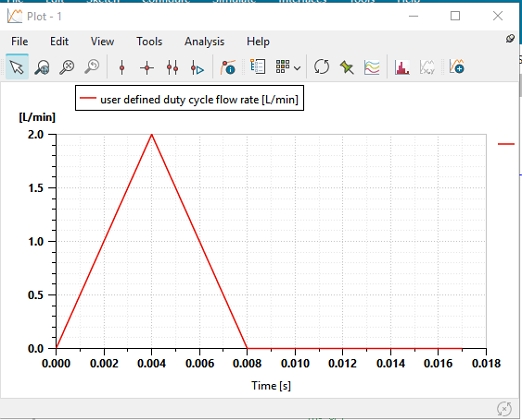
The simulation was conducted using three flow rate values to create a triangular-shaped input flow profile. Additionally, four flow rate values were employed to generate a trapezoidal-shaped profile. The output observed from these input flow rates included the injected flow rate, injected volume, and needle lift. Figure 4 shows the triangular-shaped flow rate and Figure 5 shows the non-triangular input flow rate.
Figure 4 depicts the triangular flow-rate input profile employed in one of the simulation strategies. This profile features a gradual increase, peak, and symmetric decrease in flow rate, promoting a controlled pressure rise within the injector. The shape is intended to produce a single, clean injection event and to minimize undesirable needle oscillations, thereby enabling evaluation of injector behavior under smooth excitation.
Triangular shape input Flow rate
Figure 5 illustrates the trapezoidal input flow-rate profile, characterized by a rapid rise, a constant high-flow plateau, and a subsequent decline. The extended high-flow interval introduces sustained hydraulic force acting on the needle, which may enhance injection duration but also increases the risk of needle rebound or secondary injections. This profile serves to assess injector performance under more aggressive excitation conditions.
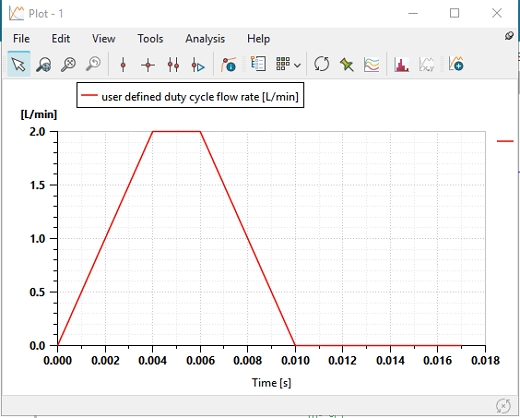
Trapezoidal Shape input Flow rate
To avoid ambiguity, Table X summarizes all simulated input flow-rate profiles and durations used in this study. Each simulation case is uniquely defined by its flow-rate magnitude, profile shape, and stage duration.
3. Result
The simulation was conducted five times, incorporating variations in stage duration, input flow rate, and the shape of the input flow rate profile. The output observed in this simulation was the injected rate, needle lift, and injected volume. The result is qualitatively compared by other injection process from previous research about the solenoid diesel injector [3]. In this preliminary study, no experiment validation needed because this study focuses on developing preliminary model of mechanical injector. This study also focuses on flowrate input instead of pressure input.
To avoid ambiguity, Table 3 summarizes all simulated input flow-rate profiles and durations used in this study. Each simulation case is uniquely defined by its flow-rate magnitude, profile shape, and stage duration.
caption needed!
3.1 Input Flow Rate at 1,2,1 L/m and Duration of Stage 0.002s
In this simulation, a triangular input flowrate profile was implemented using three stages with flowrates of 1, 2, and 1 L/min, each lasting 0.002 seconds. This configuration is depicted in Figure 6. The simulation results demonstrated an injection process aligning with expected performance, yielding an injected flowrate ranging from 3.5 to 4.5 L/min. The total injected volume achieved was 90 × 10⁻⁶ liters, with the needle lift varying between 108 × 10⁻⁶ meters and 140 × 10⁻⁶ meters. Figures 7, 8, and 9 illustrate the performance outcomes of this scenario.
The predicted needle lift magnitude (on the order of 100–200 μm) is smaller than values typically reported for full-scale mechanical injectors. This discrepancy arises from the simplified 1D representation, parameter scaling inherited from the demo model, and the absence of full pump pressure dynamics. Therefore, absolute lift values are not interpreted quantitatively; instead, relative trends and dynamic behavior are emphasized.
In Figure 6, The triangular flow-rate sequence (1–2–1 L/min), each stage lasting 0.002 s, used in Scenario 3.1 presented in figure 6. The profile provides a short, symmetrical excitation that enables a single, well-defined injection pulse. This configuration is designed to serve as a benchmark for evaluating stable needle motion under moderate hydraulic loading.
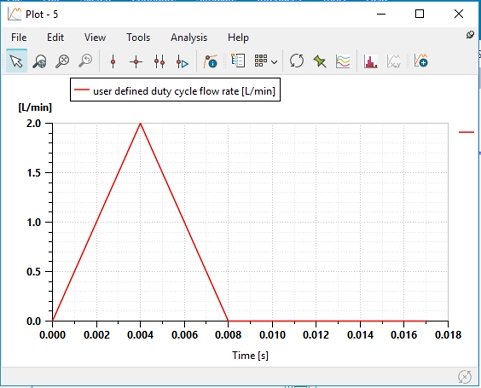
Input Flowrate
Figure 7 shows the injected flow-rate response corresponding to the 1–2–1 L/min input. The output curve exhibits a single, smooth injection pulse with a peak between 3.5 and 4.5 L/min, indicating that the needle opens and closes cleanly without secondary oscillations. The behavior confirms that the triangular excitation produces a stable and predictable injection event.
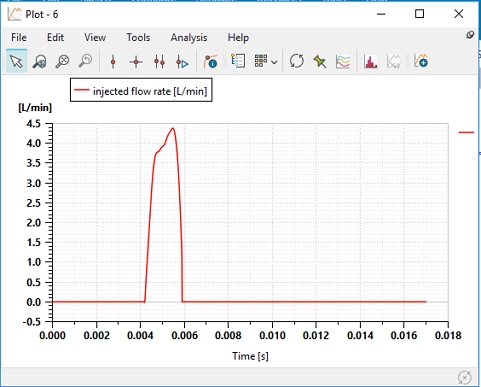
Injected Flowrate
Figure 8 displays the cumulative injected volume for Scenario 3.1. The monotonic rise to approximately 90 × 10⁻⁶ L, followed by a plateau, reflects a single, continuous injection period. This figure demonstrates that the selected input profile delivers controlled fuel quantity without producing additional unintended injections.
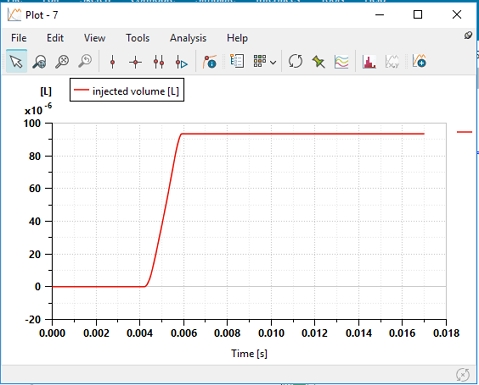
Injected Volume
Figure 9 illustrates the needle-lift trajectory associated with Scenario 3.1. The needle rises smoothly to approximately 108–140 µm before closing, confirming a stable mechanical response. The absence of oscillatory behavior indicates that the hydraulic force and spring characteristics interact in a balanced manner under this excitation profile.
Needle lift
3.2 Input Flow Rate at 1,3,1 L/m and Duration of Stage 0.002s
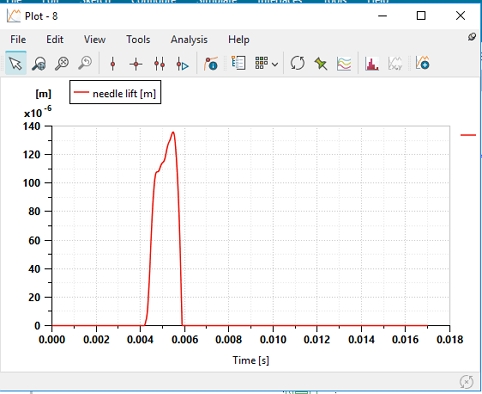
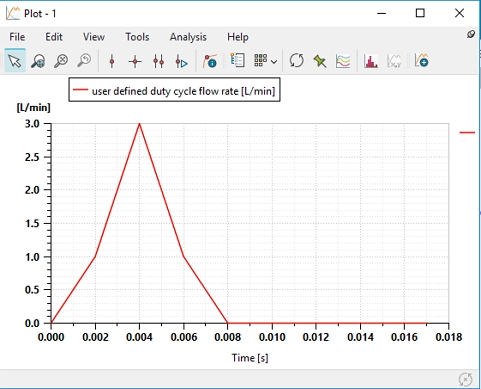
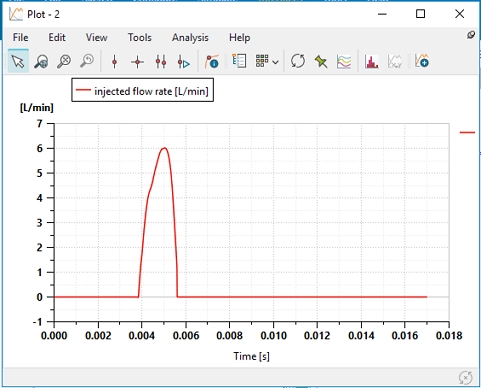
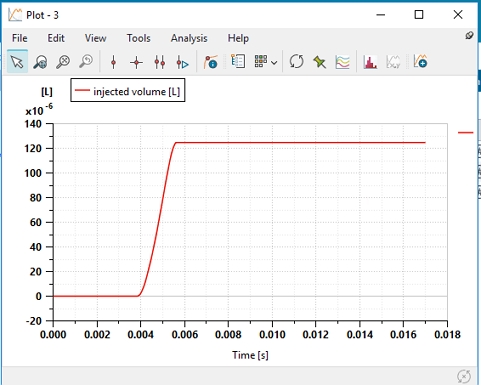
In this simulation, a non-triangular input flowrate profile was implemented using three stages with flowrates of 1, 3, and 1 L/min, each lasting 0.002 seconds. This configuration is depicted in Figure 6. The simulation results demonstrated an injection process aligning with expected performance, yielding an injected flowrate ranging from 4 to 6 L/min. The total injected volume achieved was 130 × 10⁻⁶ liters, with the needle lift varying between 210 × 10⁻⁶ meters and 140 × 10⁻⁶ meters. Figures 10, 11, and 12 illustrate the performance outcomes of this scenario.
Figure 10 presents the non-triangular input flow-rate profile used in Scenario 3.2, featuring a higher peak flow of 3 L/min. This increased hydraulic forcing enables assessment of injector sensitivity to more energetic input conditions while maintaining the same short duration as Scenario 3.1.
Input Flowrate
Figure 11 shows the injected flow rate resulting from the 1–3–1 L/min input. The peak output rises to approximately 4–6 L/min, demonstrating the stronger hydraulic actuation produced by the elevated flowrate. The signal remains smooth, indicating that the injector continues to operate within stable limits.
Injected Flowrate
Figure 12 illustrates the cumulative injected volume for Scenario 3.2, which increases to approximately 130 × 10⁻⁶ L. The higher total delivery reflects the increased peak flow. The absence of abrupt volume increments indicates that only a single injection event occurs.
Injected Volume
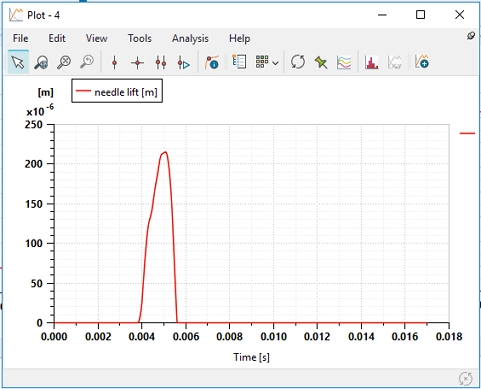
Figure 13 presents the needle-lift response for Scenario 3.2, with maximum lift reaching approximately 210 µm. The increased lift height corresponds to the stronger hydraulic force. Despite the higher excitation, the lift curve remains stable, confirming that the needle motion stays within a physically realistic operating regime.
Needle lift
3.3 Input Flow Rate at 3,5,3 L/m and Duration of Stage 0.002s
In this simulation, a non-triangular input flowrate profile was implemented using three stages with flowrates of 1, 2, and 1 L/min, each lasting 0.002 seconds. This configuration is depicted in Figure 6. The simulation results demonstrated an injection process but the injection performance was not as effective as in the previous case.
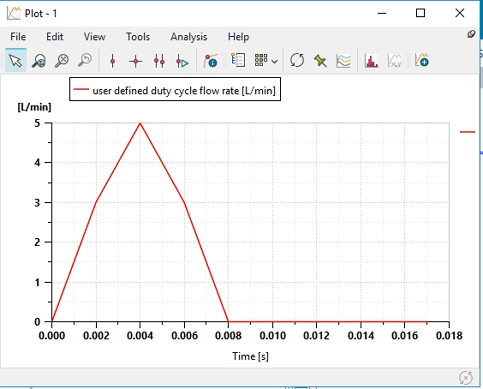
Figure 14 displays a more aggressive flow-rate profile, with a peak of 5 L/min. This input represents extreme operating conditions and is used to examine the injector’s mechanical limitations and susceptibility to instability under high hydraulic loading.
Input Flowrate
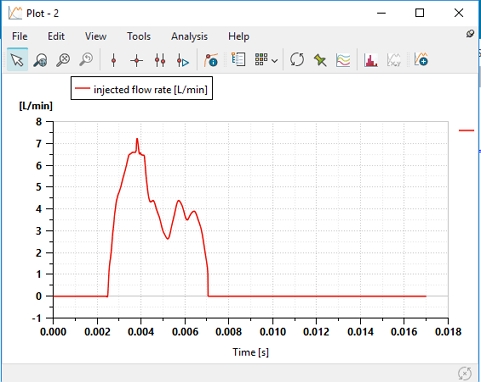
Figure 15 shows the injected flow-rate output for Scenario 3.3. The resulting curve becomes less smooth and exhibits irregularities, indicating degradation of injection stability. The excessive hydraulic force begins to produce nonlinear needle behavior and reduced control over injection timing.
Injected Flowrate
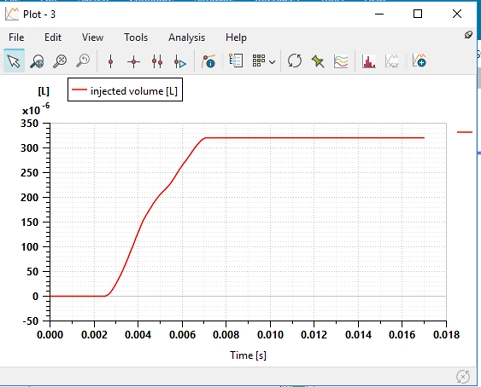
Figure 16 presents the injected-volume response under high-flow conditions. Despite the elevated input energy, the cumulative volume increases less effectively than in Scenario 3.2, highlighting the onset of inefficiency and unstable hydraulic–mechanical interaction.
Injected Volume
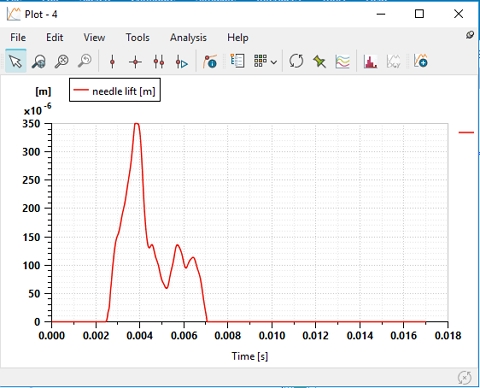
Figure 17 illustrates the needle lift under the 3–5–3 L/min input. The lift amplitude becomes irregular and fails to reach values consistent with the applied flowrate, indicating mechanical oscillation and loss of stable needle motion. This confirms that the injector cannot maintain proper operation at this excitation level.
Needle lift
3.4 Input Flow Rate at 1,3,1 L/m and Duration of Stage 0.02s
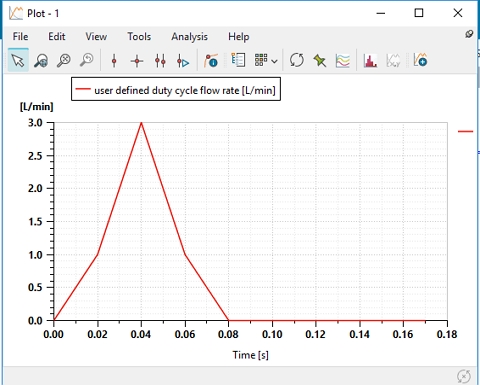
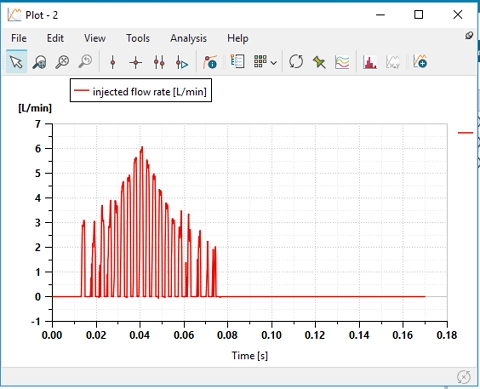
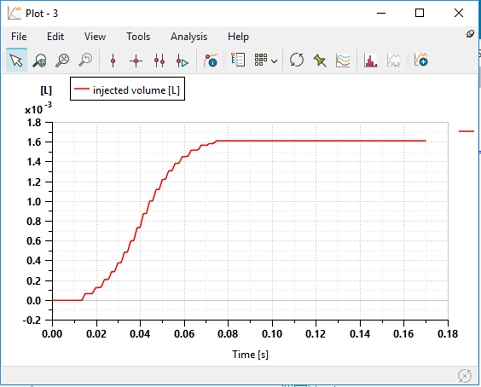
In this simulation, a triangular input flowrate profile was implemented using three stages with flowrates of 1, 2, and 1 L/min, each lasting 0.002 seconds. This configuration is depicted in Figure 18. The simulation results demonstrated an injection process but there are several time injection processes in this scenario.
Input Flowrate
Figure 18 presents the 1–3–1 L/min input profile with an extended stage duration of 0.02 s. The longer high-flow interval imposes sustained hydraulic loading on the injector, enabling assessment of how prolonged excitation influences needle dynamics.
Figure 19 shows that the prolonged excitation induces multiple needle openings and closings. The oscillatory pattern indicates dynamic instability and suggests that long-duration pressure application leads to resonance-like behavior in the needle–spring system.
Injected flowrate
Figure 20 presents the cumulative injected volume for Scenario 3.4, exhibiting step-like increments corresponding to multiple unintended injection events. This behavior confirms that extended excitation causes repeated needle reactivation, reducing injection controllability.
Injected Volume
Figure 21 illustrates the combined injection response under long-duration excitation, showing multiple peaks consistent with repeated needle lift events. The figure reinforces that prolonged flow application disrupts the injector’s ability to produce a single, stable injection pulse. Input flow rate at 1,2,2,1 L/m and duration of stage 0.002s.
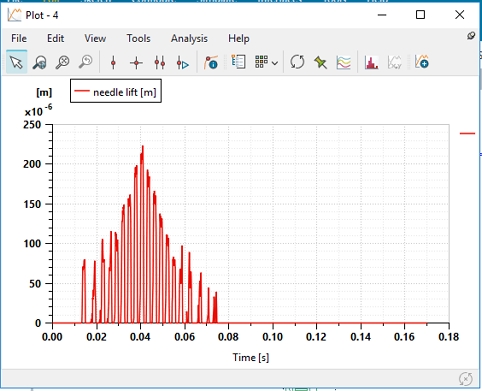
Needle lift
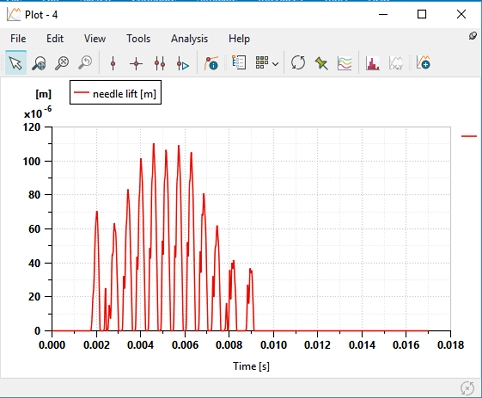
In this simulation, a triangular flowrate profile was implemented using four stages with flowrates of 1, 2, 2 and 1 L/min, each lasting 0.002 seconds. This configuration is depicted in Figure 22. The simulation results demonstrated the injection performance was not as effective as the other profile. The result is shown in Figure 23, 24, 25.
Figure 22 depicts the four-stage flow-rate profile (1–2–2–1 L/min), creating a trapezoidal excitation with an extended plateau at 2 L/min. This profile is used to evaluate the injector’s sensitivity to sustained mid-level hydraulic forcing.
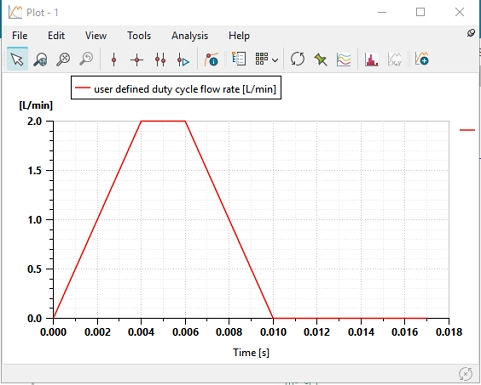
Input Flowrate
Figure 23 shows the injected flow-rate output for Scenario 3.5, where the signal becomes irregular and exhibits multiple pulses. The extended plateau induces needle oscillation, preventing formation of a single, coherent injection event.
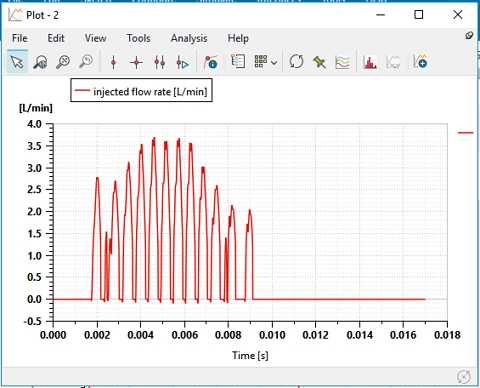
Injected Flowrate
Figure 24 displays the cumulative injected volume for the four-stage profile, showing a series of discrete steps rather than a continuous rise. These steps correspond to repeated unintended injection events caused by needle instability during the sustained plateau phase.
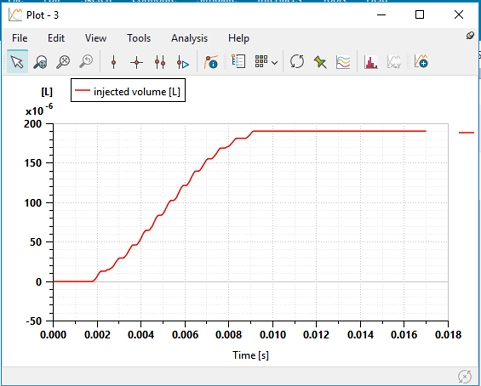
Injected Volume
Figure 25 presents the needle-lift response, illustrating multiple lift cycles that occur during the trapezoidal input profile. The repeated peaks indicate significant mechanical oscillation and highlight the limitations of the injector under prolonged or plateau-type hydraulic excitation.
Needle lift
Based on the five simulation scenarios applied to the mechanical injector model, it was found that two scenarios were suitable for application, while the remaining three did not yield optimal performance. The less effective scenarios were primarily influenced by the input flowrate values and the duration of each stage in the input flowrate profile. Higher input flowrates led to repeated injection processes, and longer stage durations resulted in multiple injection events. Among the tested profiles, the triangular-shaped input flowrate demonstrated better performance compared to the trapezoidal-shaped profile. The trapezoidal profile caused multiple injection events within a relatively short time frame, indicating less efficient performance.
The shape of the input pressure profile significantly influences the injection behavior in a mechanical injector. A slow-rising pressure profile (slow ramp) causes the nozzle to open more gradually, which can delay the start of injection and result in a shorter overall injection duration. In contrast, a pressure profile with oscillations or sudden spikes can lead to unstable needle movement. This may cause the needle to open and close multiple times during a single injection event, leading to multiple injections, which are undesirable in most combustion systems. Furthermore, if the input flow rate is too high, the excessive force may push the needle open too quickly, resulting in an uncontrolled injection process. This can cause harsh injection characteristics or even fuel leakage due to incomplete needle sealing. Therefore, careful control of the input pressure profile is crucial to ensure stable, accurate, and efficient fuel injection performance.
The multi-injection process occurs due to the mechanical injector model being built with parameters predefined by the manufacturer, resulting in limitations when handling certain input profiles. One contributing factor is that the spring and nozzle needle components have specific mass and stiffness. If the system experiences mechanical resonance, the needle may oscillate, leading to uncontrolled opening and closing.
Therefore, selecting an appropriate input shape is crucial for optimizing injector performance and achieving desired combustion characteristics.
The occurrence of multiple injection events under trapezoidal and long-duration input profiles can be explained by the dynamic interaction between needle mass, spring stiffness, and sustained hydraulic force. When the excitation duration exceeds the mechanical damping capability of the system, repeated opening and closing cycles may occur. Similar oscillatory behavior in injector needle dynamics has been reported in prior numerical studies [ref]. Although a full frequency-domain analysis is beyond the scope of this work, the observed behavior is consistent with mass–spring system response under prolonged forcing.
4. Conclusion
In this study, the construction and performance of 1D AMESIM mechanical injector was analyzed. The optimal input flow rate was found 1,3,1 L/m. Moreover, the duration of the input flow rate also affects the performance of mechanical injectors. The duration that gives best result is 0.002s. The triangle shaped input flow rate is the best strategy for this model. The model can simulate the injection process of mechanical injector.
Acknowledgments
This work was supported by the National Research Foundation Korea(NRF) grant funded by the Korea government(MSIT) (No. RS-2023-00281590).
This result was supported by the "Regional Innovation System & Education (RISE)" through the Ulsan RISE Center, funded by the Ministry of Education (MOE) and the Ulsan Metropolitan City, Republic of Korea.(2025-RISE-07-001)
Author Contributions
Conceptualization, F. R. Dwi, O. LIm; Methodology F. R. Dwi, O. LIm; Software, F. R. Dwi; Formal Analysis, F. R. Dwi; Investigation, F. R. Dwi; Resources, S. Lee, M. Kim; Data Curation, S. Lee, O. LIm; Writing-Original Draft Preparation, F. R. Dwi; Writing-Review & Editing, F. R. Dwi, O. LIm; Visualization, F. R. Dwi, S. Lee; Supervision, O. LIm; Project Administration, M. Kim; Funding Acquisition, O. LIm.
References
-
F. J. Salvador, J. Gimeno, J. Martín, and M. Carreres, “Thermal effects on the diesel injector performance through adiabatic 1D modelling. Part I: Model description and assessment of the adiabatic flow hypothesis,” Fuel, vol. 260, 116348, 2020.
[https://doi.org/10.1016/j.fuel.2019.116348]

-
R. Payri, F. J. Salvador, M. Carreres, and M. Belmar-Gil, “Thermal effects on the diesel injector performance through adiabatic 1D modelling. Part II: Model validation, results of the simulations and discussion,” Fuel, vol. 260, 115663, 2020.
[https://doi.org/10.1016/j.fuel.2019.115663]
-
J. Kim, J. Lee, and K. Kim, “Numerical study on the effects of fuel viscosity and density on the injection rate performance of a solenoid diesel injector based on AMESim,” Fuel, vol. 256, 115912, 2019.
[https://doi.org/10.1016/j.fuel.2019.115912]