
Process design of multi-stage hot forging for manufacturing tripod housing

Copyright © The Korean Society of Marine Engineering
This is an Open Access article distributed under the terms of the Creative Commons Attribution Non-Commercial License (http://creativecommons.org/licenses/by-nc/3.0), which permits unrestricted non-commercial use, distribution, and reproduction in any medium, provided the original work is properly cited.
Abstract
In this study, we develop a multi-stage hot forging process to manufacture a weldless single-piece tripod housing. This multi-stage hot forging process consists of forward extrusion, blocker, and finishing stages. The thermo-mechanical three-dimensional finite element (FE) analysis is used to develop the overall manufacturing technology. This involved determining the shapes of the initial material and preform, as well as designing the blocker, finisher, and sizing die sets. The validity of the proposed hot forging process design was confirmed through hot forging experiments conducted on S45C billets. Quality assurance was then performed through prototype tests to assess the dimensional accuracy, hardness, and tensile strength of the hot-forged tripod housing. The results demonstrate that the tripod housing exhibits excellent mechanical and material properties, making it suitable for industrial applications.
Keywords:
Tripod housing, Multi-stage hot forging process, Finite element analysis, Process design1. Introduction
A constant-velocity(CV) joint assembly is a crucial component used primarily in the axles of front-wheel-drive or four-wheel-drive vehicles. Its main function is to transfer power from the engine to the vehicle's wheels, enabling the car to operate smoothly at a constant speed. As illustrated in Figure 1 below, the CV joint assembly consists of an outer racer, an inner racer, a cage, a tulip shaft, a spider, and a tripod housing.
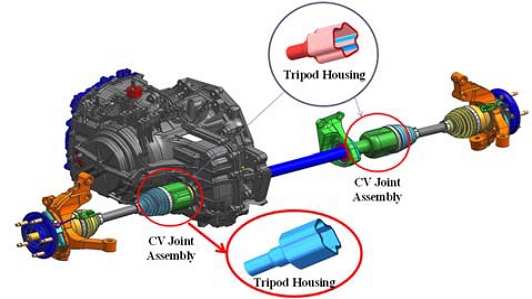
Exploded view of constant velocity joint assembly
Tripod housings have intricate geometries, require high precision, and involve multi-step forming processes, which result in extensive manufacturing costs. Therefore, there is ongoing research aimed at producing forging shapes that closely resemble the final product. In domestic manufacturing, most tripod housings are currently made through a combination of cold forging and welding. Alternatively, they can be manufactured as a single piece using a warm forging process. However, this multi-step approach demands significant development costs and time to achieve an almost perfect final shape [1]-[6].
The typical process for manufacturing the tripod housing, which is part of the CV joint assembly, is illustrated in Figures 2 and 3. The conventional cold forging process includes four cold working stages, four heat treatment stages(annealing and normalizing), and a final cold sizing process. The traditional warm forging process involves several stages: a first forward extrusion, a second forward extrusion, an upsetting, a backward extrusion, and a fifth cold sizing process to produce the tripod housing.
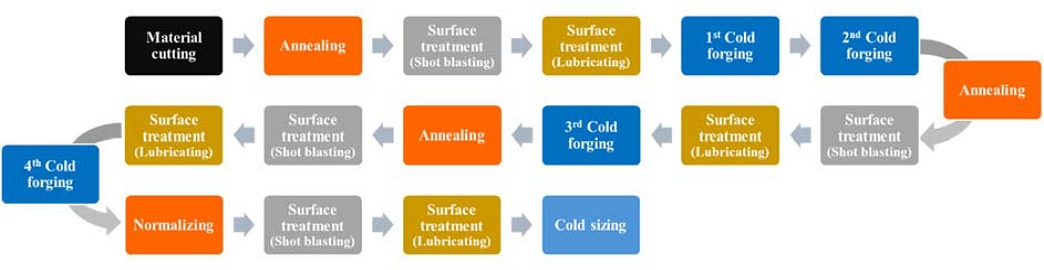
Conventional cold forging process for manufacturing tripod housings, consisting of 18 stages

Conventional warm forging process for manufacturing tripod housings, consisting of 13 stages
Both the conventional cold forging and warm forging methods require high-capacity, high-precision, and expensive press equipment, which leads to significant die development costs. Additionally, the multiple cold forging steps and required annealing heat treatments contribute to high development costs and extended timeframes, further increasing overall manufacturing expenses.
In contrast, the manufacturing process developed in this study, including the first, second, and third hot forging operations (forward extrusion, blocker, and finisher), followed by final cold sizing, significantly reduces the number of steps involved. This approach shortens development time and minimizes die development costs, as illustrated in Figure 4. The reduced manufacturing cycle time also leads to shorter delivery times, maximizing cost savings and ensuring high economic efficiency, even with low production volumes.
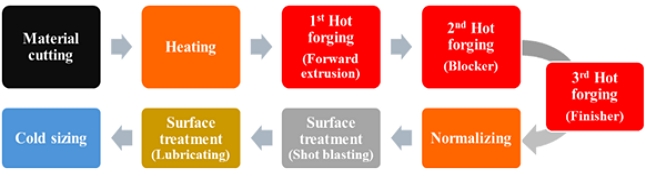
Developed hot forging process for manufacturing tripod housings, consisting of 9 stages
This study was conducted to design a hot forging die and process for manufacturing weldless, single-piece CV joint tripod housings. Through 3D finite element (FE) analysis, the overall manufacturing process technology was developed. This included determining the shape of the initial material and preform, as well as designing the blocker, and finisher die set. The validity of the proposed hot forging die design was confirmed through hot forging experiments conducted with S45C billets. Quality assurance was subsequently carried out through prototype tests for Vickers hardness, tensile strength, austenite grain size, and dimensional accuracy
2. FE-analysis of Multi-stage Hot Forging Process
2.1 Hot Compression Test
The material used for the tripod housing in this study is S45C. The mechanical properties of S45C are illustrated in Figure 5. Hot compression tests were conducted using a Gleeble machine to examine S45C. Taking into account the temperature drop, strain, and strain rate during the hot forging process, the test temperatures varied from 600°C to 1000°C, with the strain rates ranging from 1 s-1 to 10 s-1.
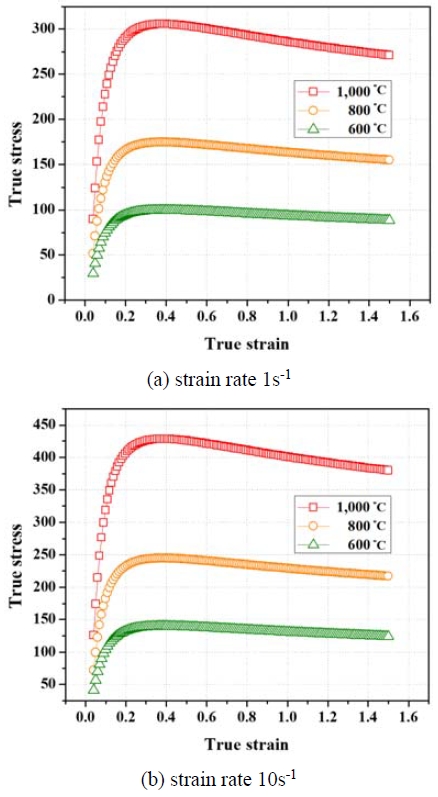
Stress-strain curves of S45C under various strain rates and temperatures (unit: MPa)
2.2 Conceptual Layout Design for Hot Forging Process
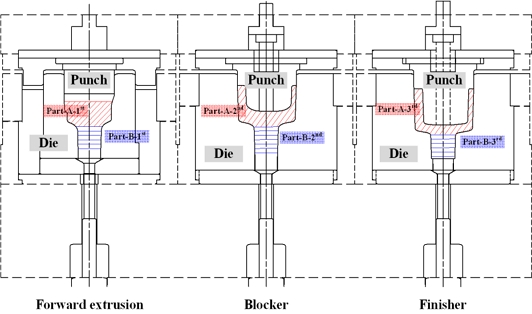
Figure 6 depicts the conceptual layout of the hot forging process. Initially, a cylindrical billet is heated and then undergoes several stages: forward extrusion, blocker, and finisher process. These stages combine to produce the weld-less, single-piece CV joint tripod housing. After these processes, a cold sizing operation is performed to enhance the dimensional accuracy of the final prototype. The objectives of each stage in the hot forging process are as follows:
Layout design of multi-stage hot forging process
- ① Forward extrusion: This stage involves descaling heated material, ensuring that inclined cut surfaces remain flat, facilitating easy positioning of billets for subsequent processes, distributing material volume evenly, and extending the lifespan of the tool.
- ② Blocker: This stage serves as an intermediate deformation process that helps prevent defects in the finisher stage, ensuring dimensional accuracy and extended tool life
- ③ Finisher: This stage focuses on ensuring the quality of the final product
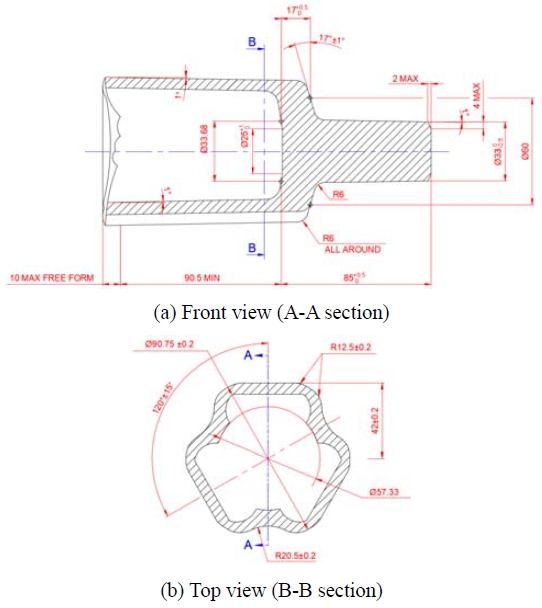
The design diagram for the product to be manufactured in a real industrial setting is shown in Figure 7. The primary objective of the tripod housing process design is to minimize the production of unformed parts after the final stage, thereby eliminating the need for post-machining operations. Additionally, potential challenges in the hot forging of tripod housing in actual industrial environments include unformed parts at the end of the cup section, defects in the cup's cross-sectional shape, and inadequate press capacity. Consequently, the design was focused on addressing these issues. It is also important to note that, given the actual press conditions, the maximum usable press capacity was capped at 1,600 tons.
Shape and dimensions of tripod housing (unit: mm)
2.3 Conditions of FE-analysis
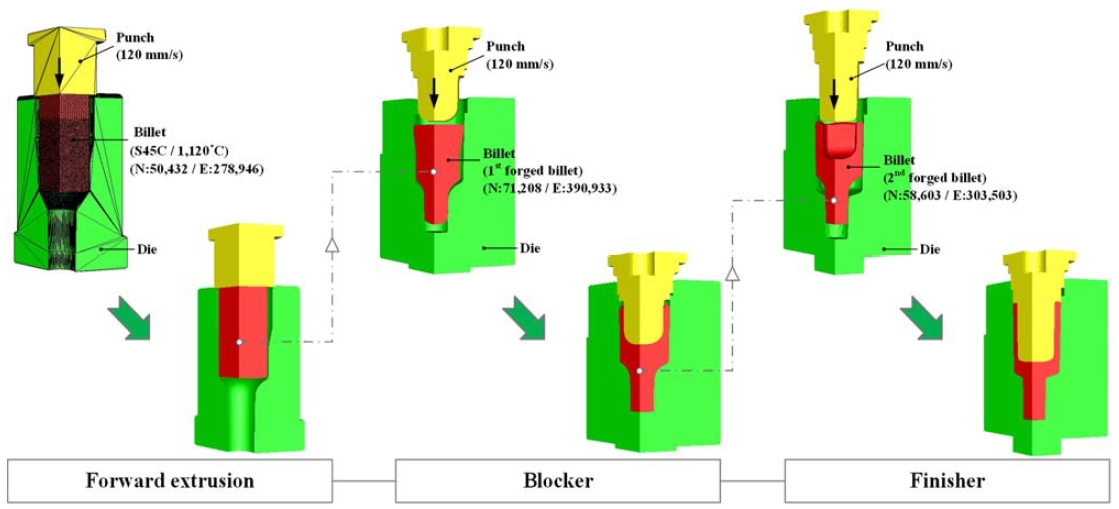
Figure 8 illustrates the FE model used for the multi-stage hot forging process conducted in this research, using FORGE-Nxt 3.2. Due to the symmetrical shape of the tripod housing, a 1/3 model was chosen as the focus of the FE analysis. The punch and die were modeled using four-node rigid shell elements, while the S45C billet was represented as a deformable body with a thermo-mechanical tetrahedron element with 4 nodes. The FE analysis for the forward extrusion was carried out using an annealed S45C billet, which had an initial height of 117.0 mm and a radius of 30 mm. The initial billet was discretized into 50,432 nodes and 278,946 elements. The initial temperature of the billet was approximately 1,120°C, and a friction constant of 0.3 was applied between the die and the billet. Furthermore, the deformation history—including shape, strain, stress, and temperature—of the S45C billet from the previous stage was used as the initial conditions for the billet in the next stage. Representative conditions for the finite element analysis are detailed in Table 1.
FE-analysis model for multi-stage hot forging process

Input parameters required for hot forging process
2.4 Results of FE-analysis
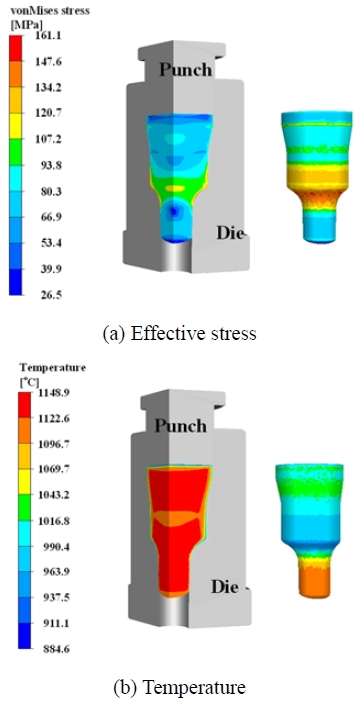
Figure 9 illustrates the distributions of effective stress and temperature obtained from the FE analysis results for the forward extrusion process, which is the initial stage of the hot forging process. The maximum effective stress, approximately 160 MPa, occurs at the inclined section where the head and the extrusion shaft intersect. Aside from localized areas of excessive deformation, the effective stress remains below 100 MPa. The highest temperature recorded at the core of the billet reached 1140°C, while the temperature on the surface of the extrusion shaft was around 1095°C. Meanwhile, the temperature on the head surface dropped to below 1045°C.
FE-analysis model for forward extrusion process
The FE analysis of the blocker process was continuously conducted using the forward-extruded billet. Figure 10 shows the distribution of effective stress and temperature during the blocker process, which is the second stage of the hot forging process. The maximum effective stress observed was approximately 200 MPa, while the minimum temperature recorded at the upper part of the cup bottom (the area in contact with the punch) was 760°C. Overall, effective stress values ranged from 100 to 140 MPa in the main deformation region. Additionally, the maximum temperature at the core of the intermediate forged product reached about 1150°C. The surface temperatures of the backward-extruded cup and the lower extrusion shaft were measured at 950 to 1050°C and 850 to 950°C, respectively.
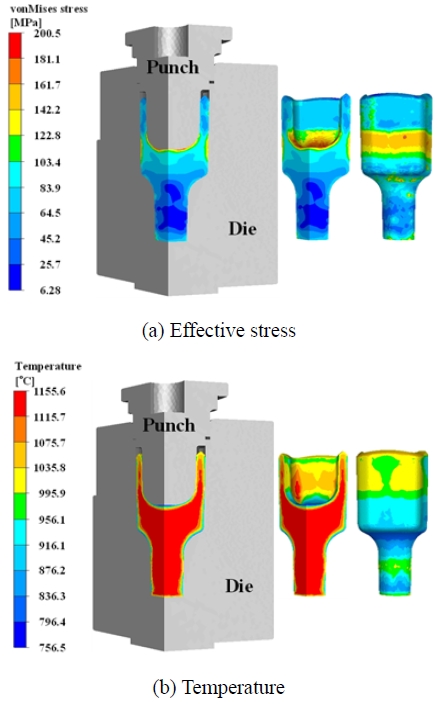
FE-analysis model for blocker process
The FE analysis of the blocker process was continuously conducted using the forward-extruded billet. Figure 10 shows the distribution of effective stress and temperature during the blocker process, which is the second stage of the hot forging process. The maximum effective stress observed was approximately 200 MPa, while the minimum temperature recorded at the upper part of the cup bottom (the area in contact with the punch) was 760°C. Overall, effective stress values ranged from 100 to 140 MPa in the main deformation region. Additionally, the maximum temperature at the core of the intermediate forged product reached about 1150°C. The surface temperatures of the backward-extruded cup and the lower extrusion shaft were measured at 950 to 1050°C and 850 to 950°C, respectively.
The FE analysis of the finisher process was continuously conducted using the second intermediate deformed product that was forged during the blokcer process. Figure 11 illustrates the results of the FE analysis for the finisher process. The maximum effective stress reached approximately 240 MPa at the bottom corner of the cup, where it contacts the lower part of the punch, as well as at the rim of the cup in contact with the upper part of the punch. Additionally, effective stress levels exceeding 150 MPa were observed in the main deformation region, while overall, a low stress distribution of less than 100 MPa was noted. In the case of the forward extrusion shaft, where most of the forming occurred during the second blocker process, a low stress of approximately 50 MPa was produced. When examining the temperature distribution of the product after completing the finisher process, it was found that the core temperature remained above 1150°C. The upper section of the backward extruded cup registered temperatures above 1000°C; however, most surface temperatures fell to approximately 950°C or lower.
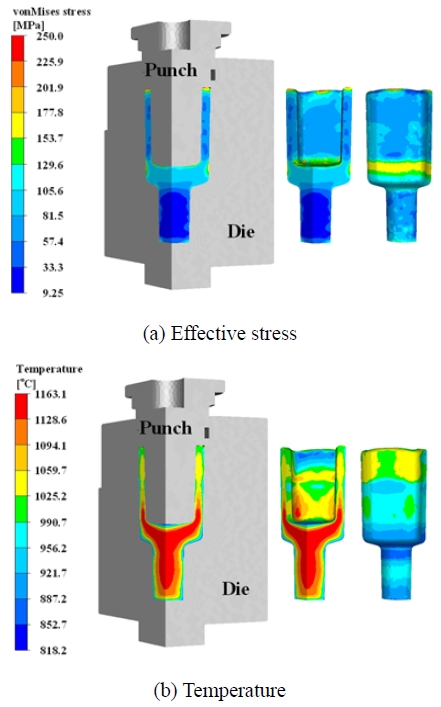
FE-analysis model for finisher process
The loads needed at each stage of the multi-stage hot forging process for the tripod housing were monitored and are illustrated in Figure 12. In the first stage, the forward extrusion process required a forming load of approximately 75 tons. The blocker process demanded a forming load of around 110 tons, while the finishing process required about 200 tons. This trend indicates that as the multi-stage process progressed, the forming load increased due to several factors, including a decrease in billet temperature, increased shape complexity, and heightened friction resulting from the increased height of the cup. It is generally advisable to use a hot forging press with a capacity that exceeds 100% of the maximum load observed during the FE analysis. Therefore, based on the forming load curve presented in Figure 12, a hot forging press with a capacity of over 1,000 tons is recommended for this research.
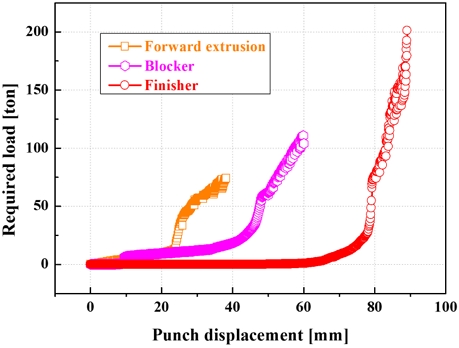
Load diagram for each stage in multi-stage hot forging
3. Experiment of Multi-stage Hot Forging Process
3.1 Experimental Procedures
The multi-stage hot forging process involved sequential experiments using the automatic forging line and various die sets, as shown in Figure 13. The general experimental conditions are consistent with those outlined in Table 1. Based on the results of the finite element analysis, a hot forging experiment was conducted using a 1,600-ton press, which operates at a forming speed of 200mm/s. For the prototype production, an initial spheroidized annealed S45C billet, measuring 60 mm in diameter and 117 mm in height, was used.
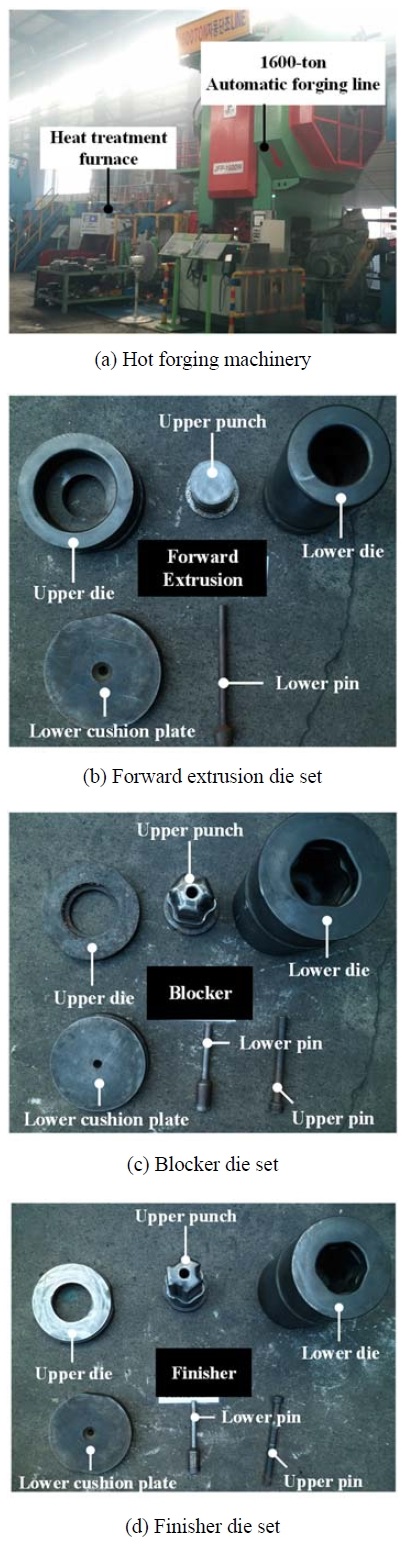
Multi-stage hot forging machinery and die sets
3.2 Results of Hot Forging Experiments
A photograph of the prototype tripod housing, manufactured during the 1st test operation, is shown in Figure 14. To ensure accurate measurements, the cup portion, produced by backward extrusion, was cut with a waterjet. Following this, 3D scanning equipment was utilized to confirm the absence of dimensional errors in the prototype. The vertical and longitudinal cross-sectional dimensions of the hot-forged prototype were measured and compared, as shown in Figure 15. The top-view cross-sectional measurements revealed no significant dimensional defects on either the inner or outer surfaces of the tripod housing, including the radius section. However, the front-view cross-sectional measurements identified an unfilled area at the end of the cup portion in the back-extruded section and the lower forward extrusion shaft. This issue is thought to be the result of volumetric defects caused by billet expansion and the presence of oxide scales during hot forging.
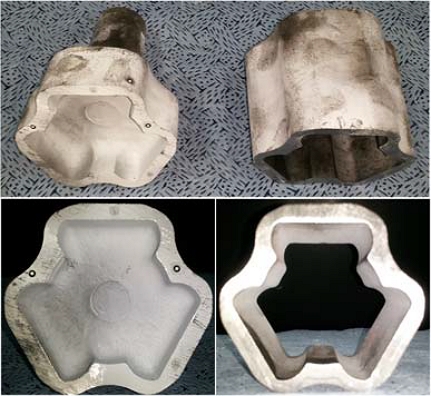
Prototype specimen prepared for 3D scanning
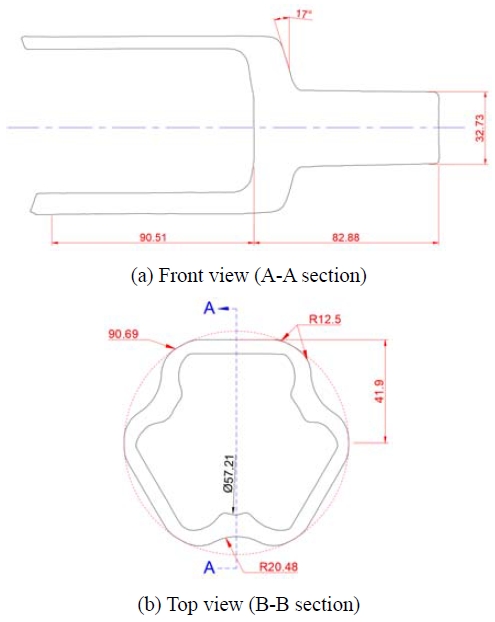
Shape and dimensions of prototype specimen (unit: mm)
To resolve the unfilled area, the initial mass of the billet was increased during the second, third, fourth, and fifth test operation processes. In the final fifth test operation, a tripod housing without dimensional defects was successfully manufactured using an initial billet with a diameter of 60 mm and a height of 127 mm, as illustrated in Figure 16.
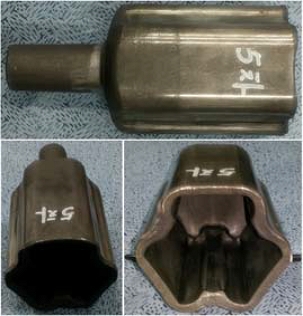
Hot forged tripod housing (5th test operation)
The tripod housing, successfully formed during the 5th test operation, underwent testing and evaluation for surface hardness, tensile strength, austenite grain size, and dimensional accuracy. Initially, a Vickers hardness test was performed following the KS B0811:2003 standard. The results indicated a hardness range of HV 243 to HV 250. A tensile strength test was conducted using the ASTM E8/E8M-13a test method, with results indicating a tensile strength ranging from 818MPa to 843MPa. Additionally, an austenite grain size test was performed according to the KS D0205 test method, revealing a grain size number of 9.5. Furthermore, a dimensional accuracy test was carried out using a non-contact 3D measuring instrument, which showed a maximum dimensional error of 0.045 mm. The values obtained from these various evaluations are summarized, demonstrating that the tripod housing possesses excellent mechanical and material properties, making it suitable for use in actual industrial applications.
4. Conclusion
In this study, we proposed a multi-stage hot forging process consisting of forward extrusion, blocker, and finisher stages to manufacture a weldless single-piece tripod housing. The thermo-mechanical three-dimensional finite element (FE) analysis is used to develop the overall manufacturing technology. This involved determining the shapes of the initial material and preform, as well as designing suitable die sets for each stage based on analysis of effective stress, temperature, and required load. The validity of the proposed hot forging process design was confirmed through hot forging experiments conducted on S45C billets with a diameter of 60 mm and a height of 127 mm. After completing the multi-stage hot forging process, the mechanical properties of the tripod housing were evaluated. The results indicated a minimum hardness of HV 243, a minimum tensile strength of 818 MPa, a grain size of 9.5, and a maximum dimensional error of 0.045 mm, respectively. The tripod housing produced using the hot forging technology in this research demonstrates outstanding mechanical and material properties, making it suitable as an industrial component for CV joint assembly.
Acknowledgments
This research was supported by Korea Basic Science Institute (National Research Facilities and Equipment Center) grant funded by Ministry of Education. (grant No. 2022R1A6C101B738).
Author Contributions
Conceptualization, K. H. Lee; Methodology, K. H. Lee; Software, K. H. Lee; Validation, K. H. Lee; Investigation, K. H. Lee; Data Curation, K. H. Lee; Writing—Original Draft Preparation, K. H. Lee; Writing—Review & Editing, K. H. Lee; Visualization K. H. Lee; Supervision, K. H. Lee.
References
-
B. -S. Kang and T. -W. Ku, “Process modification and numerical simulation for an outer race of a CV joint using multi-stage cold forging,” Transactions of Materials Processing, vol. 23, no. 4, pp. 211-220, 2014 (in Korean).
[https://doi.org/10.5228/KSTP.2014.23.4.211]

-
B. -S. Kang and T. -W. Ku, “Experimental study on multi-stage cold forging for an outer race of a CV joint,” Transactions of Materials Processing, vol. 23, no. 4, pp. 221-230, 2014 (in Korean).
[https://doi.org/10.5228/KSTP.2014.23.4.221]
-
C. C. Liao, C. C. Hsu, J. H. Huang, W. C. Chen, Y. K. Fuh, C. A. Liao, and H. Y. Chiu, “Deformation mechanism of forging tool for multi-stage forming of deep groove ball bearing,” Proceedings of the Institution of Mechanical Engineers, Part B: Journal of Engineering Manufacture, vol. 233, no. 4, pp. 1182-1195, 2018.
[https://doi.org/10.1177/0954405418774596]
-
J. -H. Kang, “A study on the elimination of surface defect and increase in tool life of the warm forged spider,” Journal of the Korean Society of Manufacturing Process Engineers, vol. 19, no. 5, pp. 82-90, 2020.
[https://doi.org/10.14775/ksmpe.2020.19.05.082]
- S. -G. Seong, K. -H. Kim, Y. -S. Lee, S. -Y. Lee, and E. -Y. Yoon, “Die stress reduction design and mechanical properties analysis of warm forging process for the application of warm-closed forging of automotive steering unit yoke,” Transactions of Materials Processing, vol. 31, no. 2, pp. 51-56, 2022 (in Korean).
- T.-W. Ku, “Process design and elasto-plastic finite element simulation for multi-stage cold and warm forging of a tripod housing,” Transactions of Materials Processing, vol. 34, no. 1, pp. 41-50, 2025 (in Korean).