
Experimental investigation of bonding characteristics in composite bulletproof panels for small hulls

Copyright © The Korean Society of Marine Engineering
This is an Open Access article distributed under the terms of the Creative Commons Attribution Non-Commercial License (http://creativecommons.org/licenses/by-nc/3.0), which permits unrestricted non-commercial use, distribution, and reproduction in any medium, provided the original work is properly cited.
Abstract
In this study, the bonding performance of different materials was evaluated to fabricate integral ultra-high molecular weight polyethylene (UHMWPE) composite bulletproof panels for small hulls. Thus, 12 types of bonded specimens were fabricated using high density polyethylene (HDPE), glass fiber reinforced polymer (GFRP), and aluminum (as hull materials); carbon fiber, aramid fiber, and aluminum (as shielding materials); and Permabond TA4605 and Rasatek (as adhesives). Subsequently, single-lap shear bond strength tests were performed. The results show the normalized shear bond strength for each material composition and the main effects of the considered hull materials, shielding materials, and adhesives on the bond strength. Furthermore, the ballistic resistance performance was evaluated in accordance with the National Institute of Justice (NIJ) Level III ballistic resistance standard using specimens of composite bulletproof panels shielded with carbon fiber and aramid fiber and bonded to the HDPE hull material and UHMWPE bulletproof panels. The results confirmed no difference in the bulletproof performance of the abovementioned composite bulletproof panels due to a change in bonding strength. These findings are expected to facilitate the construction of integral composite bulletproof panels and lightweight composite bulletproof panels.
Keywords:
Bulletproof, Composite, Bonding, UHMWPE, Small hull1. Introduction
Since the Ukraine–Russia war, the utilization of unmanned vehicles has expanded rapidly beyond land and aviation to the maritime domain. Among maritime weapon systems, small-unmanned surface vehicles (USVs) have demonstrated their tactical value and strategic impact as well as offer the advantages of low production cost, high mobility, elimination of human casualties, and remote and autonomous operation. These small USVs can be used for various missions, including reconnaissance, minesweeping, electronic warfare, and self-destructive strikes, which has resulted in the requirement for armor to protect them from damage or improve their survivability during operations.
In the defense industry, the term “armor” is defined as a protective panel used to absorb the impact energy of a fired gun or explosion. This can include bulletproof panels for hull protection, ballistic shields, vests for upper- body protection, and helmets for head protection [1][2]. The level of ballistic protection depends on the kinetic energy received from the projectile, which can be protected by armor [3][4].
Studies are being conducted to investigate the optimal geometry and materials for ballistic armor to achieve light weight, ease of assembly, and maximum energy absorption [5][6]. Most recent armor designs are based on ballistic material optimization, and hybrid composite armor is widely used for ballistic impacts. Liu et al. [7] reduced the thickness of ceramic and Kevlar layers in ceramic body armor to achieve the same protection while affording a lighter weight. Yuen et al. [8] analyzed the effects of geometric and material design variables on the impact-absorption performance of tubular structures with desirable energy-absorption properties, whereas Xu et al. [9] experimentally evaluated the impact-energy absorption performance of carbon-fiber-based hybrid composite tubes manufactured via filament winding. Alkhatib et al. [10] analyzed the crush response of CFRP and KFRP composite corrugated tubes under quasi-static sliding axial loading. From a structural design perspective, introducing small-scale energy absorbers and forming sandwich panels is a promising strategy in ballistic applications [11]-[13].
Among ballistic materials, ultra-high molecular weight polyethylene (UHMWPE) in the form of fiber-reinforced composites with high stiffness and low density has been increasingly used in lightweight armor systems in the defense field to protect against ballistic impacts on ships, structures, and military body armor [14]-[16]. Nguyen et al. [17][18] analyzed the behavior of UHMWPE composites under impact loading via numerical analysis and experimentally evaluated the effectiveness of UHMWPE composites against fragmentary ballistic impacts. Li et al. [19] analyzed the penetration velocity of UHMWPE composite armor plates against curved warhead bullets and quantitatively evaluated the ballistic limit velocity.
Existing studies have focused on the ballistic resistance performance and impact behavior of UHMWPE composite armor plates. However, structural bonding techniques, particularly integral hull-to-armor plate bonding, are essential for their application in real-world hull structures. This becomes an even more critical challenge for structures with limited space and weight requirements, such as small-unmanned vehicles or lightweight floating platforms. Therefore, in this study, the bonding characteristics of each adhesive used are experimentally analyzed for the integral bonding of UHMWPE composite bulletproof panels to small hull materials. Additionally, specimens of the bonded composite bulletproof panels are fabricated to evaluate the bulletproof performance in accordance with NIJ Level III standards to confirm the shock-absorption performance of the bulletproof panels.
2. Materials and Methods
2.1 Materials used
As the materials for small hulls, HDPE, GFRP, and aluminum were considered. These materials are primarily used in small boats, unmanned surface craft, rescue boats, etc., and provide both corrosion resistance and strength. In particular, HDPE is a plastic-based material with low manufacturing and maintenance costs that has recently been increasingly utilized in small vessels. It is characterized by high impact resistance, high chemical resistance, good machinability, and complete non-corrosion compared with metals. The types of materials and mechanical properties for small ship hulls are shown in Table 1 [20].

Mechanical properties of materials for small ship hulls
UHMWPE bulletproof panels feature a protective facing. Although UHMWPE is an excellent bulletproof material, its low surface energy renders it vulnerable to scratches, abrasion, ultraviolet light.
Therefore, shielding it with materials such as carbon fiber, aramid, and aluminum improves its durability by preventing external impact, friction, and environmental degradation. Additionally, UHMWPE is characterized by low shear strength and flexural stiffness; however, the material used to shield UHMWPE functions as a sandwich reinforcement to increase interfacial shear strength and improve interlayer peel resistance. Additionally, shielding the bulletproof panel can suppress multiple impacts and fragment propagation. When a bulletproof panel is struck, fragments are scattered to the outside; however, the shielding material suppresses these fragments. The material properties of shielding materials applied to bulletproof panels are shown in Table 2 [21].
Material properties of shielding materials
2.2 Experimental Apparatus and Test Method
To experimentally analyze the bonding properties of composite armor plates in one piece, a single-lap shear-adhesion test was performed. A ZWICK Z250 universal material-testing machine was used to test the shear adhesion of composite specimens, and the shear strength of each type of specimen was evaluated under shear conditions. A photograph of the equipment used in the test is shown in Figure 1.
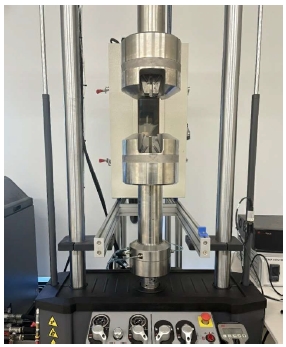
Test equipment of shear strength
The lap shear-adhesion strength test was performed in accordance with American society for testing and materials (ASTM) D5868[22]. To evaluate the adhesion performance of the overlapped interface, a loading velocity was applied to shear the specimen, and the shear-force direction was set such that the overlapped area was subjected to shear.
2.3 Specimen Fabrication
The types of test specimens fabricated to evaluate the interfacial adhesion performance of composite bulletproof panels are shown in Table 3 and Figure 2, and the total number of specimens fabricated was 12. The hull material was composed of HDPE, GFRP, and aluminum, which are suitable for small USV hulls, and the materials used for shielding the bulletproof panel were carbon fiber, aramid, and aluminum. Permabond TA4605 and Rasatek adhesives were used to bond the hull material and composite ballistic panel.
Types of specimens for evaluating lap shear strength
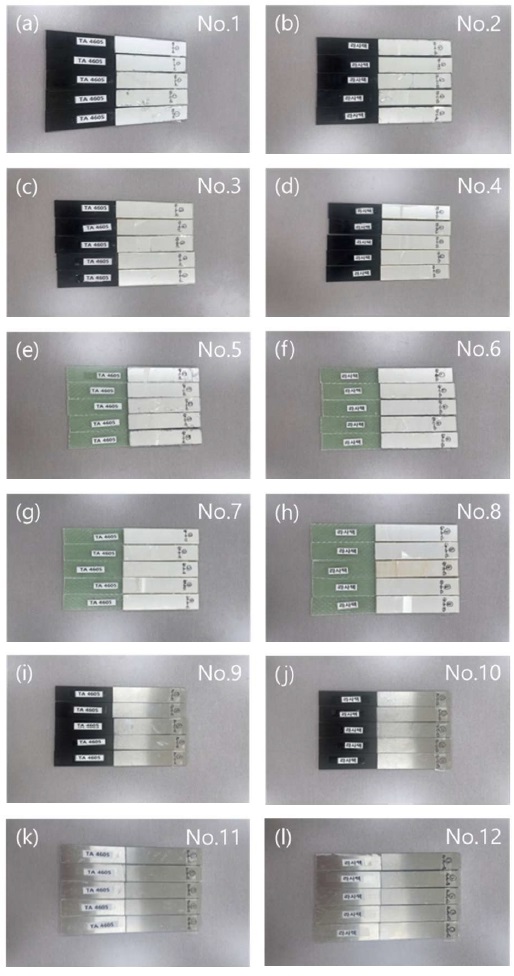
Specimens prepared for lap shear strength test
Permabond TA4605 is a methyl methacrylate- based structural adhesive for low-surface-energy plastics that can be bonded without pretreatment or surface preparation and offers high toughness and impact resistance, thus rendering it ideal for bonding hull structures. Rasatek is a rubber-modified epoxy-based high-toughness adhesive with high shear strength and impact resistance.
3. Experimental Results
3.1 Bond-Strength Test Results
The results of the overlap shear adhesive strength tests performed using the specimens and test methods described in the previous section are shown in Table 4. The normalized shear strengths in Table 4 are expressed as a ratio of the measured values to the reference strength, and the ratio of the normalized shear strength is expressed as shown in Equation (1). The test results showed distinct differences depending on the hull-material properties, whereas the failure modes differed depending on the chemical and physical interactions at the hull/shield/adhesive interfaces.
| (1) |
Lap shear strength test results for 12 combinations of hull, shielding, and adhesive materials
For the HDPE hull material, the adhesive strength was measured to be 0.5 on average for TA4605, which was approximately 61% higher than that (i.e. 0.31) for Rasatex with CFRP shielding material. This is likely due to the non-polar surface characteristics of HDPE, which resulted in the dominance of interfacial failure in Rasatex, whereas TA4605 exhibited mixed failure due to chemical bonding and improved wettability.
For the GFRP hull material, both adhesives exhibited strengths ranging from 0.79 to 1.06 against the CFRP and aramid shielding material, and their failure modes were observed to be cohesive dominated. This suggests that the chemical bonding of the adhesive to the resin matrix of GFRP significantly affects the bond strength. TA4605 showed improved bond strengths by approximately 28% and 34% for the CFRP and aramid shielding materials, respectively.
For the aluminum hull material, TA4605 showed relatively high bond strengths ranging from 0.56 to 1.36 for both shielding materials. The failure mode was dominated by stable cohesiveness at the metal–adhesive interface for TA4605, whereas Rasatex was dominated by mixed failure, which may explain the wider bond-strength range. TA4605 measured the highest strength of 1.23 for the aluminum shielding material, which was attributed to the high surface energy of the metal surface and the adequate wettability of the adhesive, thus resulting in cohesive failure within the adhesive and the highest measured shear bond strength.
Table 5 shows the results of the generalized linear analysis of variance for shear bond strength using the Minitab S/W. Based on the table, the sum of the corrected sum of squared deviations (Adj SS) for the hull material, shielding material, and adhesive are 0.596, 0.017, and 0.181, respectively, thus indicating that the variation for the hull material and adhesive is larger than that for the shielding material. This is because the chemical or physical interaction of the hull material and adhesive interface significantly affects the adhesion strength. Based on an analysis of variance for the adhesive strength, the F values for the hull material and adhesive are 11.64 and 7.09, respectively, and the expected P value of the variance is less than 0.05. Therefore, the results of analysis of variance are considered to be the main factor influencing the adhesive strength at the 5% significance level.
Analysis of general linear model on lap shear strength for hull, shielding, and adhesive materials
3.2 Bond Strength Main-Effect Plots
Figure 3 shows the main effects of the hull materials, shielding materials, and adhesives on shear bond strength. In the main-effect graph, the center dotted line indicates the overall average of the shear bond strength, with each point representing the average at the level. The bond strength shows clear sensitivity to changes in the design variables. Based on the effect of each material change, Figure 3 shows that GFRP has the highest adhesion strength, followed closely by aluminum. However, HDPE indicates a low adhesion strength, which implies that it may require additional surface treatment to improve its adhesion strength. Thus, the hull material is the most important factor affecting the adhesion strength. Regarding the shielding materials, aluminum indicated the highest bond strength, followed by CFRP and then aramid. For the adhesives, TA4605 indicated the highest bond strength, whereas Rasatex indicated the lowest. Although the adhesive type affects adhesion, it affected the bond strength less as compared with the hull/shielding materials, thus suggesting that improving the material’s interfacial properties is the most important, followed by the adhesive properties.
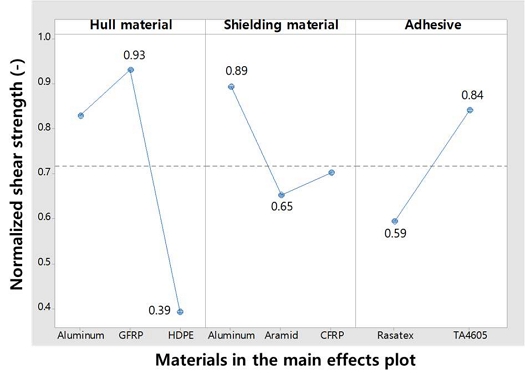
Main-effect analysis for each material on shear strength
4. Bulletproof Performance Test
4.1 Test Method and Specimen Preparation
Because the goal of the bonded multi-composite bulletproof panel is to provide lightweight and bulletproof performance simultaneously, bulletproof-performance test must be performed for evaluation. The bulletproof panel absorbs the kinetic energy of the warhead and induces fragmentation, whereas the composite layer disperses and absorbs the impact energy. Bulletproof tests were conducted to verify changes in the protection performance based on the shielding material and adhesive of the bulletproof panel.
The NIJ Level III ballistic test method is commonly applied to naval armor evaluations. In this study, the NIJ Level III ballistic test was performed to evaluate the penetration of the ballistic panel against a 7.62 mm NATO FMJ bullet. Additionally, the back-face signature was measured to determine if the deformation depth exceeded the reference depth.
The specimen for the ballistic performance test was fabricated using the HDPE hull material to realize a lightweight hull, while CFRP and aramid were used as shielding materials for the UHMWPE panel. The ballistic test specimen measured 400 mm × 400 mm.
4.2 Test Results
The results obtained using the fabricated ballistic test specimen are shown in Figure 4. The kinetic energy of a warhead fired from distance of 15m was absorbed by the UHMWPE panel, which was the core component of the bulletproof panel. No penetration occurred in both specimens, and the backward deformation depth was within the specified limit. When bulletproof panels are composed of multiple composites, the adhesion between the materials affects structural continuity and energy-transfer efficiency. Adequate adhesion strength is required to ensure that the impact load is uniformly distributed. Conversely, if interfacial desorption occurs due to low adhesion strength, the shock-absorption mechanism may not occur as expected, thus deteriorating the bulletproof performance. In the test condition of this study, this may be attributed to the dominant energy absorption capacity of the UHMWPE core, which could mask the minor variation in interfacial bonding strength.
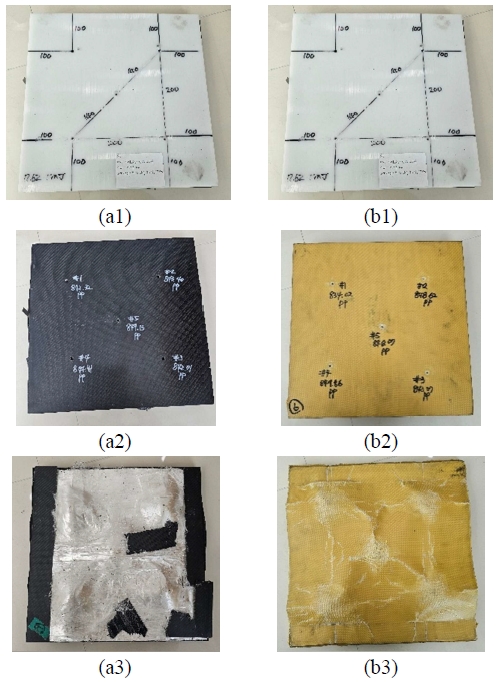
Specimens after bulletproof test: (a) CFRP shielding materials for the UHMWPE panel and (b) aramid shielding materials for the UHMWPE panel
4. Conclusion
In this study, the shear-adhesion strength characteristics of hull materials, shielding materials, and adhesives were experimentally analyzed for the integrated manufacturing of UHMWPE composite bulletproof panels on a small-hull material. Subsequently, the bulletproof performance of the bonded composite bulletproof-panel specimens was evaluated in accordance with NIJ Level III standards. The results of the study are summarized below.
For the hull materials (i.e., HDPE, GFRP and aluminum), shielding materials (i.e., carbon fiber, aramid, and aluminum), adhesives (i.e., Permabond TA4605 and Rasatek), lap shear bond strength tests were performed for each material combination to derive and compare the normalized bond-strength ratios.
The test results were used to determine the main effects of the hull materials, shielding materials, and adhesives on shear bond strength. The highest normalized shear strengths were achieved by GRPT (hull material), aluminum (shielding material), and TA4605 (adhesive). In terms of main effects, hull-material selection exerted the greatest effect on bond strength.
Specimens were fabricated by bonding UHMWPE panels—shielded with CFRP or aramid—to HDPE hull material to realize a lightweight hull. Additionally, NIJ Level III ballistic testing confirmed that variations in bond strength did not affect ballistic performance.
Therefore, the shear-adhesion strength characteristics of the hull materials, shielding materials, and adhesives obtained experimentally in this study may facilitate the construction of integrated composite bulletproof panels and lightweight composite bulletproof panels.
Acknowledgments
This research was supported by the Ministry of Science and ICT(MSIT) of Korea (RS-2023-00283385)
Author Contributions
Conceptualization, T. W. Kim; Methodology, K. S. Kim and J. W. Lee; Formal Analysis, Y. G. Lee; Investigation, K. S. Kim and G. Y. Lee; Data Curation G. Y. Lee; Writing-Original Draft Preparation, K. S. Kim; Writing-Review & Editing, T. W. Kim; Project Administration, Y. G. Lee.
References
-
E. L. Thomas, “Opportunities in protection materials science and technology for future army applications”, Advances in Ceramic Armor VIII, pp. 145–148, 2012.
[https://doi.org/10.1002/9781118217498.ch13]

- UK Ministry of Defence Standards, Proof of ordnance, munitions, armor, and explosives, UK Ministry of Defense Standards: Glasgow, Scotland, 2005.
- J. S. Montgomery and E. S. Chin, “Protecting the future force-towards a new generation of metallic structural armor,” Military Technology, vol. 32, no. 2, p. 110, 2008.
- K. Rice, M. Riley, and A. Forster, “Ballistic Resistance of Body Armor,” National Institute of Standard and Technology, 2008.
- A. Bhatnagar, Lightweight Ballistic Composites: Military and Law-Enforcement Applications, Woodhead Publishing: Cambridge, UK, 2016.
-
L. R. Vargas-Gonzalez and J. C. Gurganus, “Hybridized composite architecture for mitigation of nonpenetrating ballistic trauma,” International Journal of Impact Engineering, vol. 86, pp. 295–306, 2015.
[https://doi.org/10.1016/j.ijimpeng.2015.08.014]
-
W. Liu, Z. Chen, Z. Chen, X. Cheng, Y. Wang, X. Chen, J. Liu, B. Li, and S. Wang, “Influence of different back laminate layers on ballistic performance of ceramic composite armor,” Materials & Design, vol. 87, pp. 421–427, 2015.
[https://doi.org/10.1016/j.matdes.2015.08.024]
-
S. Yuen and G. N. Nurick, “The energy-absorbing characteristics of tubular structures with geometric and material modifications: An overview,” Applied Mechanics Reviews, vol. 61, no. 2, 020802, 2008.
[https://doi.org/10.1115/1.2885138]
-
J. Xu, Y. Ma, Q. Zhang, T. Sugahara, Y. Yang, and H. Hamada, “Crashworthiness of carbon fiber hybrid composite tubes molded by filament winding,” Composite Structures, vol. 139, pp. 130-140, 2016.
[https://doi.org/10.1016/j.compstruct.2015.11.053]
-
F. Alkhatib, E. Mahdi, and A. Dean, “Crushing response of CFRP and KFRP composite corrugated tubes to quasi-static slipping axial loading: Experimental investigation and numerical simulation,” Composite Structures, vol. 246, 112370, 2020.
[https://doi.org/10.1016/j.compstruct.2020.112370]
-
F. Alkhatib, E. Mahdi, and A. Dean, “Development of composite double-hat energy absorber device subjected to traverser loads,” Composite Structures, vol. 240, 112046, 2020.
[https://doi.org/10.1016/j.compstruct.2020.112046]
-
A. Esnaola, I. Ulacia, L. Aretxabaleta, J. Aurrekoetxea, and I. Gallego, “Quasi-static crush energy absorption capability of E-glass/polyester and hybrid E-glass–basalt/polyester composite structures,” Materials and Design, vol. 76, pp. 18–25, 2015.
[https://doi.org/10.1016/j.matdes.2015.03.044]
-
Q. Liu, H. Xing, Y. Ju, Z. Ou, and Q. Li, “Quasi-static axial crushing and transverse bending of double hat shaped CFRP tubes,” Composite Structures, vol. 117, pp. 1–11, 2014.
[https://doi.org/10.1016/j.compstruct.2014.06.024]
-
S. L. Phoenix and P. K. Porwal, “A new membrane model for the ballistic impact response and V50 performance of multiply fibrous systems,” International Journal of Solids Structures, vol. 40, pp. 6723–6765, 2003.
[https://doi.org/10.1016/S0020-7683(03)00329-9]
- Z. Mei, X. Zhu, L. Zhang, “Ballistic protective mechanism of FRC laminates,” Acta Materiae Compositae Sinica, vol. 23, no. 2, pp. 143-149, 2006.
- C. Chen, X. Zhu, J. Wang, H. Hou, T. Tang, “Mechanism of high-velocity blunt-nosed projectiles penetrating moderately thick UHMWPE fiber reinforced plastic laminate,” Acta Materiae Compositae Sinica, vol. 30, no. 5, pp. 226- 235, 2013.
-
L. H. Nguyen, T. R. Lassig, S. Ryan, W. Riedel, A. P. Mouritz, A. C. Orifici, “Numerical modelling of ultra-high molecular weight polyethylene composite under impact loading,” Procedia Engineering, vol. 103, pp. 436–443, 2015.
[https://doi.org/10.1016/j.proeng.2015.04.043]
-
L. H. Nguyen, S. Ryan, S. J. Cimpoeru, A. P. Mouritz, A. C. Orifici, “The efficiency of ultra-high molecular weight polyethylene composite against fragment impact,” Experimental Mechanics, vol. 56, pp. 595–605, 2016.
[https://doi.org/10.1007/s11340-015-0051-z]
-
L. Ding, X. Gu, P. Shen, and X. Kong, “Ballistic limit of uhmwpe composite armor under impact of ogive-nose projectile,” Polymers, vol. 14, no. 22, 4866, 2022.
[https://doi.org/10.3390/polym14224866]
-
S. S. Cho, W. M. Kwak, B. S. Ham, and Y. C. Jo, “A study on structural strength assessment of polyethylene boat,” Journal of the Korea Academia-Industrial cooperation Society, vol. 13, no. 3, pp. 1045-1053, 2013, Available:
[https://doi.org/10.5762/KAIS.2013.14.3.1045]
- H. Seeber and A. Ramezani, “Development of flexible and lightweight ballistic body armor,” International Journal on Advances in Systems and Measurements, vol. 12, no. 1&2, 4866, 2019.
- ASTM International, ASTM D5868-23: Standard Test Method for Lap Shear Adhesion for Fiber Reinforced Plastic (FRP) Bonding, ASTM International, West Conshohocken, PA, USA, 2023.