
Analysis of ammonia boil off gas treatment in fuel storage systems

Copyright © The Korean Society of Marine Engineering
This is an Open Access article distributed under the terms of the Creative Commons Attribution Non-Commercial License (http://creativecommons.org/licenses/by-nc/3.0), which permits unrestricted non-commercial use, distribution, and reproduction in any medium, provided the original work is properly cited.
Abstract
The decarbonization of international shipping has accelerated the transition from conventional fossil fuels to carbon-zero alternatives, with ammonia emerging as a promising next-generation marine fuel. However, the management of the boil-off gas (BOG) generated in unpressurized ammonia fuel tanks remains a critical challenge. This study investigated the application of solid oxide fuel cell (SOFC) technology to utilize ammonia BOG for auxiliary power generation to enhance both energy efficiency and environmental sustainability. A 15,000 TEU ammonia-fueled container ship was selected as the reference ship, and the amount of BOG required for various fuel-cell outputs was calculated. The results indicate that producing 250 kW of auxiliary power requires 140 Nm³/h of ammonia, corresponding to 32.8% of the BOG generated in the ammonia fuel storage tank. The remaining BOG, equivalent to only 1.4% of the daily fuel consumption of the main engine, can be effectively consumed by the auxiliary engine without requiring additional reliquefaction systems. A comparative analysis highlights that SOFC-based BOG utilization not only reduces installation and maintenance costs but also offers a viable pathway toward the commercial implementation of eco-friendly power solutions in ammonia-fueled ships.
Keywords:
Ammonia, Boil-off gas (BOG), Fuel cell, Reliquefaction, Solid oxide fuel cell (SOFC)1. Introduction
Traditionally, ships have relied on fossil fuel-based engines for propulsion. However, with the increasing emphasis on global environmental protection, environmental regulations have become increasingly stringent, making the adoption of eco-friendly fuels essential. In April 2025, the 83rd session of the Marine Environment Protection Committee (MEPC) was held by the International Maritime Organization (IMO) in London. During this session, amendments to MARPOL Annex VI were approved to introduce mid-term measures to further reduce GHG emissions from international shipping starting in 2027. The IMO also established a Goal-Based Marine Fuel Standard to regulate the greenhouse gas intensity of marine fuels (CO₂eq/MJ) in a phased manner and introduced a GHG Pricing Mechanism, which will impose specific monetary penalties for excess GHG emissions beginning on January 1, 2028 [1].
Traditionally, heavy fuel oil (HFO) and marine diesel oil (MDO) have been used as primary propulsion fuels [2]. However, with the IMO’s agreement to achieve net-zero carbon emissions by 2050, reinforced by the revised targets of 2023, the pressure on the shipping industry to reduce energy consumption and transition to carbon-neutral fuels has intensified [3]. Although alternative fuels such as liquified natural gas (LNG), methanol, biofuels, and electric propulsion are under consideration, ammonia has attracted significant global interest as a next-generation fuel because net-zero carbon emissions are essential to meeting international regulations and achieving carbon neutrality.
Ammonia has several advantages as a marine fuel. It produces negligible amounts of sulfur oxides (SOx) and particulate matter, thus reducing air pollution, and does not emit CO, thus lowering the cost burden associated with carbon credits [4][5]. A critical requirement for its adoption as a marine fuel is the establishment of bunkering infrastructure. Fortunately, large-scale production, storage, and transport systems already exist in the fertilizer and chemical industries, ensuring stable supply and demand [6]. Furthermore, ammonia is compatible with LNG transport and storage systems, enabling a relatively smooth transition from LNG to ammonia as a marine fuel [7].
Ammonia is considered more attractive than liquefied hydrogen for maritime applications owing to its favorable storage and transport properties. It can be liquefied at –33 °C and stored at costs up to 16 times lower than hydrogen while also offering a higher volumetric energy density under the same conditions. These properties make ammonia a suitable option for long-distance global shipping, enabling eco-friendly and high-efficiency energy conversion in marine engines [8].
First-generation ammonia-fueled engines are dual-fuel systems capable of delivering a performance comparable to or exceeding that of conventional fossil-fuel engines. Ammonia-fueled engines can satisfy the MEPC 83 carbon emission standards under Tier I, comply with IMO Tier II requirements without DeNOx systems, and fulfill Tier III requirements when equipped with DeNOx systems [9]. Xu et al. confirmed the potential of ammonia/diesel dual-fuel engines to significantly reduce carbon emissions by studying the combustion processes, pollutant and GHG formation mechanisms, and injection timing [10]. Cheliotis et al. [11] reviewed the application of ammonia fuel cells in the maritime sector and highlighted them as promising decarbonization technologies. Similarly, Micoli et al. [12] explored the application of ammonia proton exchange membrane (PEM) fuel-cell technology as a primary power generation system for ships and evaluated its applicability, stability, and performance, particularly for passenger ships.
According to the Ammonia Energy Association (AEA), the number of ammonia-fueled and ammonia-ready ships increased by 46.4%, from 263 ships (69 ammonia-fueled and 167 ammonia-ready) in September 2024 to 385 ships (146 ammonia-fueled and 239 ammonia-ready) in June 2025. The first delivery of these ships is expected after 2026 [13].
Under the IGF Code, ammonia-fueled ships must be equipped with at least two independent systems for managing boil-off gas (BOG) generated in unpressurized fuel tanks. Lee et al. [14] designed an onboard ammonia reliquefaction system for a 14,000 TEU container ship and reported an exergy efficiency of 34.71%, with 60% of the exergy loss occurring in heat exchangers. Wang et al. [15] conducted a cost analysis of LNG BOG management methods, including auxiliary engines (AEs), gas combustion units (GCUs), and reliquefaction, demonstrating that reliquefaction is more economical at high LNG prices and low sailing indices. However, for large ships, the economic feasibility of this system depends less on the LNG price, and overall, BOG utilization in AEs was identified as the most cost-effective option.
In this study, methods for handling BOG were investigated through the application of solid oxide fuel cell (SOFC) technology, enabling the utilization of the BOG generated from ammonia-fueled propulsion ships for additional power generation.
Approaches were also examined not only for BOG treatment but also for the production of auxiliary power in an environmentally sustainable manner. Finally, measures are proposed to facilitate the commercialization of these technologies through their application to actual sailing ships.
2. Methodology
2.1 Ammonia-Fueled SOFC
Figure 1 shows the operating principles of SOFC-O and SOFC-H. Fuel cells are electrochemical devices that directly convert chemical energy from fuel oxidation into electrical energy. Compared with internal combustion engines, they exhibit higher energy conversion efficiency and contribute to global environmental protection because the fuel is not combusted directly.
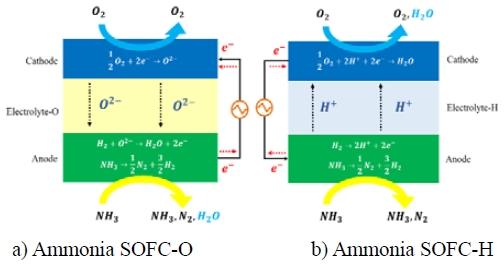
Operating Principle of SOFC-O and SOFC-H
Several types of fuel cells have been developed, including molten carbonate fuel cells (MCFCs), polymer electrolyte fuel cells (PEFCs), phosphoric acid fuel cells (PAFCs), and SOFCs. Among these, SOFCs operate at high temperatures and are attracting significant interest as next-generation energy sources that can replace conventional power generation processes. Their advantages include a relatively simple structure, cost-effectiveness, ability to directly utilize fuels through internal reforming, and high overall according to the current density efficiency.
When ammonia is used as the fuel, SOFCs can be classified according to the type of electrolyte: oxygen ion-conducting SOFCs (SOFC-O, O²⁻ electrolyte) and proton-conducting SOFCs (SOFC-H, H⁺ electrolyte) Figure 1(b) [16].
2.2 Direct Reforming of Ammonia Fuel
The direct reforming reaction of ammonia fuel, along with the electrochemical reactions at the anode and cathode and the overall fuel cell reaction, are expressed as follows:
| (1) |
| (2) |
| (3) |
| (4) |
2.3 Modeling of SOFC Stacks
Figure 2 illustrates the variation in cell voltage with respect to current density. According to Zhao et al. [17], cell voltage decreases as current density increases. At 1 atm and 800 °C, when the current density was 0.4 A/cm², the fuel cell output was calculated by assuming a cell voltage of 0.7 V.
3. BOG Processing
3.1 System configurations
Figure 3 shows a schematic of the fuel oil flow in an ammonia-fueled ship in which the BOG is processed through an SOFC system. The ammonia BOG generated from the fuel tank can either be combusted in the GCU or compressed using a compressor and subsequently supplied to the SOFC to produce auxiliary propulsion power for the ship. Additionally, a portion of the BOG can be condensed using the cryogenic energy of ammonia within a condenser and utilized as engine fuel.
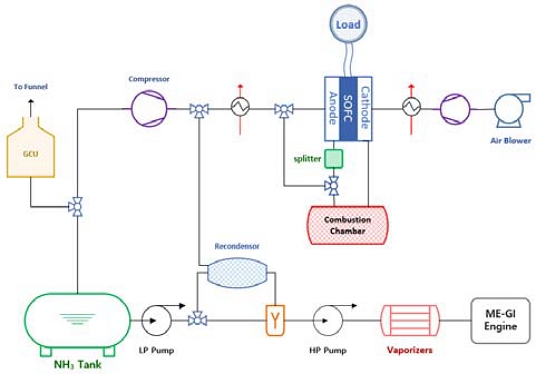
Schematic of BOG treatment and fuel oil flow for ammonia-fueled ships through an SOFC system
Figure 4 presents a schematic of the fuel-oil flow in an ammonia-fueled ship equipped with a reliquefaction system for BOG processing. The ammonia fuel stored in the fuel tank is pressurized using low- and high-pressure pumps (LP and HP pumps, respectively) and vaporized in vaporizers for use as a propulsion fuel for the ME-GI engine. Traditionally, BOG is either combusted in a GCU or returned to the fuel tank through a reliquefaction system. Among the available BOG treatment methods, reliquefaction systems in combination with GCUs are the most widely adopted despite their several operational and economic limitations.
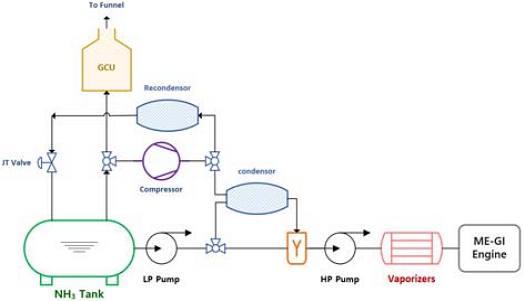
Schematic of BOG treatment and fuel oil
3.3 Selection of Target Ship
In this study, the ship specifications were established based on the conceptual design of a 15,000 TEU ammonia-fueled container ship released by SEASPAN in September 2023. The ammonia-fueled engine model introduced by WinGD was adopted as the main propulsion engine [18].
For fuel storage and BOG management, ammonia requires storage solutions with a durability comparable to that of conventional fuel oils. Typically, ammonia fuel storage tanks must have a volume that is approximately three times greater than the net volume of conventional fuel oil to ensure equivalent endurance. In this study, an IMO Type B tank was selected as the insulation method for ammonia storage. To satisfy a voyage endurance of 18,500 nautical miles, including allowances for non-pumpable fuel, filling limits, and safety margins, a storage tank with a capacity of approximately 22,600 m³ was designed beneath the accommodation area.
Table 1 summarizes the key specifications of the ammonia-fueled container ship, including engine type, propulsion power, and fuel tank capacity. The maximum capacity of refrigerated containers on a 15,000 TEU-class container ship is 1,200 units on deck and 600 units in hold, resulting in a total capacity of 1,800 refrigerated containers. The power consumption of each refrigerated container varies depending on factors such as temperature, humidity, shipping location, refrigerant type, and efficiency of the surrounding air refrigeration technology. According to Budiyanto and Shinoda [19], the average power consumption ranges from 7.2 to 7.8 kW per container at noon. Consequently, the overall power consumption associated with container shipments differs significantly, leading to variations in fuel consumption. Based on the operational status of all ships considered, the daily ammonia fuel consumption was calculated to be approximately 374 t.

Ship specifications of a 15,400 TEU ammonia fueled container ship
Table 2 summarizes the main parameters used to estimate the direction of ammonia boil-off rate (BOR) generation. For non-pressurized storage, the loading temperature of ammonia fuel is −33 °C, at which the density is 682 kg/m³ and the latent heat of evaporation is 1369 kJ/kg. Considering the location of the tank in the cargo hold, the ambient air temperature was assumed to be 45 °C. The overall heat transfer coefficient was set to 0.32 W/m²·K, based on a study by Al-Breiki and Bicer [20].
Key parameters for calculating ammonia BOR generation rate
The loading limit of the liquefied fuel tank varies depending on tank shape, capacity, operating route, and service characteristics; in this study, the effective loading volume was assumed to be 21,471 m³, corresponding to 95% of the total 22,600 m³ capacity.
To calculate the BOGs generated on a 15,000 TEU ammonia-fueled container ship, the amount of heat transferred from the external environment to the tank was first determined. The overall heat transfer coefficient (U), heat-transfer surface area of the tank (A), and temperature difference (ΔT) between the ammonia fuel and surrounding atmosphere of tank are related as follows:
| (5) |
Normal boil-off gas (NBOG) generation can then be estimated using the following equation:
| (6) |
The NBOR represents the daily percentage of evaporated gas generated from the tank. The formula includes the heat ingress from the tank's external surface (Q), average density (ρ), latent heat of vaporization (Hv), and volume of fuel remaining in the tank (Vn).
| (7) |
The NBOG represents the thermal energy generated per hour, which is calculated by dividing the heat ingress (Q) by the latent heat of vaporization (Hv).
Based on these assumptions, the heat ingress into an ammonia tank of 22,600 m³ was calculated as approximately 123.7 kW. The corresponding NBOG was estimated to be 326.4 kg/h, which is equivalent to approximately 0.054% of the tank volume per day. Under actual operating conditions, the BOR may exceed this value owing to variations in the tank level from fuel consumption, sloshing induced by ship motion, and differences in operating routes.
4. Results and Discussion
A study by Wang et al. [15] investigated an effective method for treating the BOG generated by heat ingress into LNG fuel tanks to prevent overpressure and enhance fuel efficiency. The life cycle cost (LCC) of representative BOG handling methods, namely the GCU, AE, and reliquefaction system, was compared under varying fuel prices, voyage durations, and ship sizes. The study suggested that the performance of ammonia-fueled ships can be predicted by referencing LNG-fueled ships owing to their similar fuel characteristics and BOG treatment methods.
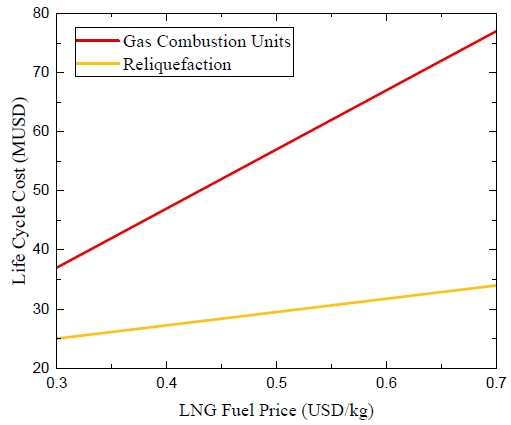
Figure 5 shows that at a sailing index of 0.6, the GCU consistently incurred the highest cost, with the cost difference between the GCU and reliquefaction ranging from approximately 12 to 55 MUSD (million USD) depending on the LNG fuel price. Figure 6 indicates that, under the same conditions, the cost difference between the AE and reliquefaction was approximately 10 MUSD. When the sailing index increased to 0.8, Figure 7 shows that the cost gap between the GCU and reliquefaction decreased to 12–43 MUSD, whereas Figure 8 shows that the difference between the AE and reliquefaction narrowed to 4–5 MUSD.
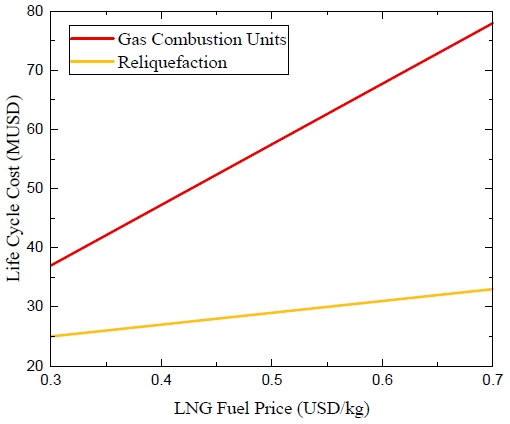
Influence of LNG price on LCC of GCU and AE for a large-scale ship. Sailing time index is 0.6, lifetime is 20 years, and LNG price ranges from 0.3 to 0.7 USD/kg
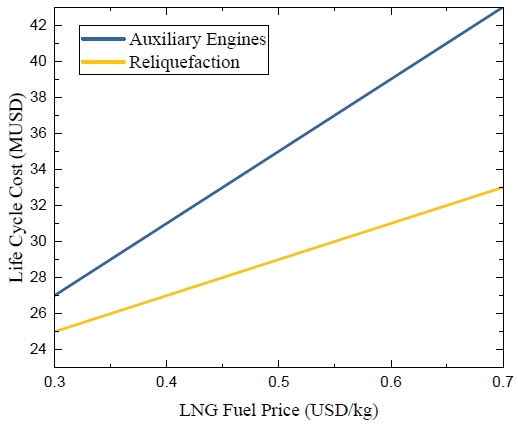
Influence of LNG price on LCC of AE and reliquefaction for a large-scale ship. Sailing time index is 0.6, lifetime is 20 years, and LNG price ranges from 0.3 to 0.7 USD/kg
Influence of LNG price on LCC of GCU and AE for a large-scale ship. Sailing time index is 0.8, lifetime is 20 years, and LNG price ranges from 0.3 to 0.7 USD/kg
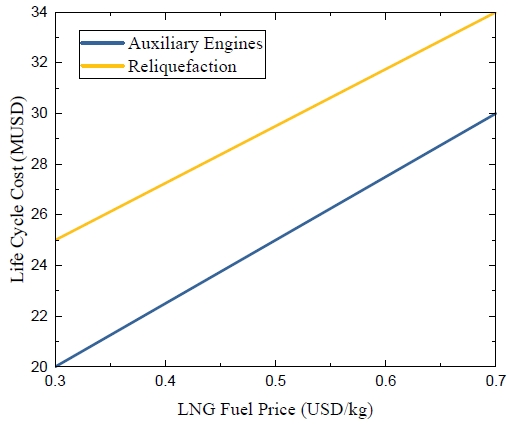
Influence of LNG price on LCC of AE and reliquefaction for a large-scale ship. Sailing time index is 0.8, lifetime is 20 years, and LNG price ranges from 0.3 to 0.7 USD/kg
These results indicate that, as the sailing index increases, utilizing BOG as an engine fuel is generally more efficient than reliquefaction. Because the initial capital cost of reliquefaction systems is significantly higher, AE utilization may remain more cost-effective than reliquefaction even when the sailing index decreases, owing to the high upfront installation expense of reliquefaction technology.
As shown in Figure 9, the amount of BOG generated in the ammonia tank was 326.4 kJ/h. Although this amount varied depending on the number of refrigerated containers loaded, it was significantly lower than the amount of fuel consumed by the main engine, with a difference of approximately 10,798.6 to 15,256.9 kJ/h. The BOG produced during sailing is sufficient for use as engine fuel. During port stays, the BOG can be managed using an AE, GCU, or a reliquefaction plant. However, because the amount of the BOG is very small, equivalent to only 2.09%–2.93% of the engine's fuel consumption, it may be more efficient to use it in an AE or to generate additional power via a fuel cell rather than using a reliquefaction system.
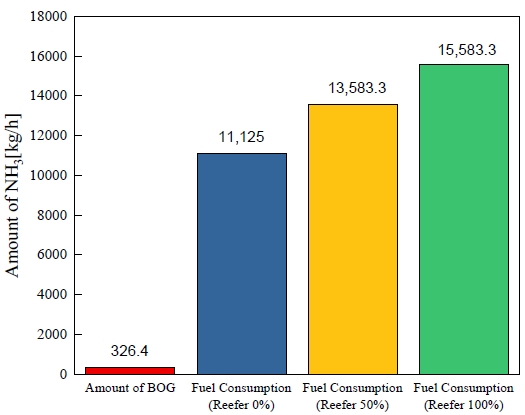
Comparison of ammonia fuel consumption according to the amount of BOG generated in ammonia tank and the number of loaded reefer container
Figure 10 depicts the amount of ammonia BOG generated with respect to output, accounting for DC stack losses. As the power demand of the DC stack increased, the required ammonia supply increased directly. Specifically, an ammonia flow of 140 Nm3/h was required to produce an output of 250 kW.
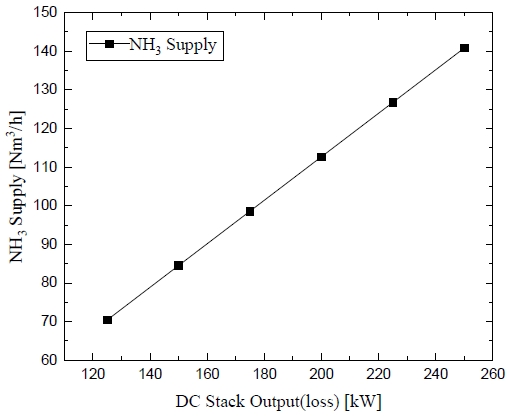
Ammonia BOG generation amount according to DC stack output (consider the loss)
Figure 11 shows the total stack voltage as a function of the output, considering the DC stack losses. The total voltage increased proportionally with output demand, reaching approximately 1811 V at 250 kW. The voltage per stack was determined based on the number of stacks employed.
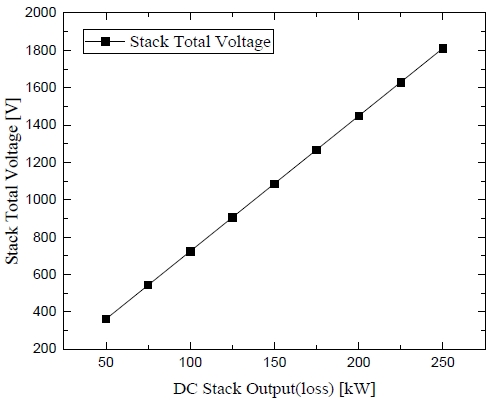
Stack total voltage according to DC stack output
Figure 12 shows the total number of cells in the stack with respect to the output, again accounting for DC stack losses. The required number of cells increased linearly with the output, amounting to approximately 2590 cells at 250 kW. The stacking configuration for each stage can be determined based on the cell voltage, stack current, and output requirements.
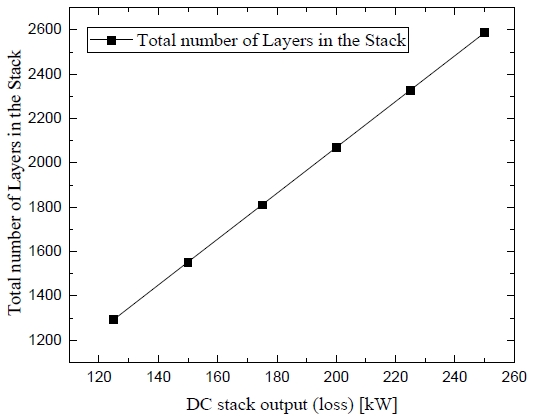
Total number of layers in the stack according to DC stack output
5. Conclusion
Various methods can be employed to manage the BOG generated in the fuel tanks of an ammonia-fueled ship, including a GCU, an AE, and a reliquefaction system. The most efficient method should be chosen by carefully considering the initial installation and overall life cycle costs.
In this study, the amount of ammonia BOG required for each output level of a fuel cell was calculated to evaluate a method capable of processing BOG while generating additional power through an SOFC directly supplied with ammonia. For a 250 kW output, the required amount of ammonia fuel is 140 Nm³/h, whereas the ammonia BOG generated in the fuel tank amounts to 429.3 Nm³/h. Accordingly, auxiliary power of 250 kW can be produced in the SOFC using 32.8% of the BOG generated in the fuel tank. The remaining 67.2% of the BOG corresponded to only 1.4% of the daily fuel consumption of the main engine. If a reliquefaction system is not installed, the remaining bog is consumed by the main or AEs.
Future research will analyze the efficiency and cost of utilizing a portion of the BOG in the ammonia fuel tank according to the type of fuel cell and determine the optimal cost-effective treatment method through comparative studies with a reliquefaction system.
Author Contributions
Conceptualization, D. H. Hwang; Methodology, D. H. Hwang; Software, D. H. Hwang; Formal Analysis, D. H. Hwang; Investigation, Y. S. Choi; Resources, T.W.Lim; Data Curation D. H. Hwang; Writing-Original Draft Preparation, D. H. Hwang; Writing-Review & Editing, T.W.Lim; Visualization, Y. S. Choi; Supervision, T.W.Lim.
References
- Report of The Marine Environment Protection Committee on Its Eighty-Third(MEPC 83/17), International Maritime Organization (IMO), 2025. Apr. 29. [Online]. Available: https://www.imo.org/en/mediacentre/meetingsummaries/pages/mepc-83rd-session.aspx
-
L. Bilgili, “A systematic review on the acceptance of alternative marine fuels,” Renewable and Sustainable Energy Reviews, vol. 182, 113367, 2023.
[https://doi.org/10.1016/j.rser.2023.113367]

-
A. Fullonton, A. R. Lea-Langton, F. Madugu, and A. Larkin, “Green ammonia adoption in shipping: Opportunities and challenges across the fuel supply chain,” Marine Policy, vol. 171, 106444, 2025.
[https://doi.org/10.1016/j.marpol.2024.106444]
-
A. Ursua, L. M. Gandia, and P. Sanchis, “Hydrogen production from water electrolysis: Current status and future trends,” Proceedings of IEEE, vol. 100, no. 2, pp. 410-426, 2012.
[https://doi.org/10.1109/JPROC.2011.2156750]
- E. R. Morgan, “Techno-economic feasibility study of ammonia plants powered by offshore wind,” Ph.D. Dissertation, University of Massachusetts Amherst, USA, 2013.
- S. Ueda, K. Tsumura, Y. Watanabe, H. Tamura, and D. Yamada, “"LNG as fuel" to "Ammonia as fuel" (Ship's fuel transition to achieve carbon neutrality),” Mitsubishi Heavy Industries Technical Review, vol. 59, no. 2, 2022.
-
K. Machaj, J. Kupecki, Z. Malecha, A.W. Morawski, M. Skrzypkiewicz, M. Stanclik, and M. Chorowski, “Ammonia as a potential marine fuel: A review,” Energy Strategy Reviews, vol. 44, 100926, 2022.
[https://doi.org/10.1016/j.esr.2022.100926]
- K. Rouwenhorst, Emission performance of ammonia-fueled, two-stroke marine engines, Ammonia Energy Association, 2025.
-
L. Xu, S. Xu, X. -S. Bai, J. A. Repo, S. Hautala, and J. Hyvönen, “Performance and emission characteristics of an ammonia/diesel dual-fuel marine engine,” Renewable and Sustainable Energy Reviews, vol. 185, 113631, 2023.
[https://doi.org/10.1016/j.rser.2023.113631]
-
M. Cheliotis, E. Boulougouris, N. L Trivyza, G. Theotokatos, G. Theotokatos, G. Livanos, G. Mantalos, A. Stubos, E. Stamatakis, and A. Venetsanos, “Review on the safe use of ammonia fuel cells in the maritime industry,” Energies, vol. 14, no. 11, 3023, 2021.
[https://doi.org/10.3390/en14113023]
-
L. Micoli, R. Russo, and T. Coppola, “Advancing zero-emission maritime solutions: Case study of an ammonia-powered fuel cell system implementation,” Energy Conversion and Management: X, vol. 22, 100588, 2024.
[https://doi.org/10.1016/j.ecmx.2024.100588]
- Ammonia Energy Association, “Low-Emission Ammonia Data (LEAD): Vessels Executive Summary,” 2025. [Online]. Available: https://ammoniaenergy.org/wp-content/uploads/2025/09/AEA-LEAD-Vessels-Executive-Summary-September-2025.pdf, .
-
C. Singh, “Ammonia as a marine fuel: Navigating the tides of decarbonization in the maritime industry,” 2025. Available: SSRN: https://ssrn.com/abstract=5224233, .
[https://doi.org/10.2139/ssrn.5224233]
-
J. Lee, Y. Choi, and J. Choi, “Techno-economic analysis of NH3 fuel supply and onboard re-liquefaction system for an NH3-fueled ocean-going large container ship,” Journal of Marine Science and Engineering, vol. 10, no. 10, 1500, 2022.
[https://doi.org/10.3390/jmse10101500]
-
C. Wang, Y. Ju, and Y. Fu, “Comparative life cycle cost analysis of low-pressure fuel gas supply systems for LNG fueled ships,” Energy, vol. 218, 119541, 2021.
[https://doi.org/10.1016/j.energy.2020.119541]
-
J. -E. Hong, S. -B. Lee, and D. W. Joh, “Development of ammonia fueled solid oxide fuel cells,” Ceramist, vol. 24, no. 4, pp. 368-385, 2021.
[https://doi.org/10.31613/ceramist.2021.24.4.08]
-
F. Zhao, Z. Wang, M. Liu, L. Zhang, C. Xia, and F. Chen, “Novel nano-network cathodes for solid oxide fuel cells,” Journal of Power Sources, vol. 185, no. 1, pp. 13-18, 2008.
[https://doi.org/10.1016/j.jpowsour.2008.07.022]
- Mærsk Mc-Kinney Møller Center for Zero Carbon Shipping (MMMCZCS), Concept design of a 15,000 TEU ammonia-fueled container vessel, 2023.
-
M. A. Budiyanto and T. Shinoda, “Stack effect on power consumption of refrigerated containers in strage yards,” International Journal of Technology, vol. 8, no. 7, pp. 1182-1190, 2017.
[https://doi.org/10.14716/ijtech.v8i7.771]
-
M. Al-Breiki and Y. Bicer, “Investigating the technical feasibility of various energy carriers for alternative and sustainable overseas energy transport scenarios,” Energy Conversion and Management, vol. 209, 112652, 2020.
[https://doi.org/10.1016/j.enconman.2020.112652]