
Influence of moisture content on the mechanical properties of birch plywood

Copyright © The Korean Society of Marine Engineering
This is an Open Access article distributed under the terms of the Creative Commons Attribution Non-Commercial License (http://creativecommons.org/licenses/by-nc/3.0), which permits unrestricted non-commercial use, distribution, and reproduction in any medium, provided the original work is properly cited.
Abstract
Plywood is a representative wood-based material that is widely utilized in various industries due to its excellent mechanical performance and cost-effectiveness. The mechanical properties of wood are strongly influenced by its moisture content, which directly affects strength, elastic modulus, and dimensional stability. In this study, the effect of moisture variation on the mechanical behavior of birch plywood was quantitatively investigated. Tensile tests were conducted under controlled environmental conditions using a universal testing machine equipped with a temperature–humidity chamber. Tensile strength increased with moisture content up to approximately 10%, but decreased sharply beyond 15%, with values at 20% approaching those observed at 0% moisture content. These findings confirm that proper moisture control is essential for ensuring the mechanical reliability of birch plywood and provide fundamental data that can contribute to the design, performance evaluation, and application of wood-based structural materials.
Keywords:
Plywood, Birch plywood, Moisture content, Mechanical properties, Tensile strength1. Introduction
Birch plywood, a wood-based structural material, has been widely used in the construction, transportation, and energy industries. Manufactured by laminating and pressing veneers in cross-grain orientations, plywood exhibits superior dimensional stability compared with solid wood, and is less prone to warping and cracking. Owing to these characteristics, plywood plays an important role in various applications such as building structures, interior materials, furniture, flooring, as well as in ships, vehicles, and packaging industries [1][2]. In addition, plywood is light-weight, highly workable, and cost-effective relative to its strength, offering significant economic advantages. The efficient use of wood resources further highlights its value as a sustainable material. Compared to the direct use of solid wood, plywood not only provides enhanced cost competitiveness but can also be manufactured in ways that improve and supplement mechanical performance.
Unlike solid wood, plywood possesses distinct composite structural characteristics. Because it is manufactured by cross-laminating veneers, the pathways of moisture diffusion are complex, and the rate and distribution of moisture migration vary depending on the fiber orientation [3]. This implies that the mechanisms of mechanical property degradation under moisture variation in plywood may differ from those of solid wood. Indeed, several studies have reported that the combined effects of fiber orientation and moisture content in plywood can result in differentiated influences on tensile strength [4][5]. Nevertheless, these investigations have generally been conducted under limited conditions, making it insufficient to comprehensively evaluate the behavior of plywood across a wide range of moisture environments.
Therefore, quantitatively clarifying the moisture-dependent mechanical properties of plywood carries significant academic and industrial implications. From an academic perspective, it can provide deeper insights into the correlation between moisture content and mechanical performance. From an industrial stand-point, such knowledge can serve as a fundamental basis for enhancing safety and reducing maintenance costs in the design and application of plywood for construction and transportation. In particular, with the growing demand for eco-friendly building materials, ensuring the reliability of wood-based structural components has become an increasingly critical challenge [6][7].
However, wood is inherently sensitive to moisture, and its mechanical properties vary considerably with changes in moisture content. Within the cellular structure of wood, both free water and bound water exist. As the moisture content changes, swelling and shrinkage of the cell walls occur, and such microscopic alterations are directly reflected in macroscopic properties, influencing strength, elastic modulus, and dimensional stability. For instance, when the moisture content is low, wood becomes dry and tends to exhibit brittle behavior, whereas high moisture content weakens the bonding between fibers, resulting in a reduction of tensile strength. In this regard, moisture content can be regarded as a critical parameter for ensuring the reliability of wood-based structural materials [8][9].
Previous studies have repeatedly reported correlations between moisture content and the mechanical characteristics of wood [4][10]. Experimental findings have shown that increasing moisture content generally leads to a reduction in tensile strength, and beyond a certain threshold, a rapid deterioration of strength occurs [11]. In addition, some studies have indicated that wood exhibits brittle fracture behavior within specific moisture ranges. Nevertheless, many of these investigations were carried out under typical atmospheric conditions or without sufficient consideration of moisture effects, thereby failing to fully reflect the diverse humidity conditions encountered in practical applications. Consequently, there remains a need for more systematic and quantitative research on the moisture–property relationship in wood.
In this study, tensile properties of birch plywood specimens were systematically examined using a universal testing machine equipped with a temperature–humidity chamber. By applying various moisture conditions, the mechanical performance of plywood was quantitatively evaluated, and the importance of moisture management as well as its implications for structural applications were addressed. The findings of this research are expected to serve as fundamental data for the stable utilization of wood-based plywood, contributing not only to academic understanding but also to industrial practices in quality control and the establishment of design criteria.
2. Experimental Preparation
2.1 Preparation of Tensile Test Specimens
Through a review of previous studies and case analyses, it was confirmed that tensile testing of plywood often exhibits considerable variability among specimens with the same moisture content, as well as issues such as stress drop. In the present study, tensile specimens were prepared in accordance with ASTM D3500-14 (Standard Test Methods for Structural Panels in Tension), and the corresponding test procedures were applied to ensure reliable mechanical property measurements and reproducibility [12].
ASTM D3500-14 is a standard that applies to plywood composed of veneer sheets and specifies the use of specimens with a reduced cross-section at the mid-length to prevent failure in the grip region. Figure 1 illustrates the tensile test specimen prepared for evaluating the moisture-dependent mechanical properties of plywood. The gauge length for strain measurement was set to 50 mm. The 12 mm thick plywood specimens consisted of nine cross-laminated veneer layers. For the X-direction specimens, four veneers were oriented parallel to the loading direction and five veneers were oriented perpendicular to it. In contrast, the Y-direction specimens contained five veneers aligned parallel to the tensile load and four veneers oriented perpendicular to it.
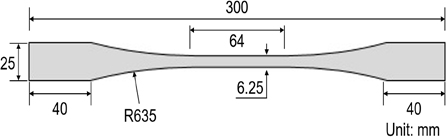
Specifications for tensile test specimens of plywood
2.2 Tensile Test Method
The mechanical property tests of plywood were conducted using a universal testing machine (UTM) equipped with an attachable temperature–humidity chamber, ensuring reliability and reproducibility of the experiments. According to ASTM D3500-14, the crosshead speed for the tensile test was set at 1.2 mm/min. The test scenarios for different moisture contents are summarized in Table 1.

Test scenarios according to moisture content(M.C.)
As illustrated in Figure 2, each specimen was designed to experience pure tensile stress at its central section. Under tensile loading, the specimens initially exhibited linear elastic behavior, followed by immediate fracture at the mid-section once the plastic region was reached. The tensile strength data of plywood specimens were obtained at the maximum stress recorded during the test.
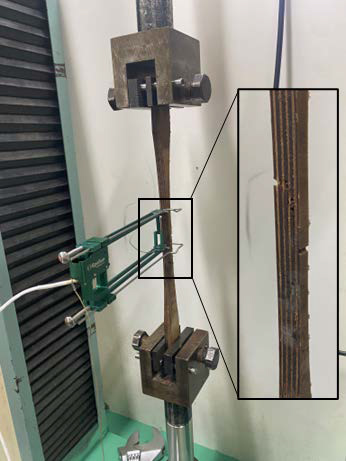
Plywood tensile test jig and photo
3. Results and Discussion
3.1 Effect of the Grip Method
The tensile test results obtained with different gripping methods are shown in Figure 3. According to ASTM D3500-14, two types of test fixtures were compared: a cast fixture and a knurling grip. Distinct differences were observed between the two methods.
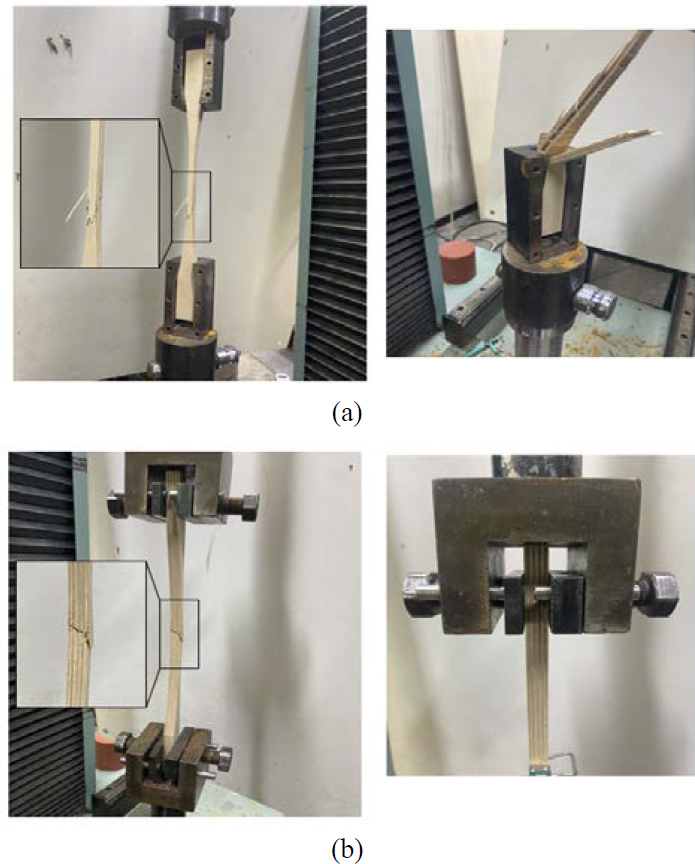
Fracture patterns of specimens depending on grip type: (a) cast fixture and (b) knurling grip
In the case of the cast fixture, indentation occurred at the neck region of the dogbone-shaped specimen due to the tensile load applied through the grips. This indentation caused specimen slip within the fixture, which resulted in a sudden stress drop in the stress–strain curve. Furthermore, the deformation was concentrated at the neck region rather than within the designated gauge length, thereby affecting the accuracy of strain measurement.
By contrast, when using the knurling grip, no slip occurred at the grip interface, and the strain of the plywood specimens could be properly measured with an extensometer. Consequently, while the ASTM D3500-14 cast fixture method introduced significant noise into the extensometer data due to indentation–slip effects, the ASTM D3500-14 knurling grip method enabled stable strain measurement. Under tensile loading, the specimens exhibited linear elastic behavior, followed by immediate fracture upon entering the plastic region, and the tensile strength of the plywood specimens was successfully obtained at the maximum stress.
3.2 Effect of Moisture Content on 12T Plywood
Figure 4(a) shows the tensile test results of 12T plywood at 0% moisture content in the X- and Y-directions, respectively. The tensile strength of the specimens at 0% moisture content was 50.7 MPa in the X-direction and 79.8 MPa in the Y-direction, corresponding to a 29.1 MPa (57.4%) increase in the Y-direction. This substantial difference highlights the effect of veneer orientation on load-bearing capacity. The fracture characteristics, shown in Figure 4(b), indicate that cracks in the X-direction specimens propagated along both X- and Y-oriented fibers, while in the Y-direction specimens, cracks initiated near the center of the gauge length and extended predominantly in the longitudinal direction, with additional diagonal cracks observed on the specimen surface. This fracture morphology suggests that the alignment of veneer layers parallel to the loading direction enhances strength but also governs the mode of failure.
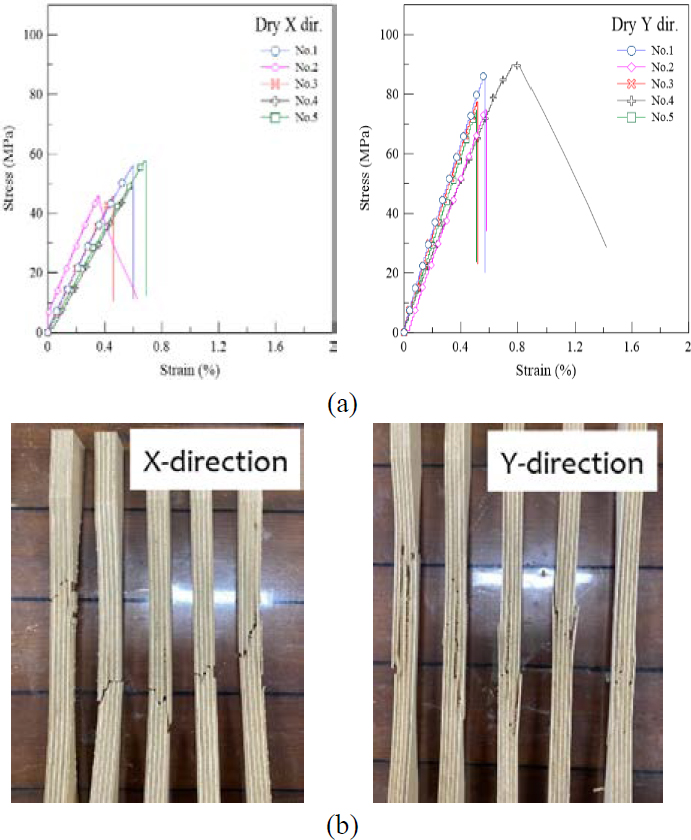
Tensile test results of 12T plywood at 0% moisture content: (a) stress-strain curve and (b) fracture characteristic of the specimen
Figure 5(a) presents the tensile test results of 12T plywood at 10% moisture content in the X- and Y-directions. Similar to the results at 0% moisture content, the Y-direction specimens exhibited on average 14.6% higher tensile strength than the X-direction specimens. The measured tensile strength values were 75.7 MPa in the X-direction and 86.7 MPa in the Y-direction, corresponding to an increase of 14.5 MPa in the Y-direction. Figure 5(b) shows the fracture characteristics of the plywood specimens. At 15% moisture content, both the X- and Y-direction specimens exhibited fracture patterns similar to those observed at 0% moisture content, suggesting that the failure mechanism is primarily governed by the orientation of the plywood veneers rather than by moisture content alone.
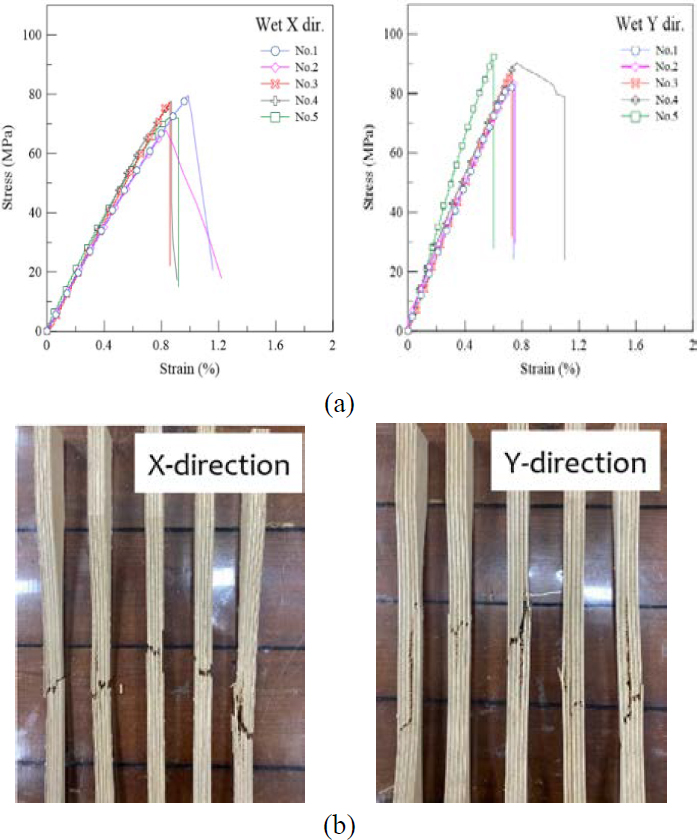
Tensile test results of 12T plywood at 10% moisture content: (a) stress-strain curve and (b) fracture characteristics of the specimen
Figure 6(a) shows the tensile test results of 12T plywood at 15% moisture content in the X- and Y-directions. At this moisture level, the tensile strength was measured as 61.1 MPa in the X-direction and 56.6 MPa in the Y-direction. Unlike the results at 0% and 10% moisture content, the difference in tensile strength between the X- and Y-directions was negligible at 15%. This suggests that, at higher moisture contents, moisture becomes a more dominant factor influencing failure behavior than veneer orientation. Figure 6(b) presents the fracture characteristics of the plywood specimens at 15% moisture content. In the X-direction specimens, partial cracking was observed within the X-oriented veneer layers. Unlike the results at 0% and 10% moisture content, however, the Y-direction specimens—which had previously exhibited relatively higher strength—also showed cracks propagating along both the X- and Y-oriented fibers, similar to the X-direction specimens.
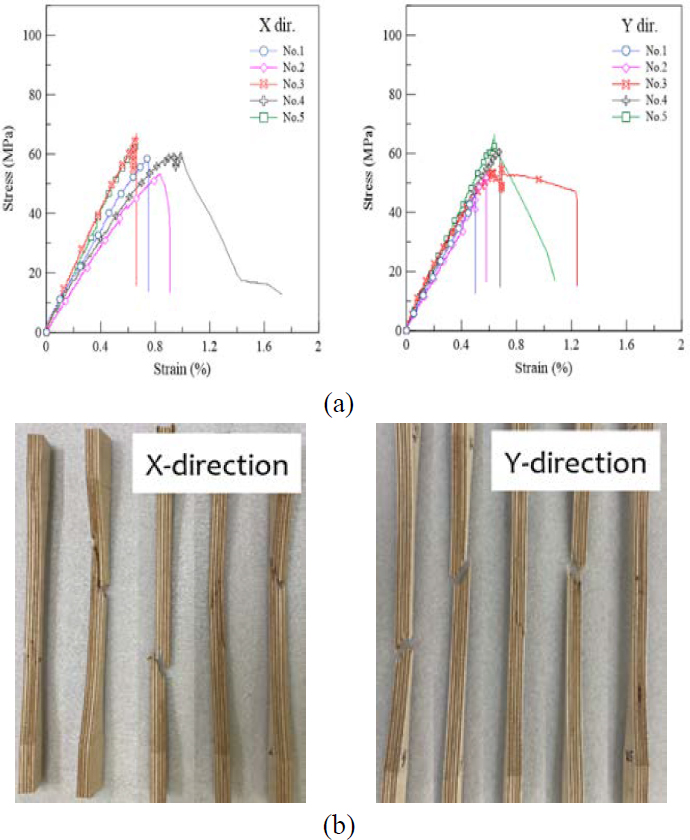
Tensile test results of 12T plywood at 15% moisture content: (a) stress-strain curve and (b) fracture characteristic of the specimen
The tensile test results of 12T plywood at 20% moisture content in the X- and Y-directions are presented in Figure 7(a). At this moisture level, the tensile strength was measured as 61.1 MPa in the X-direction and 56.6 MPa in the Y-direction. Similar to the results at 15% moisture content, the difference in tensile strength between the X- and Y-directions was negligible, indicating that veneer orientation was not a dominant factor governing failure. Figure 7(b) shows the fracture characteristics of plywood at 20% moisture content. As illustrated, the fracture patterns were similar to those observed at 15% moisture content for both the X- and Y-directions.
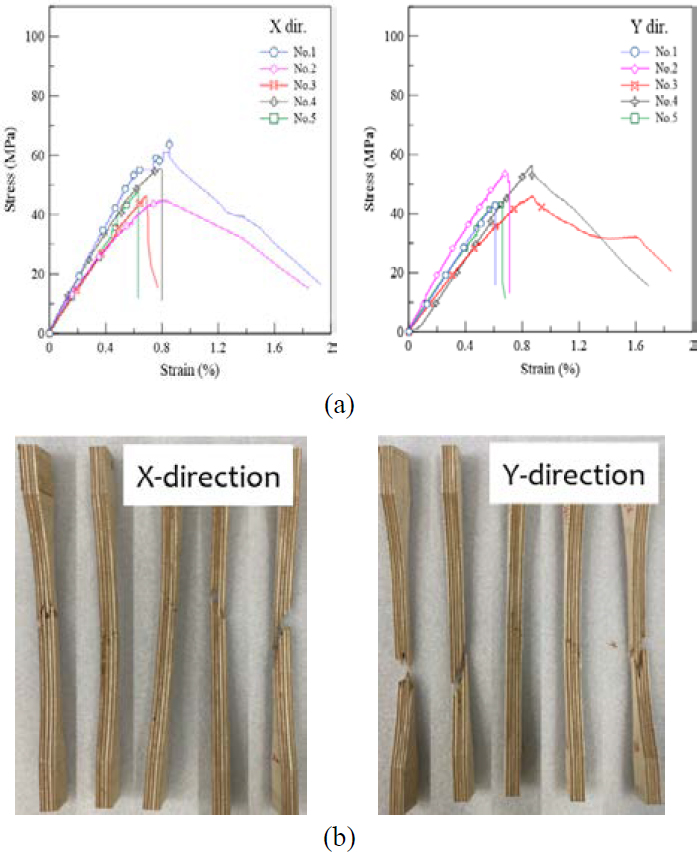
Tensile test results of 12T plywood at 20% moisture content: (a) stress-strain curve and (b) fracture characteristic of the specimen
The tensile test results of plywood obtained in this study are summarized in Table 2. The tensile strength of plywood exhibited an increasing trend with moisture content up to a certain level. This behavior can be attributed to the oven-drying process used to achieve 0% moisture content, during which heating leads to the release of bound water and consequently degrades the mechanical performance of the material under loading. While a moderate amount of moisture enhanced tensile strength, further increases—approaching 20% moisture content—resulted in a reduction in strength, comparable to that observed at 0% moisture content. In the Y-direction, tensile strength was generally higher than in the X-direction due to the greater number of veneer layers aligned parallel to the loading direction. However, similar to the X-direction, tensile strength in the Y-direction also declined sharply when the moisture content approached approximately 15%. Taken together, these findings indicate that the load-bearing performance of plywood is strongly dependent on the loading direction. Moreover, the results suggest that optimal moisture content must be carefully considered in the design and application of plywood, taking into account the orientation of the veneer layers.
Test results for tensile test of plywood (12T)
4. Conclusion
The tensile test results demonstrated that plywood exhibits brittle material behavior regardless of specimen thickness or test temperature. This tendency is attributed to the manufacturing process of plywood, where thermal treatment, pressing, and other procedures can induce embrittlement of the veneer layers.
- · The tensile behavior of plywood was significantly influenced by both the gripping method and the moisture content.
- · The knurling grip method, compared with the cast fixture, provided more reliable strain measurements by preventing slip and indentation effects, thereby enabling accurate determination of tensile strength.
- · Tensile strength increased with moisture content up to approximately 10%, but decreased sharply beyond 15%, with values at 20% approaching those observed at 0% moisture content.
- · In general, the Y-direction specimens exhibited higher tensile strength than the X-direction specimens due to the greater number of veneer layers aligned parallel to the loading direction.
- · At higher moisture levels (15%–20%), the influence of veneer orientation on tensile strength diminished, and moisture became the dominant factor controlling failure behavior.
These findings highlight the importance of considering both veneer orientation and optimal moisture content in the structural design and application of plywood to ensure reliable load-bearing performance. The present study provides fundamental data on the influence of moisture content on the mechanical properties of plywood. Nevertheless, further experimental investigations are required. Future work will focus on a more detailed study of 12T specimens and on bending strength tests, enabling a comparative analysis between tensile and bending behavior as well as an assessment of thickness-dependent effects. In addition, these extended investigations are expected to provide insights into how moisture-related mechanical performance can inform industrial guidelines and contribute to the establishment of design standards for plywood in construction and related applications.
Acknowledgments
This work was supported by a 2-Year Research Grant of Pusan National University.
Author Contributions
Conceptualization, J. H. Kim and T. W. Kim; Methodology, D. H. Lee and B. K. Hwang; Software, S. J. Cha and H. T. Kim; Formal Analysis, J. M. Lee and J. H. Kim; Investigation, T. W. Kim and D. H. Lee; Resources, B. K. Hwang; Data Curation S. J. Cha and H. T. Kim; Writing-Original Draft Preparation, J. M. Lee and B. K. Hwang; Writing-Review & Editing, J. H. Kim; Visualization, J. H. Kim; Supervision, J. M. Lee; Project Administration, J. M. Lee; Funding Acquisition, J. H. Kim and J. M. Lee.
References
-
K. W. Chun, “Technical guide for materials of containment system for hydrogen fuels for ships,” Journal of Advanced Marine Engineering and Technology, vol. 46, no. 5, pp. 212–217, 2022.
[https://doi.org/10.5916/jamet.2022.46.5.212]

-
S. J. Cha, J. D. Kim, S. K. Kim, J. H. Kim, H. K. Oh, Y. T. Kim, S. B. Park, and J. M. Lee, “Effect of temperature on the mechanical performance of plywood used in membrane-type LNG carrier insulation systems,” Journal of wood science, vol. 66, 28, 2020.
[https://doi.org/10.1186/s10086-020-01875-2]
-
J. Van den Bulcke, I. De Windt, N. Defoirdt, J. De Smet, and J. Van Acker, “Moisture dynamics and fungal susceptibility of plywood,” International Biodeterioration & Biodegradation, vol. 65, no. 5, pp. 708-716, 2011.
[https://doi.org/10.1016/j.ibiod.2010.12.015]
-
W. Li, J. Van den Bulcke, I. De Windt, J. Dhaene, and J. Van Acker, “Moisture behavior and structural changes of plywood during outdoor exposure,” European Journal of Wood and Wood Products, vol. 74, no. 2, pp. 211-221, 2016.
[https://doi.org/10.1007/s00107-015-0992-z]
-
I. Aydin, G. Colakoglu, S. Colak, and C. Demirkir, “Effects of moisture content on formaldehyde emission and mechanical properties of plywood,” Building and Environment, vol. 41, no. 10, pp. 1311-1316, 2006.
[https://doi.org/10.1016/j.buildenv.2005.05.011]
-
S. Zuo, Y. Liang, Y. Wu, S. Ge, J. Shi, X. Ma, L. Cai, J. Li, S. S. Lam, and, C. Xia, “Using environmentally friendly technology for fabricating special plywood with ultra-high strength,” Journal of Cleaner Production, vol. 396, pp. 136462, 2023.
[https://doi.org/10.1016/j.jclepro.2023.136462]
-
D. H. Lee, J. H. Bae, S. J. Cha, T. W. Kim, S. K. Kim, and J. M. Lee, “Feasibility study for design of cryogenic liquefied gas storage tank for small ship,” Journal of the Korean Society of Marine Engineering, vol. 42, no. 7, p. 546, 2018.
[https://doi.org/10.5916/jkosme.2018.42.7.546]
-
T. Wang, Y. Wang, R. Crocetti, and M. Wålinder, “Influence of face grain angle, size, and moisture content on the edgewise bending strength and stiffness of birch plywood,” Materials & Design, vol. 223, p. 111227, 2022.
[https://doi.org/10.1016/j.matdes.2022.111227]
-
S. B. Kwon, M. S. Kim, and J. M. Lee, “A numerical study on the fatigue evaluation of mark-III LNG primary barrier,” Journal of the Korean Society of Marine Engineering, vol. 41, no 4, p. 337, 2017.
[https://doi.org/10.5916/jkosme.2017.41.4.337]
-
Y. Wang, T. Wang, R. Crocetti, and M. Wålinder, “Experimental investigation on mechanical properties of acetylated birch plywood and its angle-dependence,” Construction and Building Materials, vol. 344, p. 128277, 2022.
[https://doi.org/10.1016/j.conbuildmat.2022.128277]
-
N. Horbelt, J. W. Dunlop, L. Bertinetti, P. Fratzl, and M. Eder, “Effects of moisture and cellulose fibril angle on the tensile properties of native single Norway spruce wood fibres,” Wood Science and Technology, vol. 55, no. 5, pp. 1305-1318, 2021.
[https://doi.org/10.1007/s00226-021-01315-4]
- ASTM, Standard Test Methods for Structural Panels in Tension, ASTM D3500-14, 2020.