
Weibull-based functional life analysis and calculation of zero failure test duration for pressure transmitters on LNG carriers

Copyright © The Korean Society of Marine Engineering
This is an Open Access article distributed under the terms of the Creative Commons Attribution Non-Commercial License (http://creativecommons.org/licenses/by-nc/3.0), which permits unrestricted non-commercial use, distribution, and reproduction in any medium, provided the original work is properly cited.
Abstract
This study analyzed 17 functional failures of pressure transmitters recorded during the normal operation of nine LNG carriers and calculated the zero-failure test duration required to demonstrate a development-stage B10 target. Because observation times for non-failed units were unavailable, no right-censored observations were included in the life analysis. A two-parameter Weibull model fitted to the recorded failure times yielded a shape parameter of 2.280 and a characteristic life of 152,739 hours. Separately, assuming a shape parameter of 1, an 80% confidence level, ten test units, and no allowable failures, the required duration for a target B10 life of 8,760 hours was 13,381.4 hours per unit. These results provide a quantitative basis for characterizing the recorded functional-failure times and planning reliability demonstration tests for LNG-carrier applications.
Keywords:
LNG carrier, Pressure transmitter, Weibull analysis, B10 life, Zero-failure test duration1. Introduction
On LNG carriers, the pressure conditions of LNG stored in cargo tanks must be continuously monitored, and boil-off gas (BOG) generated during loading, unloading, and voyages must be handled safely. The associated cargo storage and handling systems consist of cargo tanks, pumps, compressors, valves, and piping. Pressure within these systems is a major variable for evaluating the conditions of LNG and BOG and the operating status of the associated equipment. Pressure transmitters measure pressure in cargo tanks and piping, convert the measurements into electrical signals, and transmit them to control, alarm, and emergency shutdown systems. Functional failures such as measurement errors, fixed outputs, and unstable signals can hinder accurate assessment of cargo-system operating conditions and may result in false alarms, unnecessary equipment shutdowns, or delayed detection of overpressure and underpressure conditions. The IGC Code requires cargo-tank pressure indication and high-pressure alarms, as well as pressure indicators at cargo-pump discharge points and liquid and vapor manifolds [1]. The functional reliability of pressure transmitters is therefore important for the safe operation of LNG cargo storage, transfer, and BOG-handling systems.
Marine instrumentation is exposed to combinations of low temperature, humidity, salinity, vibration, and electromagnetic disturbances. These environmental conditions are also addressed in the type-approval testing of marine electrical, electronic, and control equipment [2]. The accumulation of environmental stresses during long-term operation can affect not only the internal electronic circuits of a transmitter but also its cables, connections, and signal-processing components. The resulting abnormalities may appear as pressure-signal hunting, loss of indication, measurement errors, or abnormal output signals. Although design verification and type-approval tests are useful for confirming equipment suitability under specified conditions, they cannot fully reproduce the combined environmental conditions and long-term degradation processes encountered during actual ship operation. Failure and maintenance records accumulated from ships therefore provide valuable information for characterizing the life of pressure transmitters under service conditions. However, these records may omit the observation times of non-failed equipment or describe failure causes only in general terms. The functional failure criteria and the scope of the analysis must therefore be clearly defined.
Previous reliability studies on pressure sensors and transmitters have primarily focused on manufacturing processes, environmental failure mechanisms, degradation prediction using calibration data, and risk assessment during the design stage. Song et al. investigated the effects of the bonding process and structural configuration of piezoresistive pressure sensors on high-temperature life-test performance and long-term stability [3]. Sagong et al. identified the mechanisms by which moisture-induced corrosion and ion migration on circuit boards cause output-signal fluctuations in hydrogen pressure sensors [4]. In the marine field, FMEA and QFD were applied to pressure sensors and transmitters for a shipboard liquid-hydrogen storage system to prioritize major failure modes and design requirements [5]. Measurement errors extracted from pressure-transmitter calibration records have also been used as degradation indicators to predict reliability and calibration intervals [6]. These studies have contributed to the evaluation of long-term stability, environmental failure mechanisms, and degradation behavior of pressure sensors. However, quantitative analyses of functional-life distributions and operating-period reliability based on pressure-transmitter failure times obtained from LNG carriers remain limited. Furthermore, few studies have addressed both operational failure-record analysis and zero-failure test-duration calculation for development products.
In this study, a two-parameter Weibull distribution was applied to 17 functional failures of pressure transmitters recorded during the normal operation of nine LNG carriers. The shape parameter, characteristic life, mean life, B10 life, and reliabilities at 1, 3, 5, and 10 years were calculated. The life estimated from the operational records was not directly adopted as the performance target for a development product. Instead, the zero-failure test duration required to demonstrate a separately specified target B10 life at a given confidence level was calculated. This study presents the functional life of pressure transmitters and the test duration required to demonstrate the target B10 life.
2. Data and Analysis Methods
2.1 Data Composition and Functional Failure Criteria
The collected records covered pressure-transmitter failures and maintenance activities on 12 LNG carriers. Three carriers had no reported pressure-transmitter failures during the investigation period. However, missing installation dates, observation end dates, and cumulative operating hours prevented their failure-free operating periods from being determined and included as right-censored observations. The remaining nine carriers provided 17 functional failure cases with identifiable failure times, which were used in the life analysis.
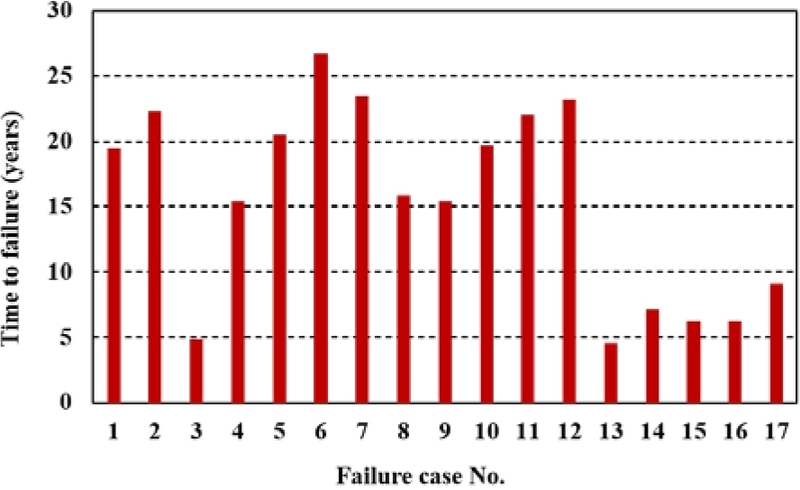
The time to failure represents the elapsed time from installation to failure. The failure times ranged from 39,576 to 234,024 hours. Table 1 presents the installation location, observed failure, estimated failure cause, installation date, failure date, and time to functional failure for each case. Figure 1 compares the failure times of the 17 cases. Cases with the same installation location represent failures of different transmitters and do not represent repeated failures of the same unit.

Functional failure records of pressure transmitters used in the life analysis
Time to functional failure for the pressure transmitters
A functional failure was defined as the inability to provide valid pressure information because of loss of indication, a fixed output, signal hunting, measurement error, or abnormal current output, thereby requiring repair or replacement. The analysis therefore included complete transmitter replacement, internal electronic-card replacement, cable reconnection, and internal moisture removal when these actions directly affected pressure measurement or signal transmission. This criterion evaluates the loss of the pressure-monitoring function rather than the physical failure mechanism of an individual component.
Accordingly, the estimated life represents the period during which the pressure instrumentation provided valid information to the shipboard control and monitoring systems, rather than the physical life of the sensing element or transmitter alone. Because observation times for non-failed units were unavailable, the life and reliability estimates characterize the distribution fitted to the 17 recorded failure times and should not be interpreted as the absolute failure probability or warranty life of the entire pressure-transmitter population.
2.2 Weibull Life Model and Reliability Measures
The 17 failure times analyzed in this study ranged from 39,576 to 234,024 hours, with the maximum value approximately 5.9 times greater than the minimum. Because such variation cannot be adequately represented by mean life alone, a life distribution is required to evaluate changes in failure probability over operating time and the characteristics of relatively short-lived units. A two-parameter Weibull distribution was therefore selected because it is applicable to positive time-to-failure data and can describe different failure-rate trends through its shape parameter [7][8]. The probability density function of the distribution is given by Equation (1).
| (1) |
Parameter estimation was performed in ReliaSoft Weibull++ using the maximum likelihood method. An exact time of functional failure was available for all 17 cases. Therefore, every observation was entered as a failure rather than as censored data. The resulting values of β and η were those that maximized the joint likelihood of the recorded lifetimes under the two-parameter Weibull model.
After the model parameters had been obtained, three quantities were derived to summarize the fitted life distribution. The reliability function R(t) gives the probability of continued operation without functional failure through time t , whereas E(T) describes the expected lifetime. To account for the shorter-lived portion that is not adequately represented by the mean, the B10 life was also calculated as the time corresponding to a cumulative failure probability of 10%. The mathematical forms of these three quantities are provided in Equations (2)-(4).
| (2) |
| (3) |
| (4) |
In Equation (3), Γ(⋅) represents the gamma function. Reliabilities at 1 year(8,760 h), 3 years(26,280 h), 5 years(43,800 h), and 10 years(87,600 h) were calculated using Equation (2).
2.3 Calculation of Zero-Failure Test Duration
The Weibull model fitted to the operational records describes the functional-life characteristics of pressure transmitters already in service. Verification of a life requirement for newly developed equipment, however, requires an independent demonstration test. This study considered a test plan in which all specimens must complete the scheduled exposure without functional failure and calculated the required duration for each specimen.
Such a test does not provide a direct estimate of the actual service life. Its purpose is to determine, with a selected level of statistical confidence, whether a prescribed reliability target or percentile life has been achieved [9][10]. When a Weibull life model is assumed and no failures are observed, the duration required for each test unit is obtained from Equation (5).
| (5) |
The symbol t0 represents the test duration assigned to each unit, and tp is the target percentile life. CL is the confidence level, n is the number of units placed on test, and p is the cumulative failure probability associated with the target life. The parameter β specifies the assumed shape of the life distribution. For a B10 requirement, p is set to 0.10.
The confidence level was established using the criticality-based approach reported by Kim and originally developed by the Reliability Evaluation Center of the Korea Institute of Machinery and Materials [11]. The assessment covered the four factors listed in Table 2. The criticality assessment, including the occurrence and severity ratings in Table 2, was performed by experts from the pressure-transmitter manufacturer with reference to the FMECA principles provided in MIL-STD-1629A[12]. Test-unit cost reflected the price of an individual pressure transmitter and the number of specimens available from the manufacturer. Test cost accounted for the power demand and electrical energy consumption associated with extended operation. Economic loss considered the possible effects of pressure-transmitter failure on shipboard monitoring and system operation. The safety criterion addressed the potential consequences of failing to detect abnormal pressure conditions.
Criticality assessment for determining the confidence level
Test-unit cost and test cost were assigned Medium occurrence and Medium severity, giving five points for each factor. Economic loss and safety were assessed as Medium in occurrence and High in severity, resulting in seven points each. The four scores produced a total criticality value of 24. Based on the classification scheme in Table 3, this value falls within Grade III, for which the corresponding confidence level is 80%. A value of CL=0.80 was therefore used in Equation (5).
Confidence level according to the cumulative criticality score
For the test-planning scenario examined in this study, the demonstration objective was set at a B10 life of 8,760 hours, equivalent to one year. This value was introduced as an initial development criterion and was not derived from the B10 life estimated from the operational records. The one-year B10 target was selected as an initial demonstration criterion for the development-stage product rather than as a target intended to reproduce the field-derived B10 estimate. A functional failure during testing was defined according to Section 2.1 as the inability to provide valid pressure indication or output. The baseline plan used ten test units and permitted no failures. Additional calculations for 20 and 30 units were performed to examine how the allocation of total test duration affects the duration required per unit. All units were assumed to operate independently for equal durations under normal-use stress, and no acceleration factor was applied.
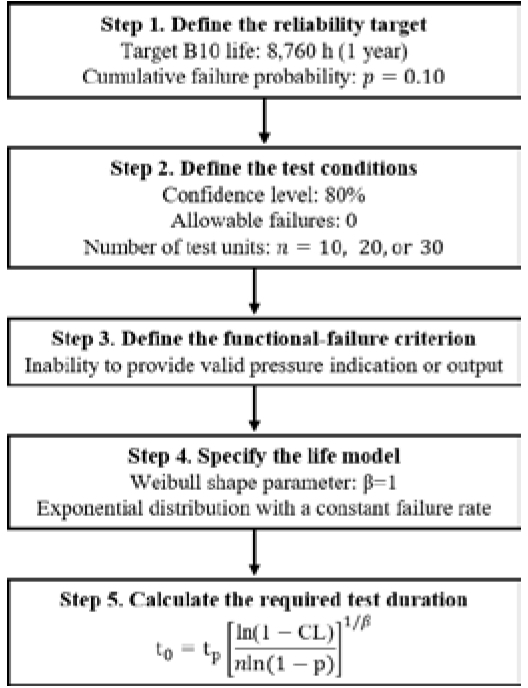
Although the operational data yielded a Weibull shape parameter of 2.280, this estimate was not transferred directly to the demonstration calculation. The 17 records include different failure phenomena associated with transmitter electronics, cable connections, moisture ingress, and signal output. Moreover, the configuration of the development product may differ from that of the units represented in the operational records. The test calculation therefore adopted β=1 , corresponding to an exponential model with a constant failure rate. The calculation sequence and principal input conditions are summarized in Figure 2.
Procedure for calculating the required zero-failure test duration
The field-derived shape parameter was not directly applied to the development product because the field records include heterogeneous failure phenomena and may not represent the failure-rate characteristics of the new product. Therefore, β = 1 was adopted as a baseline assumption for the demonstration-test calculation.
3. Life Analysis Results and Reliability Evaluation
3.1 Functional Life Characteristics of Pressure transmitters
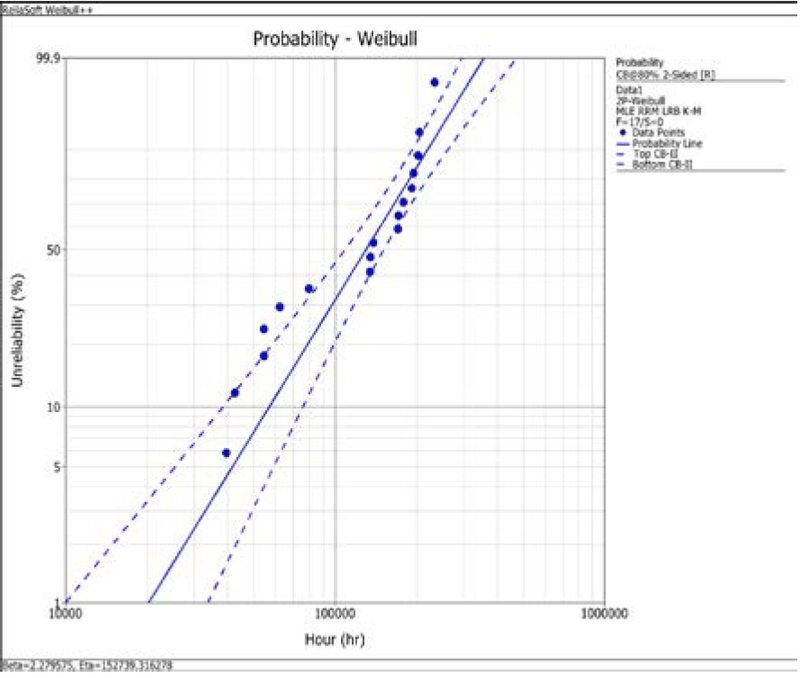
Fitting a two-parameter Weibull distribution to the 17 pressure-transmitter functional failures yielded a shape parameter of 2.280 and a characteristic life of 152,739 hours. Figure 3 presents the Weibull probability plot for the recorded failure times. Each plotted point corresponds to an individual time to functional failure. The central solid line represents the Weibull fit obtained by maximum likelihood estimation, and the two dashed lines indicate the two-sided 80% confidence bounds. The overall alignment of the data points with the fitted line provides visual support for approximating the observed lifetimes with a two-parameter Weibull model.
Weibull probability plot for pressure transmitter functional failure times
The fitted shape parameter of 2.280 suggests an increasing tendency of functional failure with operating time within the analyzed dataset. However, this interpretation should be treated with caution because of the limited number of failure observations. In addition, with only 17 failure observations, the maximum-likelihood estimate of the Weibull shape parameter may be subject to upward small-sample bias.
Moreover, Table 1 contains transmitters from different manufacturers, models, and installation locations, together with various failure symptoms such as fixed outputs, signal hunting, measurement errors, and loss of indication. The estimated shape parameter should therefore be interpreted as an overall trend in the loss of pressure-monitoring functionality during long-term operation rather than evidence of a single physical wear mechanism.
Inspection of the failure times revealed two apparent clusters. A two-component Weibull mixture model was additionally considered as an exploratory analysis. However, because only 17 failure observations were available, the mixture-model parameters were considered insufficiently robust for separate life characterization. Therefore, the single Weibull model was retained only as a descriptive characterization of the recorded failure times.
3.2 Reliability Estimates and Zero-Failure Test Results
Table 4 summarizes the mean life, B10 life, and time-dependent reliability values obtained from the fitted Weibull model. The estimated mean life was 135,301 hours, equivalent to approximately 15.45 years, while the B10 life was 56,914 hours, or approximately 6.50 years. Reliability was estimated as 99.85% at 1 year, 98.21% at 3 years, 94.37% at 5 years, and 75.46% at 10 years. These results indicate high reliability during the earlier operating period followed by a gradual increase in the probability of functional failure. Because the earliest recorded failure occurred at 39,576 hours, the 1 year and 3 years reliability values were obtained by extrapolating the fitted Weibull model below the observed data range.
Weibull life-analysis results for pressure transmitters
The B10 value of 6.50 years represents the point at which 10% of the fitted population is expected to have experienced a functional failure, leaving 90% capable of providing valid pressure information. This lower-tail measure may be used as supporting information when reviewing inspection and maintenance plans for long-serving equipment. It should not, however, be treated as a warranty life or a direct replacement interval because operating times for non-failed units were unavailable.
The field-based B10 estimate of 6.50 years and the development-test target of 8,760 hours serve different purposes. The former describes the fitted life characteristics of the existing pressure-transmitter records, whereas the latter was specified independently as an initial criterion for evaluating a development product.
The zero-failure durations calculated with an 80% confidence level, no allowable failures, and a shape parameter of 1 are listed in Table 5. With ten test units, each specimen requires 13,381.4 hours of operation, equivalent to approximately 557.6 days. If all ten units complete this duration without functional failure, a B10 life of 8,760 hours can be demonstrated at the 80% confidence level. Increasing the number of specimens to 20 or 30 reduces the required duration per unit to 6,690.7 and 4,460.5 hours, respectively. For comparison, increasing the confidence level from 80% to 90% under the same conditions increased the required test duration from 13,381.4 h (557.6 days) to 19,144.4 h (797.7 days) per unit. Because the calculated normal-use test duration is relatively long, accelerated testing may be considered to reduce the calendar duration. An appropriate acceleration model would need to be established before applying accelerated testing.
Required zero-failure test duration according to sample size
For a shape parameter of 1, the total accumulated exposure remains approximately 133,380 specimen-hours regardless of sample size. When parallel testing is available, a larger sample can therefore shorten both the exposure required per unit and the calendar duration of the test. The calculated durations do not predict the actual lifetime of the development product. Instead, they define the test exposure needed to assess whether the specified B10 target has been met.
4. Conclusion
This study analyzed 17 pressure-transmitter functional failures recorded during the normal operation of nine LNG carriers. A two-parameter Weibull model was fitted to the reported lifetimes, and the zero-failure test duration needed to demonstrate a development-stage B10 target was subsequently determined.
The fitted shape parameter was 2.280, and the characteristic life was estimated as 152,739 hours. The fitted shape parameter was 2.221, suggesting an increasing tendency of functional failure within the analyzed dataset. However, this interpretation should be treated with caution because of the limited number of failure observations. Because the dataset includes fixed outputs, signal hunting, loss of indication, measurement errors, and abnormal current outputs, this result represents the overall deterioration of pressure-monitoring functionality rather than a single wear mechanism of a specific component.
The mean life was estimated as 135,301 hours, equivalent to approximately 15.45 years, and the B10 life was 56,914 hours, or approximately 6.50 years. These values describe the Weibull distribution fitted to the 17 recorded failure times and should not be interpreted as population-level survival probabilities because observation times for non-failed units were unavailable. Rather than serving as a fixed replacement interval, the B10 life can support reviews of inspection planning and spare-unit management for long-serving equipment.
The maintenance records also contained failures associated with poor cable connections and moisture ingress in addition to transmitter malfunctions. When abnormal pressure indication occurs, examination of output signals should therefore be accompanied by checks of cable connections, sealing conditions, and possible internal moisture. Such inspections may help identify the failure source and avoid unnecessary transmitter replacement.
The B10 life derived from operational records was distinguished from the test objective specified for the development product. Because its failure-rate trend was not known in advance, a shape parameter of 1 was used for the demonstration calculation. With a B10 target of 8,760 hours, an 80% confidence level, ten specimens, and no allowable failures, the required exposure was 13,381.4 hours per unit. Increasing the sample size to 20 or 30 reduced the individual duration to 6,690.7 and 4,460.5 hours, respectively. These durations are demonstration requirements and do not constitute predictions of actual product life.
The field data analysis provides a quantitative characterization of the recorded pressure transmitter functional-failure times, while the zero-failure test calculation provides a practical basis for demonstrating a predefined B10 life target for development-stage products. Together with the identified failure modes and maintenance considerations, these results can support condition assessment, inspection planning, and reliability demonstration testing for pressure transmitters intended for shipboard application. Further collection of installation dates and operating-time data for non-failed units will allow right-censored observations to be incorporated and population-level reliability to be evaluated more appropriately. Detailed failure-cause information will enable the life estimates and maintenance criteria to be refined according to transmitter type, installation location, and operating condition.
Acknowledgments
This work was supported by a grant from the National R&D project of “Development of sensors for measuring temperature, flow and pressure (RS-2024-00430798) funded by Ministry of Trade, Industry and Energy, South Korea. All supports are gratefully acknowledged.
Author Contributions
Conceptualization, Y.H. Cho; Methodology, Y.H. Cho; Software, Y. G. Kim; Formal Analysis, J.M. Lee; Investigation, Y. G. Kim; Resources, Y. G. Kim; Data Curation J.M. Lee; Writing-Original Draft Preparation, Y. G. Kim; Writing-Review & Editing, J.M. Lee; Visualization, Y.H. Cho; Supervision, Y. G. Kim; Project Administration, Y. G. Kim; Funding Acquisition, Y. G. Kim.
References
- International Maritime Organization (IMO), Amendments to the International Code for the Construction and Equipment of Ships Carrying Liquefied Gases in Bulk (IGC Code), Resolution MSC.370(93), London, UK: IMO, 2014.
- International Association of Classification Societies, E10—Test Specification for Type Approval, Unified Requirement E10, Rev. 10, London, UK: IACS, 2023.
-
B. Song, F. Li, F. Zhu, and S. Liu, “High reliability of piezoresistive pressure sensors by wafer to wafer direct bonding at room temperature,” Sensors and Actuators A: Physical, vol. 364, Article 114834, 2023.
[https://doi.org/10.1016/j.sna.2023.114834]

-
H. Sagong, S. Jeong, and H. Lee, “Analysis of failure mechanism and reliability enhancement of silicon strain gauge-based pressure sensor for automotive applications,” Sensors, vol. 24, no. 3, Article 975, 2024.
[https://doi.org/10.3390/s24030975]
-
J. -M. Lee and Y. -G. Kim, “FMEA and QFD-based reliability evaluation of pressure sensors and transmitters for liquefied hydrogen storage systems in ships,” Journal of Advanced Marine Engineering and Technology, vol. 49, no. 4, pp. 245–255, 2025.
[https://doi.org/10.5916/jamet.2025.49.4.245]
-
B. Liu, S. Cai, H. Su, Z. Qiao, C. Wei, X. Zhao, J. Jiang, M. Jiao, F. Qin, and M. He, “Reliability modeling of field calibration data for pressure transmitters in nuclear power plants,” Nuclear Engineering and Technology, vol. 58, no. 1, Article 103878, 2026.
[https://doi.org/10.1016/j.net.2025.103878]
- Hottinger Brüel & Kjær Inc., “The Weibull distribution,” ReliaSoft Life Data Analysis Reference, 2025.
- Hottinger Brüel & Kjær Inc., “Reliability test design,” ReliaSoft Life Data Analysis Reference, 2025.
- International Electrotechnical Commission (IEC), Weibull Analysis, IEC 61649:2008, Geneva, Switzerland: IEC, 2008.
- International Electrotechnical Commission (IEC), Reliability Testing – Compliance Tests for Constant Failure Rate and Constant Failure Intensity, IEC 61124:2023, Geneva, Switzerland: IEC, 2023.
- H. E. Kim, “Korean novel concept for the reliability certification system,” Journal of Applied Reliability, vol. 6, no. 1, pp. 63–91, 2006 (in Korean).
- U.S Department of Defense, Military Standard: Procedures for Performing a Failure Mode, Effects and Criticality Analysis(MIL-STD-1629A), 1980.