
Flooding probability of conventional small-sized fishing vessels using a stochastic approach

Copyright © The Korean Society of Marine Engineering
This is an Open Access article distributed under the terms of the Creative Commons Attribution Non-Commercial License (http://creativecommons.org/licenses/by-nc/3.0), which permits unrestricted non-commercial use, distribution, and reproduction in any medium, provided the original work is properly cited.
Abstract
Capsizing represents one of the most fatal accidents in maritime operations, accounting for approximately 20% of all marine accident fatalities. In Korea, more than 96% of registered fishing vessels are classified as small-sized vessels (under 10 gross tonnages) and are thus excluded from mandatory stability and load line inspections. This regulatory gap, combined with structural characteristics such as low freeboard and simplified hull forms, makes these vessels highly vulnerable to capsizing. This study conducted hydrodynamic analyses of representative small-sized fishing vessels with conventional T-type and V-type hull forms, followed by a probabilistic analysis based on long-term wave scatter data from the Korean coast. Roll responses were compared across the different hull types, and the flooding criteria were defined based on the non-dimensional ratio of effective freeboard to depth (f/D’). The results indicated that V-type hulls exhibited significantly larger roll responses at shorter natural periods, whereas T-type hulls, despite their smaller roll responses, had stricter flooding thresholds owing to a lower freeboard ratio. Probabilistic analysis revealed significant flooding probabilities, with T-02 identified as particularly vulnerable. These findings provide fundamental insights for improving the safety guidelines and design of small-sized fishing vessels operating along the Korean coast.
Keywords:
Fishing vessel, Hull type, Hydrodynamic, Flooding probability, Stochastic approach1. Introduction
Maritime accidents remain a critical threat to safety at sea, and capsizing is recognized as one of the most fatal accident types. According to the Marine Transportation Safety Information System (MTSIS), capsizes account for approximately 20% of all fatalities in marine accidents [1].
In Korea, the fishing fleet is dominated by small-sized vessels, with over 96% of registered fishing vessels being under 10 gross tonnages and shorter than 24 m. In particular, vessels under 5 gross tonnages are the most common in Korean fishing fleet, as shown in Figure 1 [2].
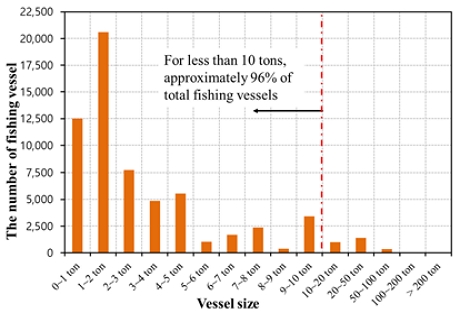
Number of fishing vessels classified by vessel size in Korea [2].
However, these vessels are exempt from mandatory stability assessments and load line inspections [3][4], resulting in a substantial regulatory gap. Structural features, such as low freeboard and simplified hull forms, further increase the vulnerability of these vessels to capsizing.
The primary mechanism underlying capsizing of small-sized fishing vessels is excessive roll motion induced by waves. As the roll response increases, the effective freeboard is rapidly reduced, leading to deck immersion and a sudden loss of buoyancy. The hull geometry plays a decisive role in this process. In Korea, small-sized fishing vessels are typically categorized into two representative hull forms: V-type (wedge-shaped) and T-type (box-shaped).
In terms of stability and operation, V-type hulls exhibit larger roll responses at shorter natural periods, causing passenger discomfort. They have high roll responses even under moderate waves and winds. Although T-type hulls exhibit smaller roll responses, they are subject to a higher flooding risk owing to lower freeboard ratio in the inclined state.
Numerous studies have investigated the safety of small-sized fishing vessels. Kang et al. experimentally confirmed deck flooding under beam sea conditions, and Park et al. analyzed roll motion characteristics at large angles [5][6]. Im and Lee compared motion responses of different tonnage classes, and Youn et al. examined roll characteristics of vessels of different sizes [7][8]. Yang and Kwon applied practical approaches to warn against capsizing according to the rolling motion [9].
Recently, Domeh et al. proposed a quantitative risk analysis (QRA) to assess the loss of stability (LoS) aboard small-sized fishing vessels, demonstrating that vulnerability is sensitive to loading conditions and wave steepness [10]. Zhang et al. developed a computational tool to evaluate the pure loss of stability in fishing vessels under various loading and sea conditions [11]. Iqbal et al. investigated the parametric roll behavior of fishing boats under different load distributions using RANS CFD simulations [12]. In Korea, Ohn and Namgung analyzed the factors contributing to capsizing of dredge fishing boats and proposed countermeasures such as uniform cargo distribution, improved gear arrangement, and early warning systems [13].
In this study, we conducted hydrodynamic analyses of representative T-type and V-type fishing vessels under 10 gross tonnages operating along the Korean coast. Flooding criteria were defined and a stochastic approach was applied using long-term wave scatter data to estimate flooding probabilities. The results are expected to contribute to improved safety assessments and guidelines for small-sized fishing vessels.
2. Methodology
2.1 Target Vessel
Most small-sized fishing vessels in Korea are constructed from fiber-reinforced plastic (FRP), which allows flexibility in hull shaping, but results in a lack of standardization among vessels of similar sizes.
For this study, two representative hull forms T-type and V-type were selected because they are the most widely adopted hull forms for Korean fishing vessels under 24 m in length. The detailed definitions of the hull types are illustrated in Figure 2.
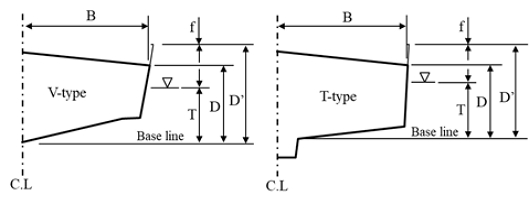
Definition of fishing vessels according to vessel type
The Korean conventional fishing vessels exhibit the following operational and performance characteristics.
- ● T-type hulls: A box keel and a flat shape, such as a prismatic type, allow less efficient high-speed navigation and resistance, but are advantageous for fishing operations because of their increased cargo capacity.
- ● V-type hulls: A sharper keel and a wedge shape, allow greater efficiency at high speeds but result in large roll responses and reduced cargo capacity.
In this study, four numerical models were developed based on the hull shape: T-01, T-02, V-01, and V-02, each representing different variations within the two hull forms. Their principal dimensions, including length (L), beam (B), depth (D’), and freeboard (f), are summarized in Table 1. The loading conditions were considered as fully loaded conditions, with a maximum draft, in a conservative manner.

Hull specifications of target fishing vessels used for hydrodynamic analysis
2.2 Numerical Modeling
Hull geometries for numerical analysis were modeled using the 2D panel method, with overall panel sizes of 0.15 to 0.20 m to capture geometric features. The grids were carefully designed to preserve the hull distinctions. The models used in this analysis are illustrated in Figure 3. The boundary condition was applied using a symmetric model, and one-way rigid body motion was assumed.
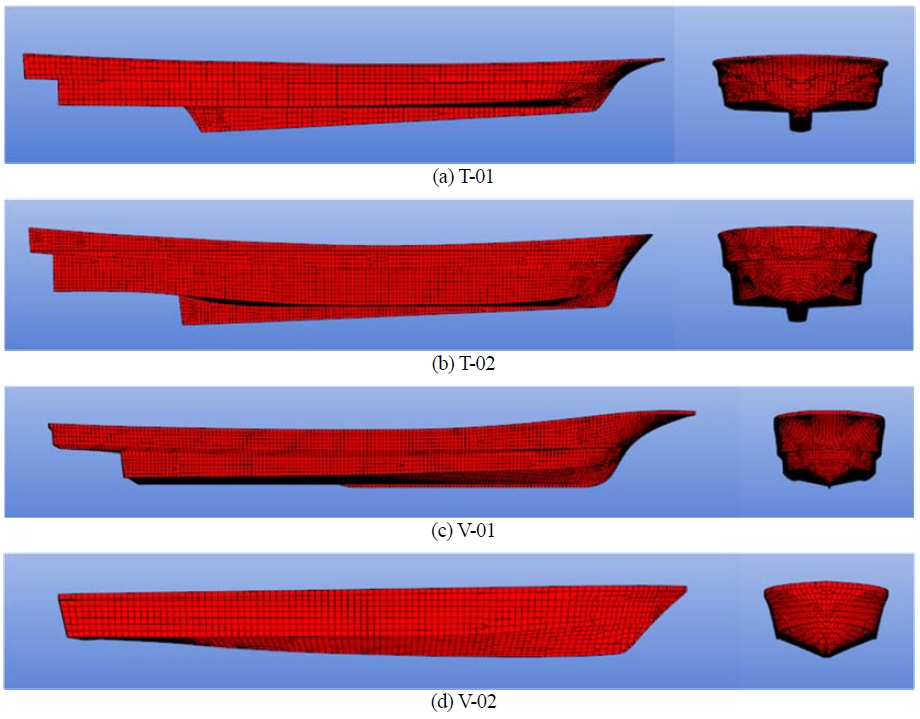
Hydrodynamic models according to hull type
2.3 Analysis Conditions
Hydrodynamic analyses were performed using BV HydroStar [14]. The wave frequency range was set from 0.3 to 3.0 rad/s in increments of 0.1 rad/s, and wave headings were varied from 0 to 180° in 15° intervals, assuming a symmetric condition.
The roll damping effect is assessed based on its relationship with the vessel’s main particulars [15]. The analytical conditions are listed in Table 2.
Conditions for hydrodynamic analysis
2.4 Validation
A mesh-size sensitivity analysis was conducted to verify the reliability of the hydrodynamic analysis. Three mesh densities (fine, medium, and coarse) were used as representatives, and the corresponding simulation conditions are summarized in Table 3. Figure 4 shows that the comparison of the response amplitude operator (RAO) results exhibit negligible differences across the mesh densities, confirming that the mesh resolution was sufficiently refined with respect to the characteristic wavelength and wave height, thereby ensuring that the vessel motions were accurately captured.
Condition for mesh-size sensitivity analysis (T-01)
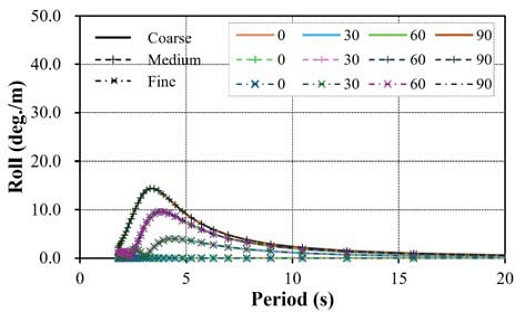
Comparison of RAO in mesh-size sensitivity analysis (T-01).
3. Hydrodynamic Analysis
3.1 Roll Motion Response Characteristics
The roll motion was quantified in terms of RAO for each hull type. RAOs typically serve as fundamental indicators for evaluating the dynamic behaviors and motions under varying sea states. The maximum roll response occurred under beam sea conditions. The maximum roll RAO of T-type was 14.3°/m for T-01 and 25.2°/m for T-02, with a peak period range of 3.3 to 4.8 s. The maximum roll RAO of the V-type was 27.0°/m for V-01 and 32.3°/m for V-02, with a peak period range of 3.0 to 3.9 s. The specific roll motion responses are shown in Figure 5.
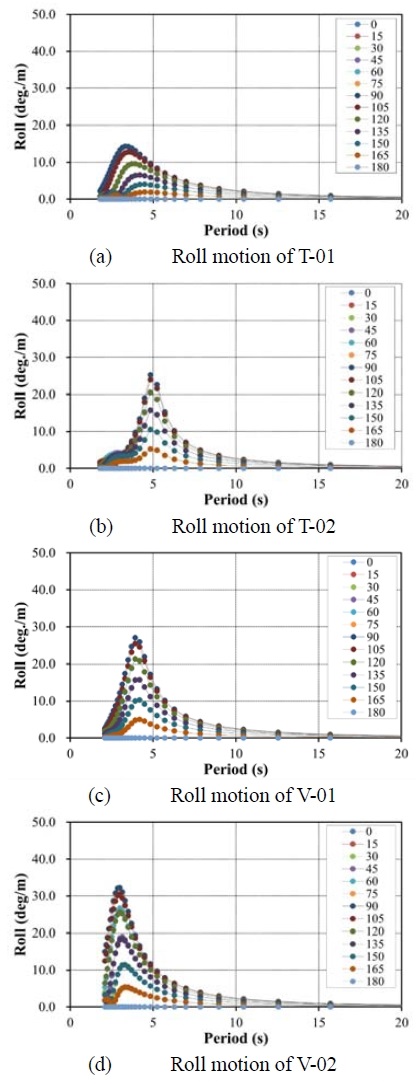
Response of the roll motion according to hull type
3.2 Results and Discussion
Hydrodynamic analysis indicated distinct operational implications for each hull type. Overall, the T-type hulls showed smaller roll responses than the V-type hulls. By contrast, the V-type hulls demonstrated considerably larger roll responses than the T-type hulls. The wedge-shaped hull of a V-type vessel induced a higher roll response in the restoring moments when it interacted with fluctuating waves. Based on these results, the following conclusions are drawn.
- ● Hull type: V-type hulls exhibit relatively higher roll responses than T-type hulls, which may result in increased short-term vulnerability.
- ● Periods: The period ranges from 3.3 to 4.8 s induced by larger roll acceleration, which may increase passenger discomfort such as seasickness, particularly when encountering short period waves.
- ● Although no significant differences were observed in the response characteristics according to hull type, a relatively smaller response of T-01 was obtained because of its larger GM value compared with the other vessel types, which resulted in reduced dynamic roll motion. In addition, unlike the other models that show sharp and prominent RAO peaks, the RAO peak of T-01 was relatively smooth and gradual, which is attributed to its larger metacentric height (Table 4).
Comparison of metacentric height according to hull type
Therefore, vessel safety cannot be evaluated solely based on the RAO magnitudes. Structural vulnerabilities associated with an actual effective freeboard depending on inclined hulls and wave characteristics at Korean-specific sites must also be considered, motivating the stochastic analysis described in Section 4.
4. Stochastic Analysis
4.1 Stochastic Analysis Procedure
The stochastic framework combined rolling motion responses with flooding criteria and long-term wave statistics.
- ● Hydrodynamic analyses in the frequency domain were performed for both T-type and V-type vessels, as defined in Section 2.
- ● RAOs of roll motion were obtained to evaluate the significant behavior.
- ● The effective freeboard (f) under inclined-roll conditions was measured and normalized by the depth (D’) to define the capsizing criterion (f/D’).
- ● Flooding criteria were derived.
- ● Wave–scatter diagrams were developed using long-term wave data obtained from marine buoys operated by the Korea Meteorological Administration.
- ● Spectral-based probabilistic analysis was then performed.
4.2 Derivation of Flooding Criterion
Flooding occurs when the inclination-dependent freeboard ratio (f/D’) reaches zero in an inclined-roll state, which defines the flooding criterion. A schematic overview of the flooding criterion is illustrated in Figure 6.
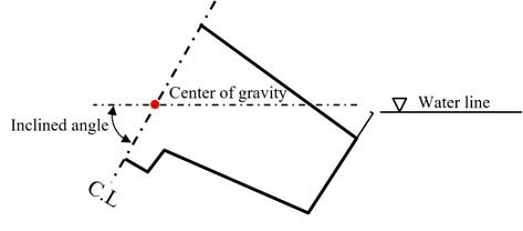
Schematic of flooding criterion
Parameters f and D’ at each inclined state were measured in the equilibrium state. In this study, the nondimensional ratio of freeboard to depth (f/D’) was used as the capsizing criterion. The flooding criteria were derived for the initiation of deck immersion in an inclined-roll state. The flooding criteria were derived from the relationship between the measured freeboard ratio and the inclined angles, as shown in Figure 7.
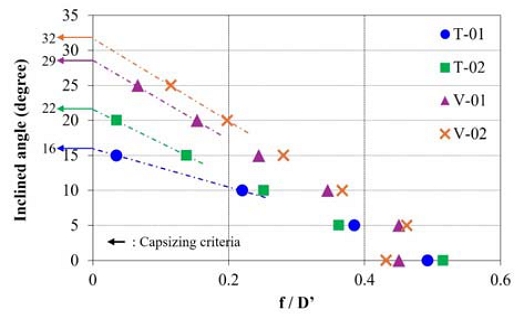
Relationship between inclined angle and freeboard ratio according to hull type
The flooding criteria indicated clear differences between the hull types. V-type hulls can survive at higher inclination angles of up to approximately 30°. This may result in a greater safety margin owing to the deck flooding and capsizing risks. By contrast, T-type hulls may survive relatively lower inclined angle under 22°, which may result in a higher vulnerability to deck flooding and capsizing risks, leading to relatively larger f/D’ values.
4.3 Development of the Wave Scatter Diagram
Figure 8 shows a wave scatter diagram developed using buoy measurements along the Korean coast [16]. Daily maximum significant wave heights (Hs) and peak periods (Tp) were statistically processed to construct a 20-year scatter diagram reflecting realistic coastal wave environments. The significant wave height of 0.5 m corresponds to a peak period of 4.5 s.
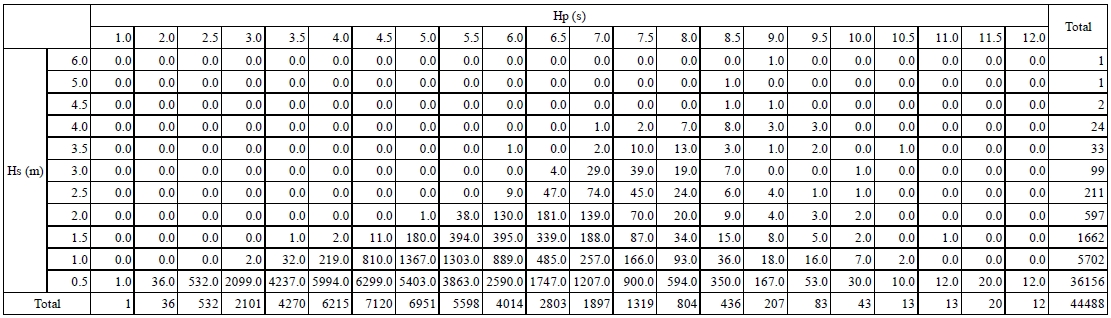
Wave scatter measurements from marine buoys around the coasts of Korea. [16]
4.4 Spectral-based Probabilistic Analysis
Statistical calculations were performed using BV Starspec [17], which enabled the estimation of exceedance probabilities for deck flooding under realistic long-term wave conditions. The Pierson–Moskowitz (P–M) spectrum was applied to describe the wave energy distribution, which was then coupled with the roll RAOs of each hull type.
4.5 Results and Discussion
The probability of flooding-criteria exceedance is shown in Figure 9. Probabilistic analysis showed differences between hull types based on flooding criteria. Although the correlation between hull type and capsizing risk was not clearly distinguishable, the analysis confirmed that all hull types exhibited substantial capsizing risk, irrespective of their geometric characteristics. The capsizing risk is likely governed more by the roll response amplitude than by hull type. Among the analyzed models, T-01 exhibited the smallest roll amplitude at the same probability level, indicating the lowest susceptibility to deck immersion. The other hull types generally exhibited similar probabilities and gradients, with their risk levels primarily shaped by the amplitude and sharpness of the response peaks. The allowable roll angles corresponding to the critical capsizing probabilities were examined by coupling the probability level with the flooding criteria derived in Section 4.2 (flooding criteria by deck immersion). The results indicated that T-02 exhibited the highest capsizing risk despite having a larger safety margin against deck flooding. This is attributed to its significantly higher RAO amplitude, which drives a large motion acceleration and increases seasickness. Considering a feasible operating duration of approximately 24 h per day, the vessels exhibited deck-flooding probabilities, even in moderate coastal states. The probability of wave cycle for roll motion This represents the worst condition, assuming heading direction encountered exclusively from the beam direction.
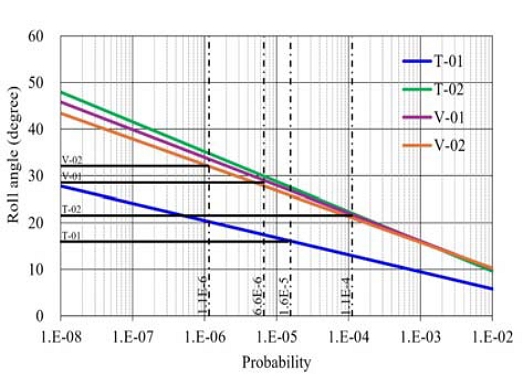
Probability of flooding-criteria exceedance according to hull type for only beam sea
However, in practice, fishing vessels actively apply steering corrections to avoid beam sea. Such operational behavior is expected to act as a mitigating factor, reducing the roll frequencies, and consequently lowering the likelihood of deck flooding during actual operations.
Therefore, this study considered a series of risk scenarios by incorporating steering adjustments based on wave direction during operation. Figure 10 illustrates the flooding risk scenarios as functions of wave direction and heading. Case 1: The vessel heading was actively controlled within 30° range relative to the head sea, representing a strict steering correction. Case 2: The vessel heading was controlled within 60° range, representing moderate steering adjustments in the oblique sea. Case 3: The vessel heading was allowed to vary by up to 90° range, representing minimal steering corrections in all directions. These cases are intended to represent realistic operational behaviors in which fishing vessels attempt to avoid roll resonance and reduce discomfort such as seasickness induced by the beam sea.
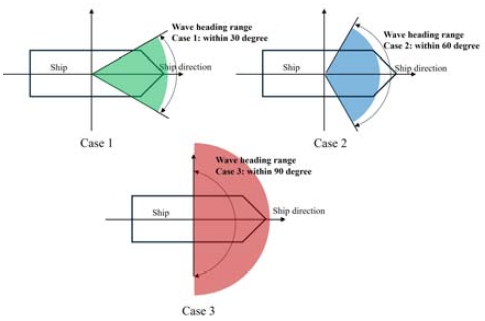
Flooding probability according to wave heading
The results of the different scenarios are presented in Table 5. High risks exceeding the probability for daily roll cycles are indicated in red. Moderate risks are lower than the probability for daily roll cycles but within 10 times the range and are indicated in orange. Risks with probabilities less than 10 times the margin of probability for daily roll cycles are indicated in green. In this study, assuming continuous 24-hour daily operation, a conservative approach with an added safety margin was adopted.
Results of flooding probability for different scenarios
The daily roll probability level was considered based on an average wave period of approximately 4.5 s around the Korean coast [18]. The results are summarized as follows.
- ● Case 1: Deck immersion and capsizing risks were safe for most hull types with restricted steering control and operation from the beam sea.
- ● Case 2: A relatively elevated roll sensitivity was observed in T-02, requiring cautious operation despite the probabilities not exceeding the probability of daily roll cycles.
- ● Case 3: T-type hulls showed a high risk of flooding and caused earlier deck immersion, whereas V-type hulls retained comparatively higher stability and flooding tolerance under wider steering adjustments.
5. Conclusion
This study investigated the flooding and capsizing risks of conventional small-sized fishing vessels operating along the Korean coast by applying a combined framework of frequency-domain hydrodynamic analysis and a long-term stochastic probability approach. Four representative vessel models were analyzed to evaluate the influences of hull type and motion characteristics on deck immersion vulnerability. The major conclusions of this study are summarized as follows.
- 1. The hydrodynamic roll responses exhibited clear differences between the hull types, with V-type vessels showing significantly larger roll RAO amplitudes during short natural periods. These responses indicate a relatively higher short-term vulnerability and increased susceptibility to dynamic significance under moderate wave conditions. By contrast, T-type hulls exhibited smaller roll responses but possessed lower effective freeboards, resulting in stricter flooding thresholds in inclined states.
- 2. The flooding criteria derived from the freeboard-to-depth ratio (f/D’) revealed geometric vulnerability. The V-type hulls sustained larger inclined angles before immersion, whereas the T-type hulls reached deck-immersion thresholds earlier. These geometric differences indicate that geometric characteristics alone cannot reliably represent actual capsizing risks, and it is necessary to consider additional measures such as dynamic roll performance and probabilistic evaluation.
- 3. Probabilistic flooding analysis using long-term wave scatter data demonstrated that all hull types exhibited non-negligible flooding probabilities in realistic Korean coastal environments. T-01 displayed the smallest roll motions at equivalent probability levels, whereas T-02 exhibited the highest flooding and capsizing vulnerabilities, despite its larger flooding criteria. This is attributed to the significantly dominant RAO peaks.
- 4. When the exceedance probabilities were extended to a representative 24-hour operating duration, vessels showed a significant likelihood of deck-immersion even at moderate roll angles from gentle sea states. The worst-case assumption was considered as a beam sea encounter without steering correction. Three operational wave-heading scenarios were examined to reflect realistic behaviors during fishing operations.
- ● Case 1: all hull types maintained safe flooding probabilities.
- ● Case 2: T-02 required caution due to enhanced roll sensitivity.
- ● Case 3: T-type hulls showed an increased flooding risk and earlier deck immersion, whereas V-type hulls demonstrated comparatively higher capsizing stability margins owing to their greater dynamic restoration capability and higher flooding criteria.
- 5. Overall, the study confirms that the capsizing vulnerability of small fishing vessels is governed more dominantly by the dynamic roll amplitude and beam sea wave exposure duration than by the hull type classification. Furthermore, the active steering employed in real fishing operations is expected to reduce the effective roll-resonance encounter duration and consequently mitigate practical flooding risks compared with conservative numerical predictions.
- 6. Future research should address several remaining challenges, such as nonlinear time-domain verification, full-scale onboard motion measurements, real operational heading statistics, and loading-distribution interaction effects, to further advance regulations capsizing risk and stability regulations for Korean coastal fishing vessels.
Acknowledgments
This research was funded by the Korea Maritime Transportation Safety Authority (KOMSA) as part of the 2025 internal research and development project, “Update and Development of the K-SHIP Program”
Author Contributions
Conceptualization, J. H. Pyun; Methodology, J. H. Pyun, M. H. Kim, J. H. Kim and S. G. Ryu; Formal Analysis, J. H. Pyun, J. H. Kim; Resources, J. H. Pyun and J. H. Kim; Writing-Original Draft Preparation, J. H. Pyun; Writing-Review & Editing, J. H. Pyun, M. H. Kim and S. G. Ryu; Supervision, M. H. Kim; Project Administration, S. G. Ryu; Funding Acquisition, S. G. Ryu.
References
- MTSIS (Maritime Transportation Safety Information System), Marine Accident Status Statistics, Available: https://mtis.komsa.or.kr/ana/accTypeStat#top, .
- Government of Korea, Statistical Yearbook of Fishing Vessels, Ministry of Oceans and Fisheries, Republic of Korea, 2022.
- Government of Korea, Structure and Equipment Standards for Small Fishing Vessels with a Gross Tonnage of Less than 10 Tons, Ministry of Oceans and Fisheries Notice, No. 2020-13, 2020.
- Government of Korea, Stability and Load Line Standards for Fishing Vessels, Ministry of Oceans and Fisheries Notice, No. 2019-86, 2019.
-
I. K. Kang, H. S. Kim, M. S. Kim, Y. W. Lee, J. C. Kim, H. J. Jo, and C. K. Lee. “Characteristics on the rolling response of a small fishing boat according to the waves and the ship's speed,” Journal of the Korean Society of Fisheries and Ocean Technology, vol. 43, no. 1, pp. 62-70, 2007.
[https://doi.org/10.3796/KSFT.2007.43.1.062]

-
R. S. Park, S. G. Kim, and J, B. Lee, “Study on motion response characteristics for large inclined state of small fishing vessel in beam sea condition,” Journal of Ocean Engineering and Technology, vol. 25, no. 6, pp. 17-22, 2011.
[https://doi.org/10.5574/KSOE.2011.25.6.017]
-
N. K. Im and S. M. Lee, “A study on motion response of small fishing vessels according to various tonnage in regular wave,” Journal of the Korean Society of Marine Environment & Safety, vol. 27, no. 6, pp. 832-838, 2021.
[https://doi.org/10.7837/kosomes.2021.27.6.832]
-
D. H. Youn, L. C. Choi, and J. H. Kim, “Motion response characteristics of small fishing vessels of different sizes among regular waves,” Journal of Ocean Engineering and Technology, vol. 37, no. 1, pp. 1-7, 2023.
[https://doi.org/10.26748/KSOE.2022.032]
-
Y. J. Yang and S. Y. Kwon, “Rolling motion simulation in the time domain and ship motion experiment for algorithm verification for fishing vessel capsizing alarm systems,” Journal of the Korean Society of Marine Environment & Safety, vol. 23, no. 7, pp. 956-964, 2017.
[https://doi.org/10.7837/kosomes.2017.23.7.956]
-
V. Domeh, F. Obeng, F. Khan, N. Bose, E. Sanli, “Loss of stability risk analysis in small fishing vessels,” Ocean Engineering, vol. 287, 115780, 2023.
[https://doi.org/10.1016/j.oceaneng.2023.115780]
-
H. Zhang and K. Li, “Assessment of fishing vessel vulnerability to pure loss of stability using a self-developed program,” vol. 12, no. 4, 527, 2024.
[https://doi.org/10.3390/jmse12040527]
-
M. Iqbal, M. Terziev, T. Tezdogan, and A. Incecik, “Unsteady RANS CFD simulation on the parametric roll of small fishing boat under different loading conditions,” Journal of Marine Science and Application, vol. 23, pp. 327-351, 2024.
[https://doi.org/10.1007/s11804-024-00427-0]
-
S. Ohn and H. Namgung, “Cause analysis and countermeasure for capsizing accident of a dredge fishing boat,” Journal of International Maritime Safety, Environmental Affairs, and Shipping, vol. 8, no. 4, 2024. Available:
[https://doi.org/10.1080/25725084.2024.2417528]
- Bureau Veritas, Hydrostar User Guide, Bureau Veritas, 2020.
-
D. W. Park, K. Lee, and J. Seo, “Evaluation of the seakeeping performance indices for enhancing crew safety and workability in small fishing vessels,” Journal of Ocean Engineering and Technology, vol. 38, no. 6, pp. 336-349, 2024.
[https://doi.org/10.26748/KSOE.2024.068]
- Government of Korea, Stability and Load Line Standards for Fishing Vessels, Ministry of Oceans and Fisheries Notice, No. 2019-86, 2019.
- Korea Meteorological Administration (KMA), Open Data Service, Available at: https://data.kma.go.kr, .
- Bureau Veritas, Starspec User Manual, Bureau Veritas, 2019.
-
U. J. Lee, D. H. Ko, J. Y. Kim, and H. Y. Cho, “Estimation and analysis of wave spectrum parameter using HeMOSU-2 observation data,” Journal of Korean Society of Coastal and Ocean Engineers, vol. 33, no. 6, pp. 217-225, 2021.
[https://doi.org/10.9765/KSCOE.2021.33.6.217]
-
U. J. Lee, W. M. Jeong, and H. Y. Cho, “Estimation and analysis of JONSWAP spectrum parameter using observed data around Korean coast,” Journal of Marine Science and Engineering, vol. 10, no. 5, p. 578, 2022.
[https://doi.org/10.3390/jmse10050578]
- Ocean Climate Prediction Center, 2024 Ocean Climate State and Trends, Available: https://www.ocpc.kr/, .