
Dispersion characteristics of liquefied natural gas in a fuel preparation room

Copyright © The Korean Society of Marine Engineering
This is an Open Access article distributed under the terms of the Creative Commons Attribution Non-Commercial License (http://creativecommons.org/licenses/by-nc/3.0), which permits unrestricted non-commercial use, distribution, and reproduction in any medium, provided the original work is properly cited.
Abstract
This study investigated the dispersion characteristics of liquefied natural gas (LNG) in a confined space of a fuel preparation room under accidental leakage conditions. Eleven leakages and simulation scenarios were simulated using FLACS-CFD V22.2 to analyze the spatial and temporal evolution of LNG vapor dispersion within an enclosed environment. These scenarios encompassed variations in leak size, release direction, and ventilation rate to comprehensively assess the effects of key parameters on gas accumulation and dispersion behavior. The results revealed that the leakage orientation and ventilation efficiency significantly influenced the concentration distribution and dilution rate of the LNG vapor. In particular, inadequate ventilation and low air exchange rates lead to the creation of persistent high-concentration zones near the floor owing to the dense property of the cold LNG vapor. These findings provide critical insights for the design and safe operation of fuel preparation rooms and the establishment of reliable ventilation and gas detection strategies. This study contributes to enhancing the safety of LNG-fueled ships by offering practical recommendations for minimizing flammable gas accumulation and improving hazard prevention in enclosed fuel preparation rooms.
Keywords:
LNG, Fuel preparation room, Safety assessment, Risk analysis1. Introduction
Maritime transportation continues to serve as the backbone of international trade and is the most energy-efficient and economically viable means of transporting goods worldwide. Maritime shipping is estimated to account for more than 80% of the total global commerce volume, forming an indispensable component of modern logistics networks. Despite its efficiency, the shipping industry is a significant contributor to global greenhouse gas emissions. According to the International Maritime Organization (IMO), maritime activities were responsible for approximately 1,076 million tons of CO2 emissions in 2018, corresponding to nearly 2.9% of the total anthropogenic emissions worldwide [1]. This contribution is projected to further increase in the absence of effective mitigation strategies, particularly with the continuous expansion of global trade and shipping capacities.
To address this growing environmental challenge, the IMO has adopted an ambitious strategy to achieve the decarbonization of international shipping. The organization has set clear milestones, including achieving net-zero emissions by the middle of the 21st century [2]. In the short and medium terms, additional targets have been defined, such as reducing the carbon intensity of ships by 40% by 2030 and 70% by 2040. To ensure the realization of these objectives, the IMO has introduced a series of regulatory instruments, including MARPOL Annex VI, which sets limits on emissions of sulfur oxides (SOx) and nitrogen oxides (NOx), as well as frameworks such as the Ship Energy Efficiency Management Plan, the Energy Efficiency Design Index, and the Energy Efficiency Existing Ship Index. Collectively, these measures promote technological innovation, operational optimization, and the adoption of low- and zero-carbon fuels as key pathways for sustainable shipping.
Within this global transition, liquefied natural gas (LNG) has emerged as a promising transitional fuel in the maritime sector. Because of its relatively low carbon-to-hydrogen ratio, LNG combustion results in approximately 20–25% lower CO₂ emissions than conventional marine fuels, such as heavy fuel oil (HFO) or marine diesel oil. Furthermore, it complies with the IMO Tier III requirements for NOx and SOx emissions without the need for additional exhaust gas treatment systems. These environmental and operational benefits have spurred significant interest and investments in LNG-fueled ships and bunkering infrastructure worldwide.
From a physicochemical perspective, LNG is a cryogenic liquid primarily composed of methane (typically above 90%) and small fractions of ethane, propane, and other light hydrocarbons. It is stored and handled at extremely low temperatures (approximately –162 ℃), and near atmospheric pressure. Although LNG has environmental advantages, its use introduces new and complex safety challenges owing to its low temperature, high volatility, and potential for rapid phase transition upon accidental release. When a leakage occurs, the cryogenic liquid vaporizes quickly, forming a cold and dense gas cloud that tends to remain close to the ground or accumulate in confined spaces owing to gravitational effects. Such vapor clouds can become flammable when the methane concentration is between the lower flammable limit (approximately 5%) and upper flammable limit (approximately 15%). If ignition occurs within this concentration range, the resulting combustion or explosion can cause severe structural and human damage.
Although numerous studies have focused on the dispersion behavior of LNG vapor during open-air bunkering operations, particularly in port and coastal environments, comparatively few investigations have examined LNG leakage and dispersion within the enclosed or semi-enclosed compartments of ships [3][4]. In particular, a fuel preparation room, which houses the equipment related to LNG fuel conditioning and supply, presents unique safety concerns. This compartment is typically located below the deck, where limited ventilation, complex geometries, and obstacles such as piping systems and machinery can significantly affect the dispersion and accumulation of leaked gas. Understanding the behavior of LNG vapor under such confined conditions is critical for ensuring the safety of personnel, preventing fire and explosion hazards, and designing effective ventilation and leakage detection systems.
Traditional deterministic and empirical approaches to defining safety zones are often insufficient for capturing the dynamic and spatially complex behavior of gas dispersion in such confined environments. Therefore, advanced numerical modeling tools, particularly those based on computational fluid dynamics (CFD), are increasingly being adopted for detailed safety analyses. CFD enables the simulation of fluid flow, heat transfer, and gas dispersion under realistic boundary conditions, providing valuable insights into the effects of leak rate, release direction, ventilation efficiency, and room geometry on gas concentration evolution.
This study employed FLACS-CFD V22.2, a widely recognized CFD program for consequence and safety analyses, to systematically analyze the dispersion characteristics of LNG in a marine fuel preparation room. Eleven leakage scenarios were modeled, encompassing variations in leak orientation, rate, and ventilation conditions. The objectives of this study were to identify the critical factors influencing the formation and persistence of high-concentration gas zones and to quantify how these parameters affect the overall dispersion trends within the enclosed area. The findings of this research will contribute to the development of evidence-based guidelines for the safe design and operation of LNG fuel systems on ships. Moreover, the outcomes are expected to assist in optimizing ventilation configurations, refining safety zone definitions, and enhancing overall risk management strategies for LNG-fueled vessels operating under the decarbonization framework of IMO’s.
2. Characteristics of LNG
Natural gas is a naturally occurring fossil fuel derived from the decomposition of ancient organic materials, mainly plant and animal remains that have been buried beneath the Earth’s surface for millions of years. Over geological timescales, these materials underwent chemical and thermal transformations to form hydrocarbon-rich deposits. When cooled and condensed into a liquid state, natural gas becomes LNG, which is a cryogenic mixture predominantly composed of methane (CH4). CH4 typically accounts for 70–99% by volume, depending on the source and processing method. Minor constituents include ethane (C2H6), propane (C3H8), butane (C4H10), and trace amounts of inert gases, such as nitrogen (N2).
In the liquefied state, LNG is colorless, odorless, noncorrosive, nontoxic, and nonflammable. However, when vaporized and mixed with air, it can form a flammable gas cloud if the methane concentration is between its lower and upper flammability limits (4–15% by volume). This unique behavior underscores the dual property of LNG safe in the cryogenic liquid phase, which is potentially hazardous when vaporized under certain confined conditions.
According to the International Energy Agency, the world’s proven natural gas reserves are sufficient to sustain global consumption for more than 250 years at the current utilization rates (as of 2011). During liquefaction, natural gas is cooled to approximately –162 ℃, reducing its volume to approximately 1/600th of its gaseous state. This substantial reduction in volume makes LNG an efficient and practical energy carrier for marine transportation and storage applications. LNG is typically stored in insulated cryogenic tanks at near-atmospheric pressures. When the ambient heat infiltrates the storage tank, part of the liquid vaporizes, forming boil-off gas (BOG). This BOG must be either reliquefied or utilized by the engine of the ship to maintain the tank pressure within safe operational limits. Therefore, a clear understanding of the LNG saturation vapor curve and its thermodynamic behavior during storage and bunkering is crucial for the design of safe and efficient marine fuel systems.

Properties of LNG
Compared with traditional HFO, LNG exhibits approximately half the density and approximately 20% higher calorific value per unit mass. Despite the higher energy efficiency of LNG, a vessel must typically bunker approximately 1.8 times more LNG to achieve the same operational range as when using HFO because of its lower volumetric energy density.
In the liquid phase, LNG remains nonflammable; however, immediately methane vapor is released and mixes with air, it becomes flammable within its ignition range. Because methane is colorless and odorless, vapor leaks are often visually detected through the condensation of the surrounding air moisture, which forms a white vapor cloud, a key visual indicator of cold-gas release on the sea surface or within confined spaces.
The chemical composition of LNG directly influences the performance of marine engines. Variations in methane and increased hydrocarbon contents can alter the heating value, combustion efficiency, and fuel consumption rate during operation. For example, LNG with a higher methane fraction generally has a lower calorific content than gases with higher ethane or propane concentrations, requiring larger fuel quantities to achieve the same power output. Consequently, when evaluating ship performance, speed, or voyage efficiency, such compositional variations must be carefully considered, particularly in the context of charter party agreements and engine performance guarantees.
3. Methodology
3.1 Overview of Simulation Approach
CFD simulations were conducted using FLACS-CFD V22.2, a validated tool widely used for consequence analysis in gas dispersion and explosion safety studies, to analyze the dispersion characteristics of LNG following accidental leakage in a confined marine fuel preparation room (Figure 1). The simulations aimed to evaluate the spatial and temporal distributions of LNG vapor under various leakage and ventilation conditions, thus enabling the identification of the most critical parameters for gas accumulation and flammability hazards.
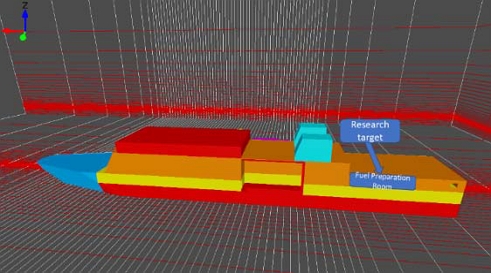
Target area of the study
Eleven leakage scenarios were designed to systematically examine the effects of key factors, including leak direction, leak rate, ventilation efficiency, and release location (Figure 2).
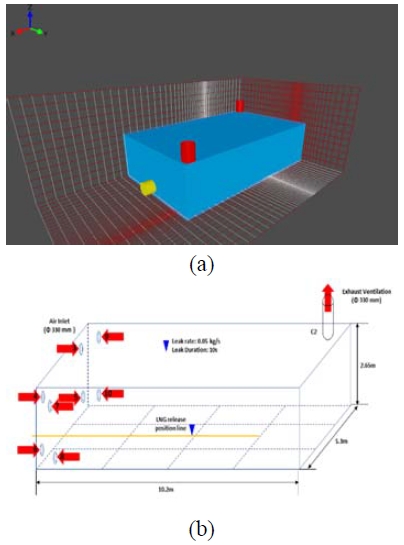
Modeling scenarios of LNG release in FPR
These scenarios represent realistic accident situations that can occur within the fuel preparation room of an LNG-fueled ship during operation or maintenance. The results of these simulations form the basis for clarifying the behavior of cold, dense gas clouds in confined marine environments and for developing evidence-based safety recommendations.
3.2 Geometry and Physical Configuration
The computational domain represents a typical fuel preparation room onboard a medium-sized LNG-fueled vessel. The domain was modeled based on the design parameters derived from the International Code of Safety for Ships Using Gases or Other Low-Flashpoint Fuels (IGF Code) and the available literature on LNG system layouts.
The room dimensions were approximately 10.2 m (length) × 5.3 m (width) × 3.6 m (height), with an internal volume of approximately 120 m3. Within the compartment, several key components were modeled, including the LNG supply pipe, valve manifold, heat exchanger, and ventilation ducts, all of which were represented as solid obstacles to accurately reproduce flow obstruction and turbulence effects.
The leak source was located in the horizontal section of the LNG supply pipeline, positioned 1.2 m above the floor. The selected leakage orifice diameters were 5, 10, and 20 mm, representing small, medium, and large leak conditions, respectively. The leak was modeled as a continuous gaseous release of methane (as the dominant component of LNG) under cryogenic conditions corresponding to –162 °C and 1.05 bar(s).
The domain was extended upward by an additional 1.0 m above the ceiling to allow sufficient room for gas expansion and buoyancy-driven movement, accounting for gravitational stratification. Structural elements such as walls, floors, and ceilings were assumed to be adiabatic, with no-slip boundary conditions applied to all solid surfaces.
3.3 Ventilation System and Boundary Conditions
The ventilation configuration was designed to simulate realistic shipboard operating conditions. Two mechanical ventilation systems of the vapor cloud were modeled.
① Inlet vapor cloud located near the ceiling at one corner of the room, supplying ambient air at a velocity of 1.0 or 2.0 m/s, depending on the scenario.
② Outlet vapor cloud located diagonally opposite near the floor to promote cross-ventilation.
The air inlet temperature was maintained at 25 °C, and the air density corresponded to the standard atmospheric conditions. For the boundary conditions, a pressure outlet was applied to the exhaust vapor cloud, whereas all other external surfaces were regarded as impermeable.
The initial gas composition was assumed to be 100% air throughout the domain, and gravitational acceleration (g = 9.81 m/s²) was included to consider the dense-gas-settling effect of the cold methane vapor. The ambient pressure was set to 1.0 bar, and the simulation time was extended until the vapor concentration throughout the domain decreased below 1% by volume.
3.4 Numerical Model and Grid Generation
The numerical domain was discretized using a structured Cartesian grid, which is consistent with the FLACS-CFD requirements. A nonuniform mesh was applied to ensure accuracy in capturing local concentration gradients and velocity fields near the leak source, with finer cells (0.05–0.1 m) in the vicinity of the leak and coarser cells (0.15–0.25 m) elsewhere. A grid independence test was performed to verify that further mesh refinement yielded lower than 3% variation in the key output parameters (for example, maximum methane concentration and dispersion distance).
FLACS employs a finite-volume solver for the three-dimensional Reynolds-averaged Navier–Stokes equations, incorporating the standard k–ε turbulence model for closure. The dense-gas effects of LNG vapor were modeled using buoyancy corrections and real-gas density variations as a function of temperature. The advection scheme used in the simulation was second-order accurate to minimize numerical diffusion.
Time integration was performed using an adaptive time-stepping algorithm to maintain numerical stability. The Courant–Friedrichs–Lewy number was limited to <1.0 for all simulations.
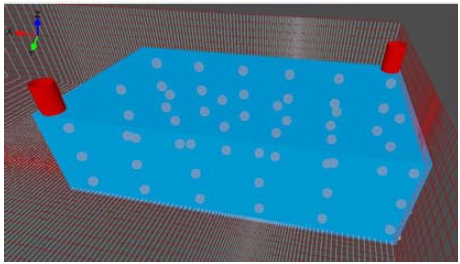
Mesh definition and sensor arrangement
3.5 Simulation Matrix
The 11 simulation cases were divided into groups according to the following parameters. Combinations of these factors generated 11 representative scenarios: Each simulation was run until the methane concentration across the domain decreased by less than 1% by volume or steady dispersion behavior was observed.
3.6 Evaluation Criteria
Key performance indicators were used to evaluate and compare the dispersion behaviors among scenarios.
- ① Maximum concentration (Cₘₐₓ): The highest methane concentration recorded within the domain during the simulation.
- ② Gas cloud volume (V₅%): The total volume within which the methane concentration exceeded the lower flammable limit (5%).
- ③ Time to safe condition (tₛ): The duration required for the entire domain to fall below 1% methane concentration.
- ④ Vertical and horizontal dispersion profiles: Used to analyze gas stratification and spreading behavior.
- ⑤ Effect of ventilation flow: Quantified through the relative reduction in V₅% compared to unventilated conditions.
These parameters provide a quantitative basis for assessing the effects of the leak rate, direction, and ventilation on the hazard potential of LNG dispersion in confined shipboard environments.
4. Results and Discussion
A total of 11 simulation cases were investigated to analyze the dispersion characteristics of LNG in a confined fuel preparation room. The results demonstrated the strong sensitivity of the gas behavior to the leak direction, ventilation rate, and leak size. In all scenarios, the cold, dense methane vapor initially descended toward the floor owing to its high molecular weight and low temperature. As time progressed, the vapor spread laterally and gradually mixed with the ambient air under the influence of buoyancy and ventilation-induced turbulence.
The temporal evolution of the gas concentration indicated that, under unventilated conditions, methane accumulated persistently in the lower regions of the compartment, forming stratified layers. In contrast, active ventilation significantly accelerated dilution and promoted upward gas movement toward the exhaust duct.
4.1 Effect of Leak Size
Figure 4 illustrates the maximum concentration fields for the three leak sizes corresponding to orifice diameters of 5, 10, and 20 mm.
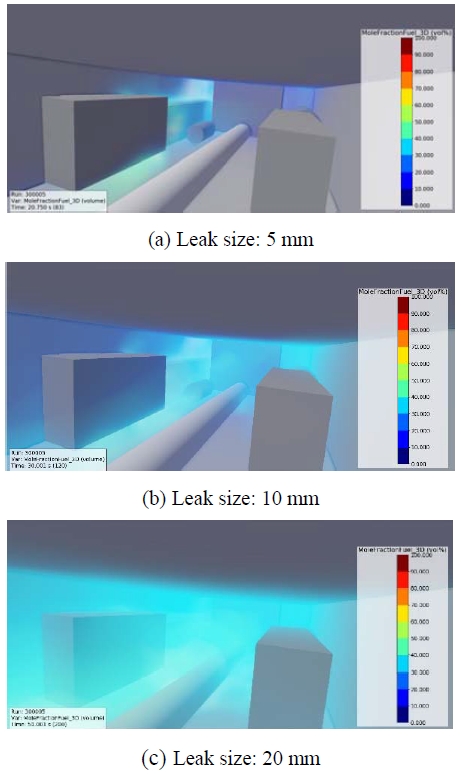
Dispersion of LNG at different leak sizes
For the 5 mm leak, the maximum methane concentration (Cmax) reached approximately 7.8% v/v, forming a small cloud localized near the leak source. The 10 mm leak resulted in an approximately threefold increase in the flammable gas volume (V5%), with a stronger downward plume and a larger stratified zone. The 20 mm leak generated a large, fast-growing dense-gas layer, reaching Cmax > 12% v/v, occupying almost 45% of the volume of the room within the first 60 s. These findings indicate that even a moderate increase in the leakage rate can cause an exponential increase in the volume of the flammable mixture, emphasizing the critical importance of early leak detection and rapid ventilation activation.
4.2 Effect of Leak Direction
The leak direction significantly influenced both the gas spreading and stratification patterns. The upward leaks induced faster dispersion toward the ceiling, followed by gradual downward recirculation. Horizontal leaks generated elongated gas clouds that followed the airflow streamlines, leading to nonuniform concentration fields. However, downward leaks resulted in the most hazardous accumulation near the floor, where the methane concentration exceeded the lower flammable limit (5%) for the longest duration.
Quantitatively, downward leaks produced up to 2.4 times larger V₅% than upward leaks at the same leak rate, confirming that leak orientation relative to gravity and ventilation direction is a dominant parameter in assessing LNG dispersion safety.
Effect of ventilation velocity of LNG
4.3 Effect of Ventilation
Ventilation efficiency was examined for three air velocities: 0 m/s (no ventilation), 1.0 m/s, and 2.0 m/s.
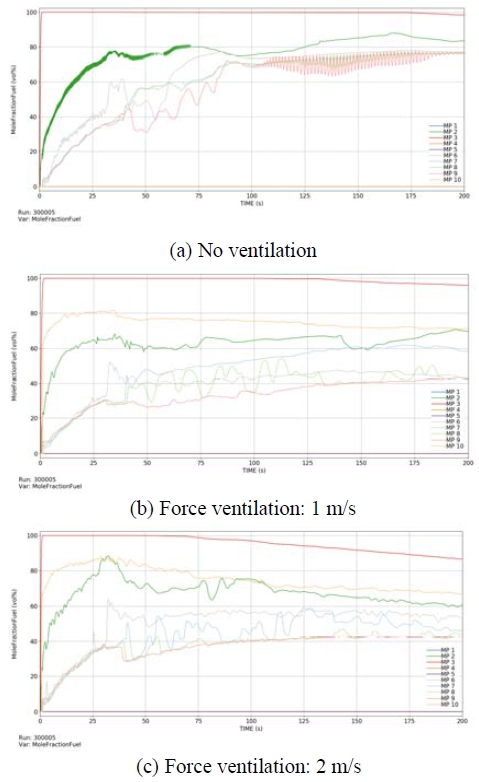
Variations in mole fuel fraction with time for different ventilation cases
Without ventilation, the methane cloud persisted for more than 100 s, with nearly 70% of the floor area exceeding the flammability limit. The introduction of 1.0 m/s ventilation decreased the persistence time from 200 to 150 s, whereas 2.0 m/s ventilation further decreased it to 120 s. However, excessive ventilation velocity also increased local turbulence, which temporarily expanded the flammable volume during the early stage (first 30–40s) owing to heightened entrainment and mixing. Therefore, ventilation should be optimized to balance rapid dilution with limited turbulence-induced spread.
The variations in V5% with ts (time to safe condition) across all ventilation conditions are summarized as follows:
This demonstrates that doubling the air velocity from 1.0 to 2.0 m/s yields an approximately 45% decrease in the flammable gas volume, confirming the strong mitigating effect of ventilation.
4.4 Spatial Distribution of Methane Concentration
The vertical concentration profiles revealed that methane concentration was the highest within 0.2–0.6 m from the floor, particularly near the leak source and adjacent corners. This is attributed to the limited natural convection and low buoyancy of cold methane. In the absence of ventilation, the gas remained trapped below the deck level, with only slow upward diffusion over time.
Contour plots from the simulation (for example, t = 30, 60, and 120 s) clearly indicate that the gas clouds formed distinct horizontal layers, particularly under low-turbulence conditions. The centerline concentration decay followed an exponential trend with distance from the source, which is consistent with the dense-gas dispersion theory.
Under ventilated conditions, the gas distribution became more uniform, and the concentration gradients between the lower and upper layers reduced significantly.
4.5 Combined Effect of Leak Direction and Ventilation
The interaction between leak orientation and ventilation airflow produces complex flow structures. When the leak direction was aligned with the incoming ventilation stream (for example, horizontal toward the inlet), the gas was rapidly entrained and exhausted. In contrast, when the leak opposed the airflow, recirculation zones were formed, leading to locally high concentrations.
The most critical condition was observed for downward leaks with low ventilation, where dense gas was pooled near the floor and corners owing to insufficient momentum to overcome gravity. This configuration resulted in the largest flammable volume and longest persistence time among all 11 cases.
4.6 Comparison of Results with those Reported in the Literature
The overall dispersion behavior and concentration trends observed in this study are consistent with previous experimental and numerical studies on methane and LNG vapor dispersion in confined or semiconfined spaces [5][6]. The downward accumulation and strong sensitivity to the ventilation rate align with the findings of FLACS validation studies and large-scale spill experiments.
However, the results of this study provide new quantitative insights specific to shipboard LNG fuel preparation rooms, which have distinct geometric confinements, low ventilation volumes, and multiple obstacles. This highlights the importance of high-fidelity CFD analysis in maritime safety design.
4.7 Safety Implications
From a safety design perspective, the findings indicate that the following:
- 1. Leak detection sensors should be installed at the floor level, particularly near the corners and under equipment, where gas first accumulates.
- 2. Ventilation inlets should be placed near the floor and outlets near the ceiling to promote efficient cross-ventilation.
- 3. Automatic ventilation activation following leak detection can significantly reduce hazard persistence.
- 4. The regular inspection of downward-oriented pipeline sections is critical because they have the highest accumulation risk.
These results provide a strong technical basis for revising the ventilation design and leak management strategies for LNG-fueled ships in compliance with the IGF Code and IMO safety guidelines.
The numerical investigation demonstrated that the LNG dispersion behavior in a confined fuel preparation room was dominated by a combination of leak rate, direction, and ventilation conditions. These results underscore the importance of effective ventilation and leakage detection systems for mitigating the formation of flammable gas clouds. These findings support the application of CFD-based design optimization to enhance the safety of future LNG-fueled ship systems.
5. Conclusions
This study systematically investigated the dispersion behavior of LNG within the confined space of a marine fuel preparation room under various accidental leakage conditions using FLACS-CFD V22.2. Eleven scenarios were simulated to examine the effects of leak direction, leak rate, and ventilation efficiency on the formation, spreading, and dilution of LNG vapor. The major findings are summarized as follows.
- 1. An increase in the leak rate significantly increased both the flammable volume and persistence time of the methane vapor cloud. Larger leaks (for example, a 20 mm orifice) produced dense gas layers covering up to 45% of the room volume within the first minute, indicating a nonlinear escalation of risk with leak size.
- 2. Downward-oriented leaks were the most hazardous, owing to the gravitational pooling of cold vapor near the floor. Upward and horizontal leaks showed faster dispersion but introduced secondary recirculation near the walls and ceiling areas. The downward direction produced up to 2.4 times higher flammable volume (V5%) than the upward direction.
- 3. Adequate ventilation was the most effective mitigation measure. Increasing the airflow from 0 to 2.0 m/s reduced the flammable gas volume by nearly 70% and shortened the persistence time from 200 to 120 s. However, an excessive ventilation velocity initially increased the turbulent mixing, temporarily expanding the flammable region.
- 4. The highest gas concentrations consistently occurred within 0.2–0.6 m above the floor, particularly around the corners and beneath the equipment. Therefore, these regions should be prioritized for gas sensor placement and ventilation inlet design.
- 5. The most critical scenario was a downward leak with low ventilation, leading to large gas accumulation and prolonged hazard duration. This finding demonstrates the importance of evaluating the interaction between the leak geometry and ventilation layout in safety design.
Based on these findings, several safety-oriented recommendations are proposed.
- ① Sufficient air exchange should be ensured in the fuel preparation room, preferably with inlets near the floor and outlets at high levels, to enhance the vertical circulation.
- ② Multilevel gas detectors should be installed, focusing on low elevations and corners where methane concentration tends to be the highest. Automatic ventilation should be triggered when the concentration exceeds the alarm threshold.
- ③ Downward-oriented joints, flanges, and valves should be inspected frequently owing to their high risk of accumulation. Periodic integrity testing of LNG pipelines is essential to prevent microleaks.
- ④ In the case of leakage, operators should initiate emergency ventilation and avoid ignition sources until the gas concentration falls below 5% (the lower flammable limit).
- ⑤ CFD should be incorporated into ship design processes to optimize the ventilation layout, verify hazard zones, and establish credible safety distances under the IGF Code requirements.
The results of this study highlight that understanding the dispersion characteristics of LNG in enclosed ship compartments is crucial for improving the safety of future LNG-fueled vessels. The proposed CFD-based approach provides a reliable framework for evaluating accident scenarios, guiding ventilation designs, and supporting compliance with international maritime safety standards.
Acknowledgments
The authors have no acknowledgements to declare.
Author Contributions
Conceptualization, J.W. Bae; Methodology, J.W. Bae; Soft ware, J.W. Bae; Formal Analysis, J.W. Bae; Investigation, J.W. Bae; Resources, J.W. Bae; Data Curation J.W. Bae; Writing Original Draft Preparation, J.W. Bae; Writing-Review & Editing, J.W. Bae; Visualization, J.W. Bae; Supervision, J.W. Bae.
References
-
P. A. Duong, B. R. Ryu, S. S. Kyu, H. Jeon, and H. Kang, “Performance analysis of a fuel cells integrated system utilizing Liquified Natural Gas as fuel for a green shipping target,” International Journal of Naval Architecture and Ocean Engineering, vol. 15, p. 100543, 2023.
[https://doi.org/10.1016/j.ijnaoe.2023.100543]

-
P. A. Duong, B. R. Ryu, M. K. Song, H. Van Nguyen, D. Nam, and H. Kang “Safety Assessment of the Ammonia Bunkering Process in the Maritime Sector: A Review,” 2023.
[https://doi.org/10.3390/en16104019]
-
C. Xie, L. Huang, J. Deng, R. Wang, and G. Hao, “Hazard assessment and hazard mitigation of fuel leak inside a ship elevator for LNG-fueled vessel,” Ocean Engineering, vol. 259, p. 111943, 2022.
[https://doi.org/10.1016/j.oceaneng.2022.111943]
-
E. Eliopoulou, A. Papanikolaou, and M. Voulgarellis, “Statistical analysis of ship accidents and review of safety level,” Safety Science, vol. 85, pp. 282–292, 2016.
[https://doi.org/10.1016/j.ssci.2016.02.001]
- M. J. Ivings, S. E. Gant, S. F. Jagger, C. J. Lea, J. R. Stewart, and D. M. Webber, “Evaluating vapor dispersion models for safety analysis of LNG facilities,” Health and Safety Laboratory, vol. 44, p. 275, 2007.
-
O. R. Hansen, F. Gavelli, M. Ichard, and S. G. Davis, “Validation of FLACS against experimental data sets from the model evaluation database for LNG vapor dispersion,” Journal of Loss Prevention in the Process Industries, vol. 23, no. 6, pp. 857–877, 2010.
[https://doi.org/10.1016/j.jlp.2010.08.005]