
A simplified method to predict full-scale ship performance in pack ice fields

Copyright © The Korean Society of Marine Engineering
This is an Open Access article distributed under the terms of the Creative Commons Attribution Non-Commercial License (http://creativecommons.org/licenses/by-nc/3.0), which permits unrestricted non-commercial use, distribution, and reproduction in any medium, provided the original work is properly cited.
Abstract
The navigation performance of ships in ice-covered waters is a vital aspect that ship designers must consider. Therefore, employing quantitative methods is essential to better understand the ship's performance and enhance the accuracy of full-scale resistance predictions in icy conditions. This research investigates the full-scale characteristics of a vessel operating in icy conditions. A simplified prediction method for full-scale ship performance in pack ice fields is proposed based on the direct power method. This research used full-scale performance information collected during the 2019 Antarctica voyage around the Ross Sea aboard the IBRV Araon. A reliable data processing procedure is employed to avoid biased data arising from intended actions during ship navigation. In addition, the full-scale ship performance characteristics, both in pack ice and in open water, are identified and thoroughly analysed in terms of speed-resistance and speed-power relations. Finally, the prediction accuracy of the proposed method is compared with that obtained using the empirical formula.
Keywords:
Full-scale ship performance, Pack ice fields, Speed-resistance relation, Speed-power relation1. Introduction
Typically, the resistance characteristics of ships in level ice are vital for designing ice-capable vessels, providing detailed insights into whether the vessel meets the design criteria under specific ice conditions. However, accurately forecasting the relationships between speed, resistance, and power in full-scale scenarios is difficult, primarily because of limited data on how propellers interact with ice and the absence of measured full-scale propeller thrust and torque. Despite these challenges, numerous studies have employed experimental and theoretical approaches to assess ship performance in icy waters. Several ice trials have been carried out in ice-covered areas to evaluate performance. For instance, Lewis and Edwards [1] used statistical methods to analyze non-dimensional variables on a USCG icebreaker, establishing a semi-empirical relationship between ice resistance and parameters describing both the ship and the ice, with predictions that aligned closely with full-scale data. Nyman [2] analyzed resistance during two ice trials with a Finnish icebreaker in the northern Baltic Sea, comparing these results with model tests. Other researchers have analyzed full-scale trial data to predict ship performance—estimating resistance based on ship speed and propulsion power, applying principles from Newton's second law and conservation of energy (Madsen [3]; Skår, [4]; Suyuthi et al. [5]; Johansen [6]). These efforts developed analytical methods to assess resistance in ice-covered waters, with predictions validated against empirical formulas. Reimer et al. [7] devised a method to analyze full-scale ice trials and examined the impacts of propeller speed changes and propulsion scaling. Li et al. [8] developed a new algorithm to predict ice resistance for fragmented sea ice, aiming to improve ship route planning in the Arctic during summer. They validated their model's fuel consumption predictions through full-scale experiments on a lower ice-class vessel navigating the Northeast Passage. Wang et al. [9] summarized ice data from R/V Xuelong cruises and applied the Monte Carlo method, utilizing Lindqvist's formula, to evaluate ship resistance in level ice.
This study aims to enhance the comprehension of full-scale performance and to develop a predictive methodology. It employs data from comprehensive trials to assess vessel performance in pack ice, with an onboard monitoring system that records data such as engine power, propeller RPM, speed, and heading angle. In situ measurements were also taken to analyze ice properties like salinity, temperature, and density. Additionally, an image processing technique was employed to evaluate ice thickness and concentration. Furthermore, resistance and propulsion data from the KRISO towing tank were used to forecast the open-water resistance at different ship speeds.
A straightforward method is also proposed for predicting a ship's full-scale characteristics under pack ice using the direct power method. The study then adopted a reliable data processing procedure using coefficients of variation and correlation coefficients, with threshold criteria for dataset evaluation. The performance characteristics of a ship in pack ice were analyzed, and the results were compared to those calculated from an empirical formula to assess the accuracy of the proposed method. This approach can provide valuable information for ship performance predictions in pack ice conditions and enhance understanding of ice performance features related to ship design.
2. Ship Performance Prediction Method
2.1 Prediction of Open Water Resistance Component
Resistance, propulsion, and propeller open water tests are typically used to evaluate full-scale performance. These tests are the most appropriate method for assessing full-scale ship resistance and propulsion performance in open water and, therefore, are essential for predicting full-scale performance. Specifically, model tests conducted in calm waters can identify the open water resistance component. These tests are generally performed in open water, but can sometimes be carried out after the ice tests when broken ice pieces have been removed from the ship's track. In such cases, it is referred to as resistance in ice-free water and differs from open-water resistance, but the difference is negligible (ITTC [10]). Moreover, the thrust deduction factor can be obtained from the resistance and propulsion test results. The open water resistance component is essential for predicting full-scale ship performance. Since ice resistance plays a more dominant role in ice conditions, with open-water resistance accounting for only about 5–10% of the total, a simplified open-water resistance equation that depends on the ship's speed is employed to estimate the ship's performance in real-world, full-scale scenarios. In this study, open-water resistance performance at full scale was established through model testing in a KRISO towing tank (MOERI [11]). Based on the experimental results, the full-scale open water resistance can be determined as follows:
| (1) |
In Equation (1), the quantity Row is expressed in newton, and v is knots.
2.2 Formulation of the Pack Ice Resistance Component
When a ship moves through ice, if ice resistance exceeds net thrust, the ship becomes stuck. Therefore, ensuring sufficient thrust to overcome ice resistance is vital for icebreaking vessels. Full-scale ice trials generally help predict a vessel's performance in ice conditions. Although the data from these trials can be helpful, accurately forecasting ice resistance remains challenging. This study proposes a straightforward approach to estimate a ship's ice performance using the direct power method (ITTC [12]; Jeong et al.[13]).
First, the power delivered to the propeller, PDms, is calculated from the measured shaft power, PSms, using the following formula:
| (2) |
where ηS represents the shaft efficiency, which is assumed to be 0.97 in this study.
Then, the torque coefficient under ice trial conditions, KQms, is calculated with the following formula:
| (3) |
where ρs represents the seawater density, nms, and D denotes the measured propeller revolution rate and diameter, respectively, and ηRms indicates the design propeller's efficiency during ice trials. The value of ηRms is assumed to be 1.04 based on resistance and propulsion tests.
Additionally, the curves of the thrust coefficient, KTms, and torque coefficient, KQms, derived from open water characteristic data for the design propeller, obtained through model testing in a towing tank, is suggested by the following formulas.:
| (4) |
| (5) |
where Jms represents the advance coefficient for the design propeller, while aT, bT, and cT are the characteristics of the thrust coefficient curve, similarly, aQ, bQ, and cQ are the characteristics of the torque coefficient curve.
Hence, the advance coefficient for the design propeller under ice-trial conditions, Jms, is calculated using the subsequent formula.
| (6) |
If there is no dedicated sensor to measure thrust in the POD propulsion system, the thrust data will not be obtained directly. As a result, the thrust coefficient of the design propeller under trial conditions, KTms, is calculated using Equation (4) along with the thrust coefficient. This allows for determining the load factor of the design propeller under ice trial conditions, τPms, as well as the thrust of each propeller, TS, as follows :
| (7) |
| (8) |
where JTS is based on the full-scale features of the design propeller.
The ice-propeller interaction in pack ice was not regarded as significant compared to level ice. Thus, this study did not consider the increase in torque excitation by ice floes and the resulting increase in delivered power. In addition, the wave effect was negligible due to the high ice-floe concentrations during the ship trials; therefore, the wave-induced added resistance component was not considered, and the ship's wind resistance was also ignored. Based on the above assumption, the effective thrust, Teff, needed to overcome pack ice resistance, Rpack, can be expressed based on the thrust generated by the design propeller and the thrust deduction factor t.
| (9) |
where t is the thrust deduction factor of 0.14, derived from the resistance and propulsion test results. Row represents the open water resistance component.
3. Prediction of Ship Performance in Pack Ice Fields
3.1 Overview of the ice trials
Between November and December 2019, comprehensive ice trials were carried out in the Ross Sea region of Antarctica under various conditions (see Figure 1). The research employed pack ice data to evaluate the ship's performance in ice interaction, with particular emphasis on the relationships between speed and resistance, as well as speed and power.
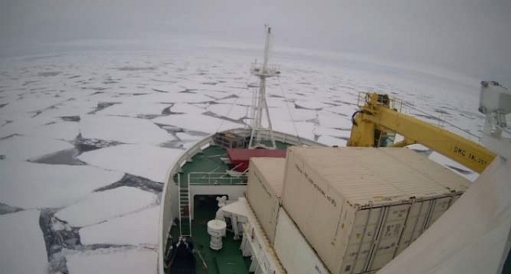
Bridge view image during the ice trials
A vessel onboard monitoring system is a valuable tool that is key to evaluating the ship's ice performance. The system can provide real-time information, including the ship's position, engine output, propeller revolution, speed, heading angle, etc. The Korea Research Institute of Ships and Ocean Engineering (KRISO) has embarked on the project to develop an integrated onboard monitoring system and has completed it. During the ice trials, the prototype was installed on the IBRV Araon as a performance evaluation tool. Therefore, the system can help evaluate a ship's performance in ice. It can collect data on hull strains, ship motions, voyage data recorders (VDR), alarm monitoring systems (AMS), and ice conditions.
In particular, the hull strain data can be used to determine the local ice pressures using the inverse method for the influence coefficient matrix, and the global ice load can also be determined by solving the equations of motion during the icebreaking process. However, this study is focused on ship performance prediction, such as speed-resistance and speed-power characteristics. Therefore, this study does not include the hull strain and ship motion data.
During these trials, network cameras installed on the bridge, bow, stern, and parallel areas recorded ice thickness and concentration measurements. The ship's operational data—such as heading angle, speeds, draft, power output, propeller revolutions, and propulsor unit angles—were recorded via the VDR and AMS systems (see Figures 2 and 3).
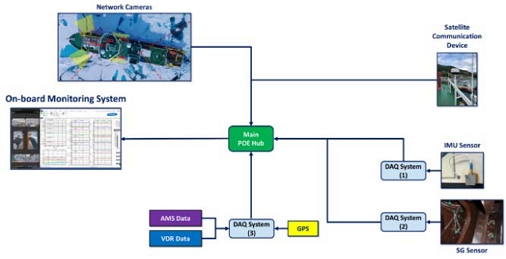
Configuration of the developed onboard monitoring system
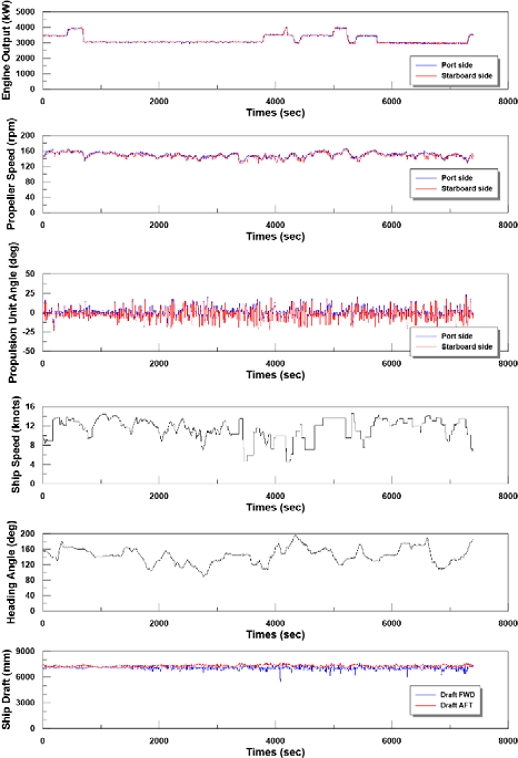
Monitored ship performance data during ice trial
The strength characteristics may depend on several parameters, such as salinity, temperature, and density. Therefore, field measurements were conducted to determine the ice's strength properties. Based on these data, the flexural and compressive strength of the ice was calculated using empirical formulas (Timco and Frederking [14]; Timco and O'Brien [15]). The average flexural and compressive ice strengths were 257 kPa and 3.88 MPa, respectively (see Table 1).

Calculated compressive and flexural strengths of the ice (Jeong et al.[13]).
3.2 Data Processing for Analysis of the Ship's Ice Performance
This study defined criteria for data selection and analysis to identify stable conditions during the ice trials. Additionally, since the time interval significantly affects accuracy, it was set to three times the ship's length to achieve reliable results in a steady state. A correlation analysis was conducted on the heading and propulsion unit angles to determine whether direction changes were intentional. If the correlation coefficient was relatively high (i.e., greater than 0.4), the vessel's heading angle changes were considered intentional actions to avoid heavy ice conditions during navigation through the pack ice fields. In that case, the data were excluded from the analysis process to eliminate intentional steering operations. Finally, the coefficient of variation (CV) was determined. Usually, the CV is a statistical metric that shows how data points are dispersed around the mean. It reflects the extent of data variation within a sample relative to the population mean and provides a standardized method for comparing various data series. The CV is computed as:
| (10) |
where σ and μ denote the standard deviation and the mean of the data set, respectively.
This study outlines criteria for datasets used to assess ship performance under steady conditions.
- 1) The correlation coefficient between the propulsion system and the ship's heading must be less than 0.4. A value greater than this indicates a deliberate measure to avoid severe icing conditions.
- 2) The power output should exceed 30% of the maximum continuous rating (MCR) to avoid getting stuck in ice and to maintain continuous icebreaking. Additionally, the coefficient of variation (CV) for engine output must stay below 0.1.
- 3) When the main engine can continuously break ice, the CV for propeller speed should be less than 0.1.
- 4) The CV for the ship's speed through water (STW) must be kept under 0.2.
- 5) The ship's heading CV must remain below 0.2 during the specified period.
Figure 4 shows the CV values and correlation coefficients for the collected dataset. Five datasets were used in the data processing procedure. According to the proposed thresholds, the selected variables were tightly clustered and maintained reasonable levels during data extraction.
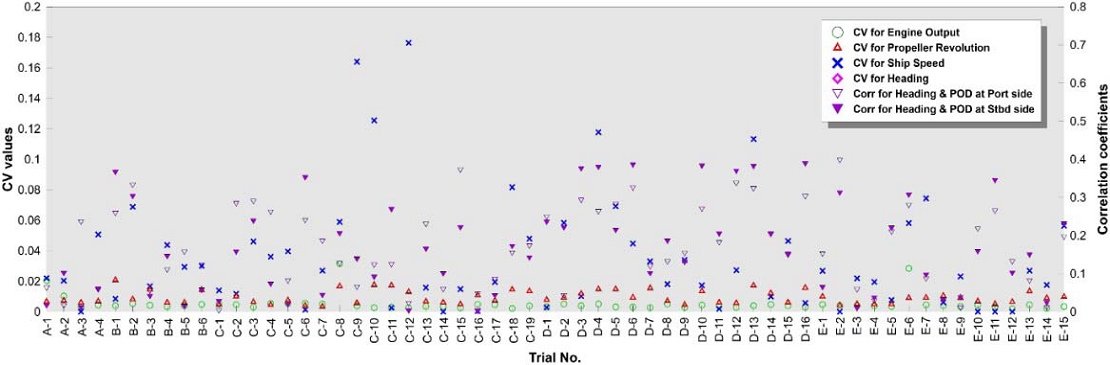
Distribution of CV values and correlation coefficients for the comprehensive dataset (Jeong et al., 2025).
As mentioned above, ice thickness was extracted using a digital image-processing method. Figure 5 shows histograms of ice thickness measured across the five ice trial runs. Here, the frequency distribution represents the number of thickness profile images captured within each ice thickness interval.
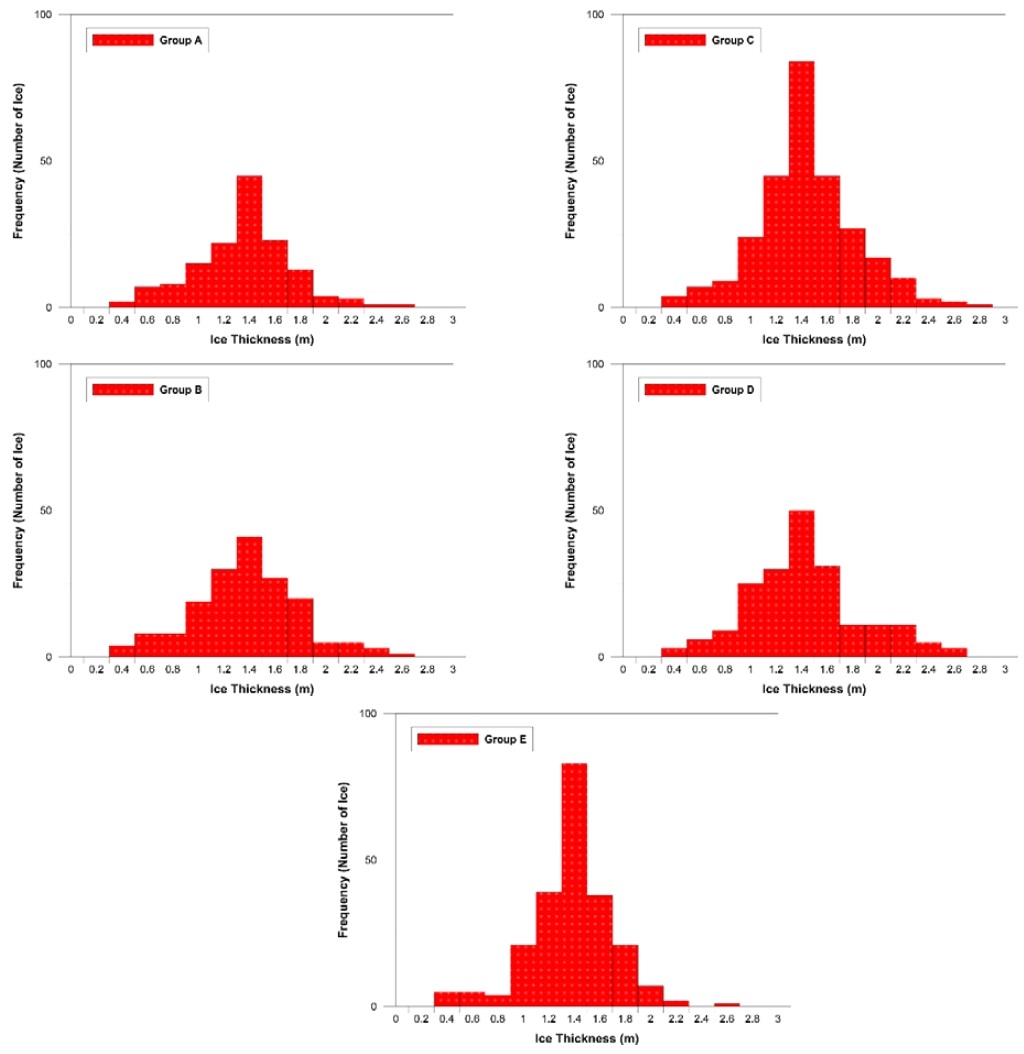
Thickness histogram of ice across five test events. The bin width for thickness was 0.2
3.3 Comparison of the Predictions Obtained from Ice Trial Data and the Calculations based on the Empirical Formula
An empirical formula for calculating pack ice resistance was proposed in a previous study, which also confirmed its accuracy (Jeong et al. [16]). In that study, the main parameters were ice floe size, ice concentration, and channel width. The developed prediction formula is defined by
| (11) |
where Fh denotes the Froude number for pack ice conditions, and represents the ratio of ice floe size to ship width. In addition, Cconc denotes the pack ice concentration, and Wch and h represent the channel width and ice thickness, respectively.
Based on earlier research, the resistance of pack ice diminishes as the channel widens. Nonetheless, the findings are consistent when the channel width is eight times the ship's beam; hence, Wch/B was designated as 8. Furthermore, the formula was optimised for vessels with dimensions similar to those of the IBRV Araon; this limitation should therefore be considered when using it.
The ice performance evaluation aims to determine an attainable ship speed and predict full-scale ship resistance. Thus, the attainable ship speed is estimated using the method proposed in this study and the empirical formula from previous research. The ice information was used in the calculation process, as summarized in Table 2. Here, the trial groups were divided into five groups based on ice conditions.
Information on ice conditions derived from bridge and side-view images.
Figure 6 shows the predicted and calculated results obtained using two approaches. The predictions are slightly higher than the calculations, except for speed sections below 11.7 knots. The main reason for these underestimates and overestimates is believed to be the variability of the ice environment during ice trials. To compensate for this, if data are collected under conditions with minimal changes in ice conditions, more accurate performance estimates are expected.
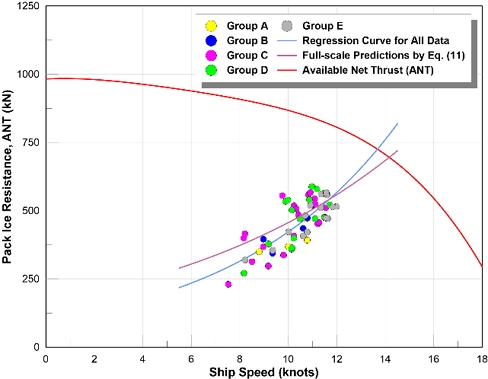
Comparison of ship attainable speeds based on results calculated through empirical formulas and results predicted through the method proposed in this study
According to the two approaches, the attainable ship speed is 13.7 and 14.2 knots, respectively. The attainable ship speed derived from the prediction method proposed in this study is slightly lower than that derived from the empirical formula. However, the results show that the proposed method can reasonably estimate ships' operational performance in ice.
A key factor for ice-going ships is the speed–power relationship, which indicates how ice resistance affects performance. When a ship moves through an ice field, its speed decreases while power output increases rapidly, entirely due to ship–ice interaction. During the ice trials, power output was plotted against the corresponding speed to produce a speed-power curve, and the delivered power ranged from 4938.4 kW to 7963.1 kW (see Figure 7). In addition, the propulsion power required to overcome ice resistance was higher than in open water. The average power needed in pack ice was roughly 5.7 times greater at a ship speed of 10 knots. This significant difference offers essential insights into power demands during overload operations and can help assess the required propulsion power capacity. In addition, the delivered power characteristics in ice-covered waters can be used to determine minimum propulsion power requirements, thereby optimizing engine performance.
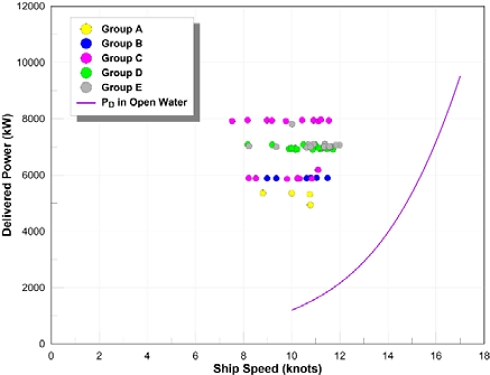
Comparison of delivered power in ice and open water conditions
4. Conclusion
This study investigates performance forecasts for the IBRV Araon operating in ice conditions in the Ross Sea, Antarctica, in 2019. It examines how the ship behaves in full-scale icy environments. A simplified method for assessing ship performance in pack ice using the direct power approach is introduced. The study found that full-scale predictions deviated from those based on empirical formulas, primarily due to the simplified resistance-prediction technique and uncertainties in ice-condition estimates during full-scale ice trials. Nonetheless, full-scale ice resistance predictions allow evaluation of the ship's icebreaking effectiveness for its designed hull and help determine the net thrust available to overcome ice resistance. As a result, this approach offers a framework for estimating a vessel's performance and insights into resistance in pack-ice conditions. Since hull strain and ship motion data during ice interaction are crucial for assessing ice performance, future research will focus on using this information to improve prediction accuracy.
Acknowledgments
This research received support from a grant from the Endowment Project entitled "Development of Evaluation Technoloy for Ship Performance in Extreme Environments," funded by the Korea Research Institute of Ships and Ocean Engineering (PES5461). Additionally, it was supported by the National R&D Project titled "Development and Validation of Sea Trial Analysis Methods in Response to International Standards and Regulations," financed by the Ministry of Trade, Industry and Energy (PNS5560).
Author Contributions
Conceptualization, Methodology, and Writing-Original Draft Preparation & Editing, S. Y. Jeong; Data Curation & Visualization, E. J. Oh.
References
- J. W. Lewis and R. Y. Edwards, “Methods for predicting icebreaking and ice resistance characteristics of icebreakers,” Society of Naval Architects and Marine Engineers (SNAME) Transactions, vol. 78, pp. 213–249, 1970.
- T. Nyman, “Resistance and manoeuvring tests in ice of the icebreaker Sampo,” VTT Technical Research Centre of Finland, 1995.
- A. Madsen, Estimation of Ice Resistance of Ships Based on Measurements of Ice Thickness, Speed And Power, Master's Thesis, Norwegian University of Science and Technology, 2010.
- T. Skår, Ice-induced resistance of ship hulls: A Comparison of Resistance Estimated from Measurements and Analytical Formulations, Master's Thesis, Norwegian University of Science and Technology, 2011.
-
A. Suyuthi, B. J. Leira, and K. Riska, “Full-scale measurement on level ice resistance of icebreaker,” Proceedings of 30th International Conference on Ocean, Offshore and Arctic Engineering, OMAE 2011–50066, Rotterdam, Netherlands, June 19–24, pp. 983-989, 2011.
[https://doi.org/10.1115/OMAE2011-50066]

- S. R. Johansen, Ship Hulls Exposed to Ice-Induced Loads And Resistance, Master's Thesis, Norwegian University of Science and Technology, 2018.
-
N. Reimer, Q. Hisette, and C. Schroeder, “Full-scale trials for the validation of ship performance and model tests in ice,” In Proceedings of Offshore Technology Conference, OTC-29155-MS, Houston, Texas, USA, November 5–7, 2018.
[https://doi.org/10.4043/29155-MS]
-
Z. Li, C. Ryan, L. Huang, L. Ding, J. W. Ringsberg, and G. Thomas, A comparison of two ship performance models against full-scale measurements on a cargo ship on the Northern Sea Route, Ships and Offshore Structures, vol. 16, pp. 237-244, 2021.
[https://doi.org/10.1080/17445302.2021.1926146]
-
Q. Wang, Z. Zong, P. Lu, G. Zhang, and Z. Li, “Probabilistic estimation of level ice resistance on ships based on sea ice properties measured along summer Arctic cruise paths,” Cold Regions Science and Technology, vol. 189, 103336, 2021.
[https://doi.org/10.1016/j.coldregions.2021.103336]
- International Towing Tank Conference (ITTC), Testing and extrapolation methods ice testing resistance in level ice, ITTC, 7.5-02-04-02.1. 2017, Available: http://www.ittc.info, .
- Maritime and Ocean Engineering Research Institute (MOERI), Hull form evaluation for icebreaking research vessel, MOERI Report 2008.
- International Towing Tank Conference (ITTC), Preparation, conduct and analysis of speed/power trials, ITTC, 7.5-04-01-01.1. 2014, Available: http://www.ittc.info, .
- S. Y. Jeong, E. J. Oh, and H. S. Kim, “Investigation of ship performance prediction methods in pack ice,” Proceedings of the 28th International Conference on Port and Ocean Engineering under Arctic Conditions, St. John's, Newfoundland and Labrador, Canada, Jul 13-17, 2025.
-
G. W. Timco and R. M. W. Frederking, “Compressive strength of sea ice sheets,” Cold Regions Science and Technology, vol. 17, pp. 227-240, 1990.
[https://doi.org/10.1016/S0165-232X(05)80003-5]
-
G. W. Timco and S. O'Brien, “Flexural strength equation of sea ice,” Cold Regions Science and Technology, vol. 22, no. 3, pp. 285-298, 1994.
[https://doi.org/10.1016/0165-232X(94)90006-X]
-
S. Y. Jeong, K. Choi, H. S. Kim, “Investigation of ship resistance characteristics under pack ice conditions,” Ocean Engineering, vol. 219, 108264, 2021.
[https://doi.org/10.1016/j.oceaneng.2020.108264]